全面市场化

Search documents
食品饮料行业周报:非标茅台代售制,pet担忧带来饮料买点
GUOTAI HAITONG SECURITIES· 2026-03-15 10:30
Investment Rating - The report assigns an "Accumulate" rating for the industry [2] Core Insights - The report highlights the implementation of a consignment sales system for non-standard Moutai, indicating a move towards full marketization. Concerns over rising PET prices have led to a pullback in the beverage sector, making valuations more attractive [4] Summary by Sections Investment Recommendations - Recommended stocks in the liquor sector include Guizhou Moutai, Wuliangye, and Luzhou Laojiao, with potential clearance stocks like Yingjia Gongjiu and Gujing Gongjiu. In the beverage sector, Eastroc Beverage and Nongfu Spring (Hong Kong stock) are recommended, along with low-valuation high-dividend stocks such as China Foods (Hong Kong stock) and Master Kong Holdings (Hong Kong stock) [9] Liquor Sector - Moutai has fully implemented a consignment sales system, allowing distributors to sell at a unified official price while receiving a 5% commission. This system aims to enhance market coverage, improve consumer service, and maintain price stability. Wuliangye has also seen significant sales growth during the Spring Festival, indicating a recovery in market sentiment [10][11][12] Beverage Sector - The beverage sector is currently facing concerns over rising PET prices, which have increased from below 7,000 RMB to 8,650 RMB since March. Despite these concerns, leading beverage companies have strategies to mitigate cost fluctuations and maintain profitability. The report suggests that if PET prices stabilize, the earnings outlook for beverage companies will improve [15][16] Profit Forecast and Valuation - The report includes a profit forecast and valuation table for key stocks, indicating that Guizhou Moutai has a market cap of 177.03 billion RMB with an EPS forecast of 75.57 RMB for 2026, while Wuliangye has a market cap of 39.96 billion RMB with an EPS forecast of 6.62 RMB for 2026. Both stocks are rated as "Accumulate" [18]



食品饮料行业周报:非标茅台代售制,pet担忧带来饮料买点-20260315
GUOTAI HAITONG SECURITIES· 2026-03-15 07:51
Investment Rating - The report assigns an "Accumulate" rating for the industry [2] Core Insights - The report highlights the implementation of a consignment sales system for non-standard Moutai, indicating a move towards full marketization. Concerns over rising PET prices have led to a pullback in the beverage sector, making valuations more attractive [4] Summary by Sections Investment Recommendations - Recommended stocks in the liquor sector include Guizhou Moutai, Wuliangye, and Luzhou Laojiao, with potential clearance stocks like Yingjia Gongjiu and Gujing Gongjiu. In the beverage sector, Eastroc Beverage and Nongfu Spring (Hong Kong stock) are recommended, along with low-valuation high-dividend stocks such as China Foods (Hong Kong stock) and Master Kong Holdings (Hong Kong stock) [9] Liquor Sector - Moutai has fully implemented a consignment sales system for non-standard products, allowing distributors to sell at a unified official price and earn a 5% commission. This system aims to enhance market coverage, improve consumer service, and maintain price stability [10][11] - Wuliangye has seen significant growth in sales during the 2026 Spring Festival, with a notable increase in market share. The company plans to continue enhancing brand value and market presence [12][14] Beverage Sector - The beverage sector is currently facing concerns over rising PET prices, which have increased from below 7,000 RMB to 8,650 RMB since March. Despite this, leading beverage companies have strategies to mitigate cost fluctuations and maintain profitability [15][16] - The report notes that leading beverage companies like Nongfu Spring and Eastroc Beverage are currently at historically low PE ratios, presenting potential investment opportunities for value recovery [16] Profit Forecast and Valuation - The report includes a profit forecast and valuation table for key stocks, indicating that Guizhou Moutai has a market cap of 177.03 billion RMB with an EPS forecast of 75.57 RMB for 2026, while Wuliangye has a market cap of 39.96 billion RMB with an EPS forecast of 6.62 RMB for 2026 [18]
白酒股集体反弹,茅台将推全面市场化,或适度放宽经销商门槛
2 1 Shi Ji Jing Ji Bao Dao· 2025-12-15 03:55
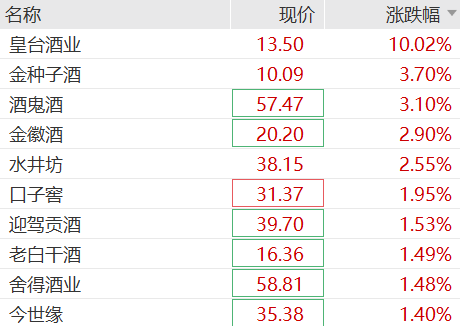
Market Overview - On December 15, the Shanghai Composite Index opened lower but rebounded during the session, while the ChiNext Index fell over 1% [1] - The total trading volume in the Shanghai and Shenzhen markets reached 1.18 trillion yuan, a decrease of 52.9 billion yuan compared to the previous trading day [1] Liquor Sector Performance - The liquor sector saw a collective rebound, with Huangtai Liquor (000995) hitting the daily limit, and Jinzhongzi Liquor (600199) and Jiugui Liquor (000799) rising over 3% [1] - Moutai (600519) opened higher, increasing nearly 0.5% [1] Moutai's Internal Meeting and Policy Changes - Moutai held an internal meeting on December 9, discussing significant policies regarding product, channel, and pricing strategies, including a halt on shipments and channel reforms [2][3] - Reports confirmed that Moutai would pause the release of its products for the first quarter of next year, with plans to resume shipments at a later date [3] Impact on Distributors - The decision to pause shipments is expected to alleviate financial pressure on distributors during a tight cash flow period, preventing panic selling [4] - Following the announcement, prices for Moutai products surged on various third-party pricing platforms, with the price of 53-degree 500ml Feitian Moutai rising significantly within a few days [5] Future Policy Adjustments - Moutai plans to implement several major adjustments in the coming year, including reducing the quantity of various Moutai products and potentially shifting from a distribution model to an application-based model for certain products [6][8] - The company aims to promote market-oriented pricing, allowing products to be sold at market prices, which could enhance operational autonomy [8][9] E-commerce and Consumer Engagement - Moutai is encouraging distributors to explore online sales channels, with recent successful e-commerce live-streaming sales indicating untapped consumer demand [10]