全面To C

Search documents
长城直营变革:坦克撤出魏牌渠道 魏牌All in直营
2 1 Shi Ji Jing Ji Bao Dao· 2025-10-20 23:04
Core Insights - The company is transitioning to a fully direct sales model for its Wei brand, phasing out the previous dealership model and rebranding existing stores to "Wei Brand New Energy" [1][5] - The shift aims to enhance brand identity and streamline operations, positioning Wei as the closest brand to new energy vehicle manufacturers within the Great Wall Automotive system [1][5] - The direct sales strategy is part of a broader trend among automotive companies to adopt dual sales models, balancing direct sales with traditional dealership networks [2][3] Group 1: Direct Sales Model - Great Wall Automotive has decided to fully embrace a direct sales model, moving away from the dual sales approach that included traditional dealerships [2][3] - The transition to direct sales is intended to improve customer experience and brand image, with a focus on connecting directly with consumers [5][6] - The company plans to expand its direct sales outlets significantly, targeting second and third-tier cities to capture new market segments [6] Group 2: Brand and Market Strategy - The Wei brand will become the sole focus of the direct sales channel, with the Tank brand being withdrawn from this model [1][5] - The company has reported significant sales growth for the Wei brand, with a 63% year-on-year increase in September deliveries and a 96% increase in cumulative deliveries from January to September [6] - The strategic shift aims to position Wei in competitive markets against emerging players, while also addressing the high costs associated with direct sales operations [6][7] Group 3: Challenges and Organizational Changes - The dual sales model presents challenges in maintaining consistent pricing between direct sales and dealership networks, which can lead to internal competition [3] - Transitioning to a fully direct sales model requires significant changes in organizational processes, decision-making, and corporate culture, which poses a greater challenge for traditional automakers [7]

坦克撤出魏牌渠道,魏牌将在10月底全面转向直营
2 1 Shi Ji Jing Ji Bao Dao· 2025-10-17 15:35
Core Insights - Great Wall Motors is transitioning to a fully direct sales model for its Wei brand, phasing out the existing dealer network and rebranding "长城智选" stores to "魏牌新能源" [2][3] - The shift aims to enhance brand identity and streamline operations, positioning Wei as the closest brand to new energy vehicle startups within Great Wall's ecosystem [2][8] - The company plans to expand its direct sales presence significantly, targeting second and third-tier cities to capture new market segments [9] Group 1: Direct Sales Model Transition - Great Wall Motors will completely adopt a direct sales model for the Wei brand by the end of October, ending the dealer model [2] - The transition is part of a broader strategy initiated in April last year, which aimed to reduce inventory pressure on dealers by shifting high-end models to direct sales [4][6] - The direct sales model is expected to improve customer experience and brand image, as articulated by company executives [8] Group 2: Market Expansion and Performance - As of May, Great Wall has established over 430 user centers across 110 cities for Wei brand sales and services, with plans to expand to 500 stores covering over 300 cities [9] - Wei brand's sales performance has been strong, with a 63% year-on-year increase in September, delivering 11,000 vehicles [9] - The direct sales model has led to a significant rise in sales expenses, with a 63.31% increase to 5.036 billion yuan in the first half of 2025, while net profit decreased by 36.39% [9] Group 3: Challenges and Strategic Implications - The dual sales model previously employed posed challenges in price control between direct sales and dealer networks, leading to potential internal competition [5][6] - The transition to a fully direct sales model aims to eliminate pricing conflicts and enhance market penetration [7] - The shift to a direct-to-consumer (DTC) approach requires a fundamental transformation in organizational processes and corporate culture, which is more complex than merely establishing direct sales outlets [10]

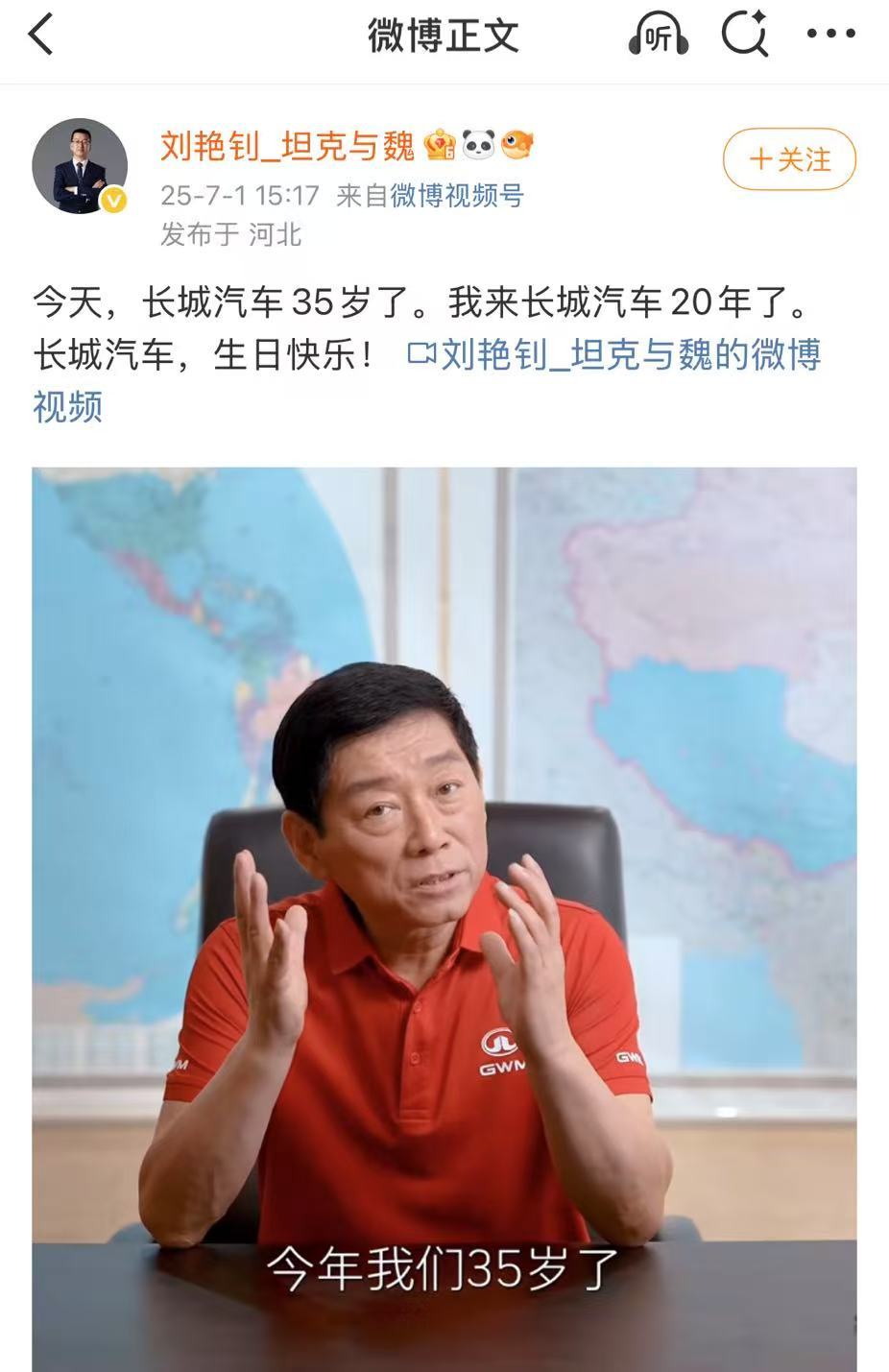
长城汽车人事调整:刘艳钊升任副总裁,四大乘用车品牌“一把手”均已到位
Mei Ri Jing Ji Xin Wen· 2025-07-11 07:09
Core Viewpoint - Liu Yanzhao has been promoted to Vice President of Great Wall Motors, overseeing the company's communication platform, while stepping down from his roles as General Manager of the Wey and Tank brands [1][4]. Group 1: Management Changes - Liu Yanzhao previously managed the Wey and Tank brands, responsible for their operational management [4]. - Following a restructuring at the end of 2022, Liu Yanzhao was appointed to oversee both brands under a dual-brand operation model [4]. - The communication platform Liu now leads was established at the end of 2023, alongside other platforms for product management, digital intelligence, user operations, sales services, terminal operations, and new media live streaming [4]. Group 2: Organizational Structure - Great Wall Motors has adopted an organizational structure inspired by internet companies, featuring a "strong backend - large middle platform - small frontend" model [4]. - The middle platform aims to optimize resources and unify marketing strategies across brands, serving as a standard guide for management practices [4]. Group 3: Marketing Strategy - Prior to the establishment of the middle platform, Great Wall Motors relied on individual brand teams, which lacked synergy and led to disorganized personnel allocation [5]. - The recent appointment of new general managers for the Wey and Tank brands indicates a shift towards a more cohesive marketing strategy [5]. Group 4: Sales Performance - In the first half of the year, Great Wall Motors reported a slight increase in sales, with a total of approximately 569,000 vehicles sold, marking a year-on-year growth of 1.84% [6]. - However, the performance of the Ora brand was notably poor, with sales dropping by 56.19% year-on-year, while the Tank brand also experienced a decline of 10.67% [6].