公共债务扩张

Search documents
“举债投资”给日本刺激计划添变数
Sou Hu Cai Jing· 2025-11-24 04:01
Core Viewpoint - The Japanese government has approved a comprehensive economic plan worth 21.3 trillion yen to stimulate the economy and support consumers affected by inflation, marking the largest economic stimulus since the pandemic began [1][2]. Economic Measures - The economic plan includes 17.7 trillion yen in general account spending, a 27% increase from the previous year's 13.9 trillion yen, 2.7 trillion yen in tax cuts, and 900 billion yen in special account spending [1]. - A budget of 2 trillion yen is allocated for local priority support subsidies, allowing local governments to plan the use of these funds autonomously [1]. - The plan provides approximately 3,000 yen in subsidies per person through rice vouchers and shopping coupons, along with 500 billion yen to subsidize residents' electricity and gas bills for the first three months of the next year [1]. Inflation Context - As of October, inflation in Japan has exceeded the Bank of Japan's 2% target for 43 consecutive months, with real wages declining for over two years [2]. - The government's price relief measures are expected to lower the overall inflation index by an average of 0.7 percentage points from February to April next year [2]. Debt Concerns - The economic plan requires approval from the National Diet, and it is anticipated that the stimulus measures will rely heavily on debt financing, with expected government bond issuance exceeding last year's 6.69 trillion yen [2]. - Concerns about public debt expansion have intensified, with the 10-year Japanese government bond yield nearing 1.8%, the highest since 2008, and the 30-year yield surpassing 3.3% [2]. Market Reactions - The spending plan has led to significant declines in Japanese bonds and currency, raising fears of uncontrolled capital flight, reminiscent of the 2022 UK bond market crisis [3]. - Experts express skepticism about the effectiveness of the stimulus measures in addressing fundamental inflation issues, suggesting that injecting large amounts of funds into an already price-pressured market may exacerbate inflation [3][4]. Future Outlook - The Japanese government is expected to finalize the legislative details of the economic plan in the coming weeks, with phased implementation starting in early 2026 [5]. - A broader growth strategy covering 17 target industries is still pending, indicating that the current stimulus may not represent the end of significant government spending [5].
商品日报(7月1日):集运欧线涨超7% 工业硅焦煤等重归跌势
Zhong Guo Jin Rong Xin Xi Wang· 2025-07-01 10:34
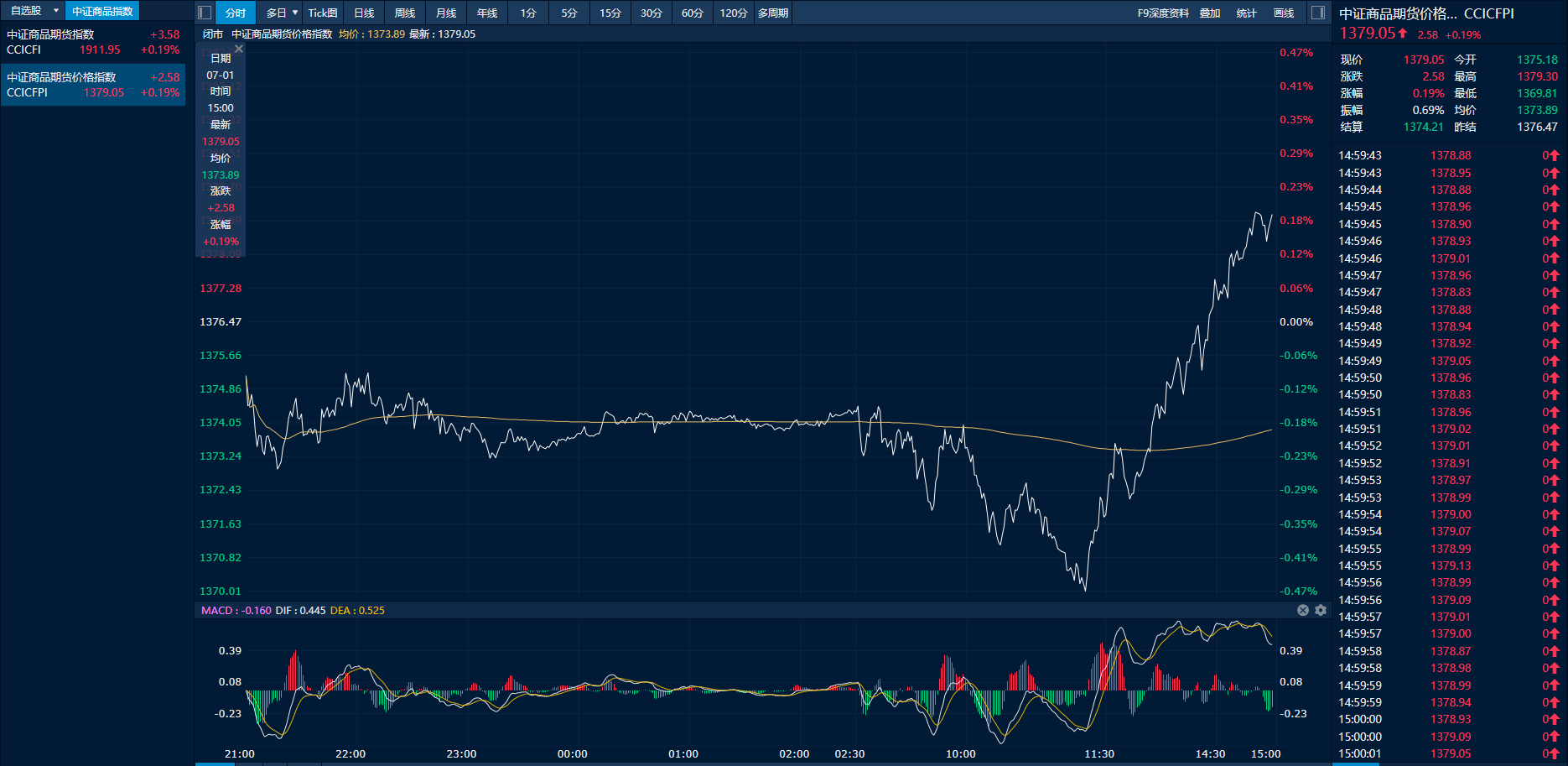
Group 1: Commodity Market Overview - The domestic commodity market showed significant differentiation on July 1, with the shipping index for European routes rising over 7%, while industrial silicon fell over 4% [1][3] - The China Securities Commodity Futures Price Index closed at 1379.05 points, up 2.58 points or 0.19% from the previous trading day [1] - The shipping index for European routes reported a 9.6% increase, reaching 2123.24 points, supported by airlines adjusting freight rates and positive market expectations for July [3] Group 2: Precious Metals - The market's increased expectations for a Federal Reserve rate cut led to a weaker dollar, resulting in a continuous rebound in spot gold prices, with both Shanghai gold and silver rising over 1% [4] - The ongoing concerns regarding Trump's tariff policies are providing additional support for gold prices, as global public debt continues to expand [4] Group 3: Industrial Silicon and Related Commodities - Industrial silicon prices fell over 4%, with production cuts from major northern manufacturers and a potential decrease in electricity prices in southern regions [5] - The supply side remains under pressure despite some production cuts, as smaller furnaces in southern regions are resuming operations, maintaining high inventory levels [5] - Focus on coal futures also showed a decline of over 3%, with expectations of increased production from various coal mines in Shanxi as environmental inspections conclude [5] Group 4: Glass Market - Glass prices dropped over 3%, with production resuming at several facilities, including a significant plant in Shandong [6] - Despite slight inventory reductions in some regions, overall demand remains weak, keeping glass prices under pressure [6]