美元指数走软

Search documents
美元走软叠加热钱涌入 铜价创下历史新高
Xin Lang Cai Jing· 2026-01-29 13:45
Core Viewpoint - Copper prices reached a historic high of over $14,000 per metric ton, driven by strong demand expectations and supported by a weaker dollar and geopolitical concerns [1] Group 1: Price Movement - Speculators expanded their buying due to strong demand expectations, leading to a significant increase in copper prices [1] - The London Metal Exchange's three-month copper contract surged by 7.9% during Asian trading, hitting a record high of $14,125 per metric ton [1] Group 2: Market Sentiment - Analysts warned that high prices could suppress physical demand from industrial consumers, indicating that current supply-demand fundamentals do not support such price levels [1] - Neil Welsh, an analyst at Britannia Global Markets, noted that aggressive speculative trading has driven copper prices to the largest single-day increase in years [1] Group 3: Economic Outlook - Investors are flocking to base metals, anticipating stronger economic growth in the U.S. and increased spending on data centers, robotics, and electrical infrastructure globally [1] - A weaker dollar index, nearing multi-year lows, has made commodities priced in dollars cheaper for buyers using other currencies, further supporting metal prices [1]
21社论丨增强外汇市场韧性,稳定市场预期
Sou Hu Cai Jing· 2025-12-25 23:10
Group 1 - The recent strengthening of the RMB exchange rate is attributed to a combination of internal and external factors, including a weakening US dollar index and favorable economic conditions in China [1][2] - The US dollar index has declined nearly 10% this year, creating a supportive environment for the appreciation of non-USD currencies, including the RMB [1] - The People's Bank of China emphasizes the importance of stabilizing market expectations and preventing one-sided trends in the RMB exchange rate, indicating readiness for counter-cyclical adjustments [4] Group 2 - The supply of foreign exchange from the real economy has provided short-term support for the RMB's appreciation, with banks reporting a cumulative settlement surplus for seven consecutive months [2] - China's economic resilience and proactive medium- to long-term policies, including more active fiscal and monetary policies, are fundamental supports for the RMB's strength [2] - The strengthening RMB enhances the value of RMB-denominated financial assets, positively impacting China's stock and bond markets, while also affecting import and export businesses differently [3][4]
黄金依然是强势上行走势
Sou Hu Cai Jing· 2025-12-25 09:17
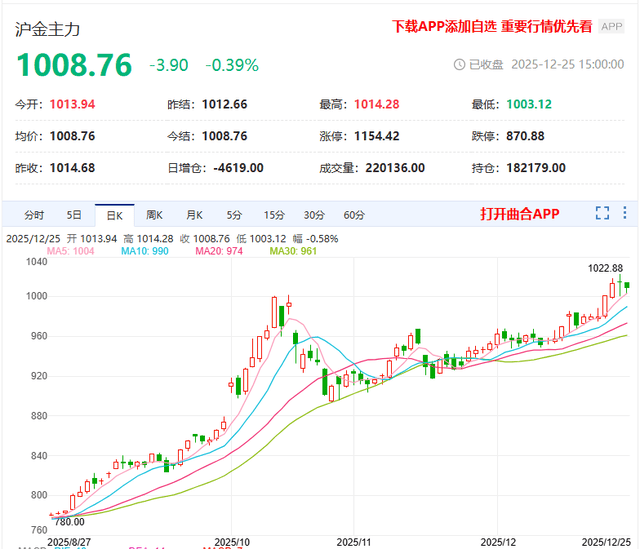
Group 1 - The gold market is entering 2026 with strong momentum despite low overall participation, indicating that the current price increase is driven by structural demand rather than short-term speculation [1] - The core driver for the gold price increase from 2024 to 2025 is the uncertainty in policy, which remains a strong support factor as the macroeconomic environment evolves [1][2] - Multiple pressures on the U.S. economy, including high government spending, persistent inflation, and declining real yields, are reinforcing the value of gold as an investment [1][2] Group 2 - The divergence in the gold market in 2025 highlights its sensitivity to macroeconomic variables, particularly the inverse relationship between gold prices and real yields [2] - Structural demand, U.S. economic pressures, and the downtrend in real yields are expected to support the gold market in 2026, likely continuing the previous strong performance [2] - Market sentiment may be influenced by trade and geopolitical risks, which could provide significant long-term upside for gold prices [5]

人民币汇率破“7”在望
Bei Jing Shang Bao· 2025-12-24 15:56
Core Viewpoint - The Chinese yuan has entered a strong appreciation phase against the US dollar, with significant increases in the exchange rate observed, driven by both internal economic resilience and external factors such as a weakening dollar index [1][3][5]. Exchange Rate Performance - On December 24, the yuan's central parity rate was set at 7.0471 against the dollar, marking a rise of 52 basis points and the highest level since September 30, 2024 [3][4]. - The onshore and offshore yuan also showed appreciation, with the onshore rate peaking at 7.0125 and the offshore rate reaching 7.0013 [3][4]. - Since November 21, the yuan has appreciated significantly, with the offshore rate rising over 1200 basis points since mid-October [4][5]. Factors Driving Appreciation - The weakening of the dollar index has created a favorable external environment for the yuan's appreciation [5][6]. - Internal factors include the resilience of the Chinese economy, improved economic data, and seasonal demand for currency exchange as the year-end approaches [5][6]. - The People's Bank of China has indicated a focus on maintaining a stable exchange rate, which supports market expectations [10]. Market Reactions - Over 30 A-share companies have announced plans to engage in foreign exchange hedging to mitigate risks from currency fluctuations [7]. - The appreciation of the yuan has mixed effects on trade, lowering costs for importers while pressuring exporters due to reduced price competitiveness [7][8]. Future Outlook - The market anticipates that the yuan may continue to approach the 7.0 mark, with potential for temporary breaches, but sustained appreciation will depend on further internal and external factors [9][10]. - The central economic work conference has reiterated the goal of maintaining a stable exchange rate, indicating that significant fluctuations are not desired [10].
人民币汇率破“7”在望,内外因素共振,全球汇市格局重构
Bei Jing Shang Bao· 2025-12-24 12:14
Core Viewpoint - The Chinese Yuan (RMB) has entered a strong appreciation phase against the US Dollar, with significant increases in the exchange rate observed, particularly around the year-end period, driven by both external and internal factors [1][4][5]. Exchange Rate Performance - On December 24, the RMB central parity rate was significantly raised by 52 basis points to 7.0471, marking the highest level since September 30, 2024 [3][4]. - The onshore and offshore RMB exchange rates continued to appreciate, with the offshore rate reaching a high of 7.0013, just shy of the critical "7" level [1][3]. - Since November 21, the RMB has appreciated from around 7.11, with a cumulative increase of over 1200 basis points since mid-October [4][5]. Market Drivers - The weakening of the US Dollar Index has created a favorable external environment for RMB appreciation, while the resilience and attractiveness of the Chinese economy provide solid fundamental support [4][5]. - The market anticipates that the RMB may break the "7" level in the short term, but whether it can maintain this level remains to be seen, with potential for increased volatility in the exchange market [1][11]. Economic Context - The RMB's recent strength is attributed to a combination of reduced external pressures, enhanced internal economic resilience, and seasonal demand for currency exchange as the year-end approaches [5][6]. - China's trade surplus exceeded $1 trillion for the first time in the first eleven months of 2025, contributing to the demand for RMB [5]. Corporate Responses - Over 30 A-share companies have announced plans to engage in foreign exchange hedging to mitigate risks associated with currency fluctuations, indicating a proactive approach to managing exchange rate impacts [7]. - Companies like Huabang Health are implementing forward foreign exchange contracts to stabilize profits against currency volatility [7]. Investment Implications - The appreciation of the RMB is expected to attract foreign investment, benefiting both the stock and bond markets, as RMB-denominated assets become more appealing [8][9]. - Investors are advised to consider the dual benefits of asset appreciation and currency gains, particularly for foreign institutional investors [8]. Regulatory Environment - The central government has reiterated its commitment to maintaining the RMB exchange rate at a reasonable and balanced level, aiming to prevent excessive fluctuations and ensure stability [10][11]. - The recent central economic work conference emphasized the importance of aligning the RMB exchange rate with economic fundamentals to avoid unilateral trends [10].

全球资本“用脚投票”:攻破7.05,人民币拿下“关键一战”
Sou Hu Cai Jing· 2025-12-16 16:38
Core Viewpoint - The recent surge in both onshore and offshore RMB exchange rates, breaking through the 7.05 mark against the USD, reflects a significant vote of confidence from global capital regarding China's economic outlook [1][3]. Exchange Rate Breakthrough - On December 15, the RMB continued its upward trend against the USD, with the onshore rate peaking at 7.0497 and the offshore rate reaching 7.0460, marking a notable recovery from earlier lows [1][3]. - The RMB's midpoint rate was reported at 7.0656, a decrease of 18 basis points from the previous trading day, while intra-day gains for the onshore and offshore RMB were nearly 200 and over 150 basis points, respectively [3]. Capital Flow Shift - The improvement in China's economic fundamentals and policy environment has led international investors to reassess the value of RMB-denominated assets, contributing to the recent appreciation of the currency [4]. - Goldman Sachs forecasts approximately $200 billion in capital inflows into the Chinese stock market over the next 12 months, indicating renewed global confidence in China's economic resilience [5]. Weakening Dollar - The depreciation of the USD has created favorable conditions for non-USD currencies, including the RMB, to appreciate [6]. - Since the beginning of 2025, the USD index has fallen by over 8%, with concerns over U.S. fiscal policy and debt further diminishing the dollar's attractiveness [6]. Policy Support - The stability and gradual appreciation of the RMB are supported by prudent and effective management from Chinese monetary authorities, aiming to maintain the currency at a reasonable and balanced level [7]. - The People's Bank of China has issued offshore RMB central bank bills to guide offshore market interest rates and stabilize market expectations [7]. Economic Resilience - The RMB's strong performance is underpinned by solid economic fundamentals, with China's GDP growth in Q1 2025 reaching 5.4%, surpassing both the previous year's growth and market expectations [9]. - Active fiscal policies and moderately accommodative monetary policies have provided robust support for economic stability, with key indicators such as fixed asset investment and retail sales showing positive growth [9]. Future Outlook - Market analysts maintain a cautiously optimistic view on the RMB's future trajectory, with predictions of a stronger exchange rate in the short term [10]. - The RMB is gradually shifting from being an optional asset to a necessary one in global reserve asset allocation, with its share in global foreign exchange reserves rising to around 3% [10].

商品日报(7月1日):集运欧线涨超7% 工业硅焦煤等重归跌势
Zhong Guo Jin Rong Xin Xi Wang· 2025-07-01 10:34
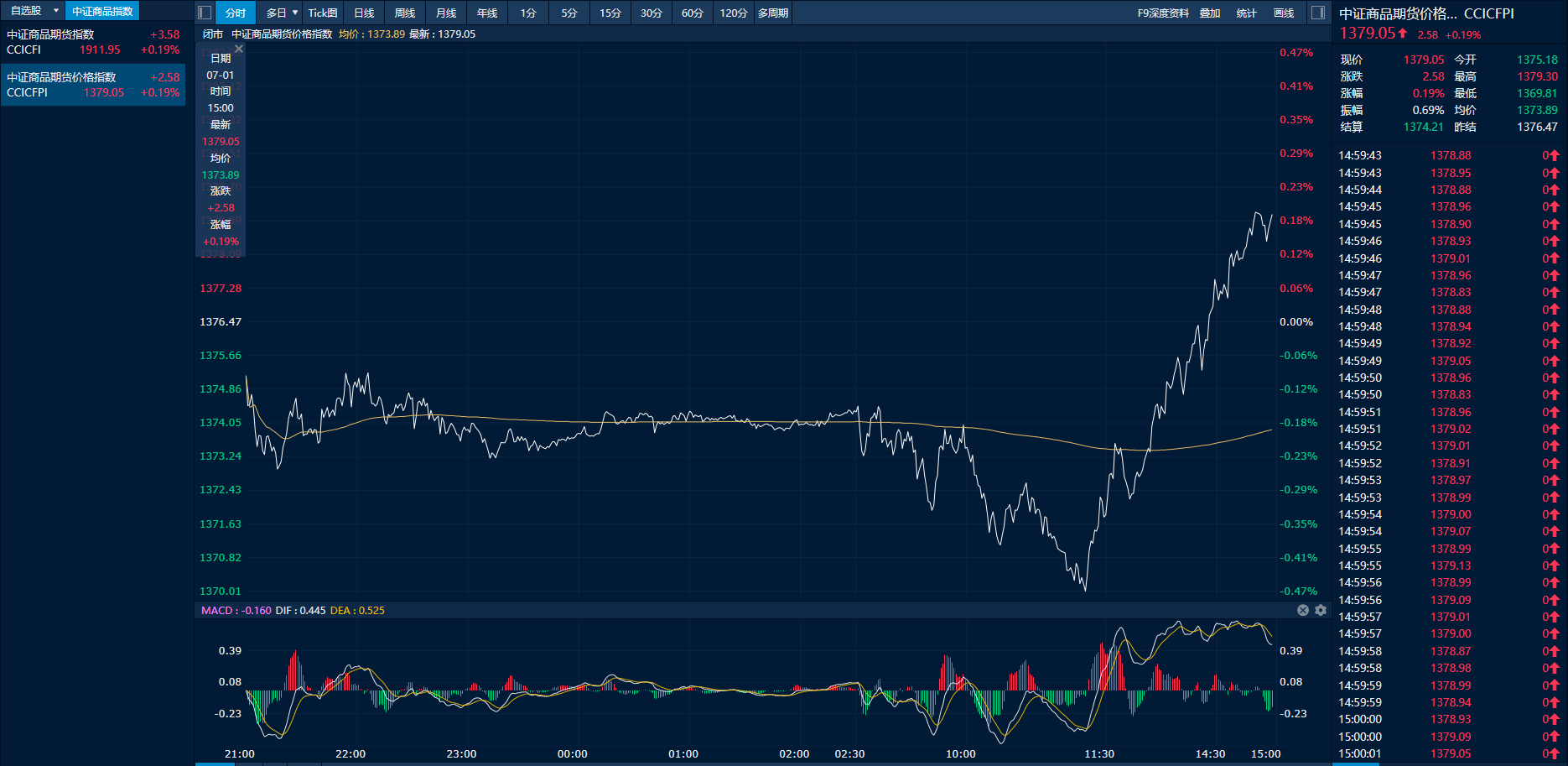
Group 1: Commodity Market Overview - The domestic commodity market showed significant differentiation on July 1, with the shipping index for European routes rising over 7%, while industrial silicon fell over 4% [1][3] - The China Securities Commodity Futures Price Index closed at 1379.05 points, up 2.58 points or 0.19% from the previous trading day [1] - The shipping index for European routes reported a 9.6% increase, reaching 2123.24 points, supported by airlines adjusting freight rates and positive market expectations for July [3] Group 2: Precious Metals - The market's increased expectations for a Federal Reserve rate cut led to a weaker dollar, resulting in a continuous rebound in spot gold prices, with both Shanghai gold and silver rising over 1% [4] - The ongoing concerns regarding Trump's tariff policies are providing additional support for gold prices, as global public debt continues to expand [4] Group 3: Industrial Silicon and Related Commodities - Industrial silicon prices fell over 4%, with production cuts from major northern manufacturers and a potential decrease in electricity prices in southern regions [5] - The supply side remains under pressure despite some production cuts, as smaller furnaces in southern regions are resuming operations, maintaining high inventory levels [5] - Focus on coal futures also showed a decline of over 3%, with expectations of increased production from various coal mines in Shanxi as environmental inspections conclude [5] Group 4: Glass Market - Glass prices dropped over 3%, with production resuming at several facilities, including a significant plant in Shandong [6] - Despite slight inventory reductions in some regions, overall demand remains weak, keeping glass prices under pressure [6]