
具身智能终端

Search documents
太魔幻了,宇树机器人东渡日本出家当和尚
3 6 Ke· 2026-02-27 00:15
Group 1 - The article discusses the emergence of a "monk robot" in Japan, which can perform meditation, chant scriptures, and provide emotional support, reflecting a blend of technology and Buddhist practices [1][8] - The development of this robot began in 2021 with a team from Kyoto University, initially starting as a text-based chatbot before evolving into a physical entity by February 2023 [3][5] - The robot is equipped with ChatGPT, allowing it to reference Buddhist texts and maintain confidentiality, addressing users' psychological needs while also performing certain religious rituals [8][16] Group 2 - The robot mimics the physical movements of monks, including slow walking and respectful gestures, and can adjust its voice, gender, and age to suit user preferences [11][13] - The project was initiated by Professor Seiji Kumagai, a monk himself, aiming to address the shortage of monks in Japan due to an aging population and to provide guidance to those in need [13][16] - The physical construction of the robot is provided by Chinese company UTree Technology, highlighting a shift in the robotics industry where Japan, once a leader, now relies on Chinese technology for advancements in this field [18][27] Group 3 - Japan's robotics industry, once dominant with innovations like WABOT-1 and ASIMO, has faced stagnation due to a focus on high precision and longevity, neglecting market demands [20][22] - The high costs associated with maintaining advanced robots have led to a decline in their development, as seen with the discontinuation of ASIMO and the emotional robot Pepper [22][25] - In contrast, China's robotics sector has rapidly advanced, with UTree Technology capturing over 60% of the global market share for quadruped robots, emphasizing practicality and affordability [29][30]


中国车企CES秀肌肉
Hua Er Jie Jian Wen· 2026-01-07 09:56
Core Insights - Chinese automakers are redefining the future of the automotive industry at CES, shifting focus from hardware to AI models and advanced driving architectures [1] - The competition is now centered around software capabilities and supply chain integration, marking a significant transition from manufacturing to standard-setting [1][11] Group 1: Technological Advancements - Geely introduced its "Universal AI 2.0" system, featuring the World Action Model (WAM), which enhances the vehicle's intelligence through a layered design [2] - WAM allows for a complete intelligent feedback loop, enabling continuous evolution in automotive intelligence [2] - Geely's strategy has led to a 20%-30% reduction in project numbers while enhancing quality, indicating a focus on efficiency [3] Group 2: Strategic Integration - Geely's brands, including Zeekr and Lynk & Co, have unified their driving software under the "G-ASD" system, promoting technology sharing across models [3] - This integration allows for rapid deployment of advanced technologies, such as the Thor-U chip, across different vehicle brands [3] - Great Wall Motors is pursuing a dual strategy of mechanical and intelligent advancements, showcasing its Hi4-Z hybrid architecture to address consumer concerns about range and energy consumption [4] Group 3: Supply Chain and Market Positioning - Chinese supply chain companies are demonstrating their production capabilities, with Leap Motor showcasing its aggressive electronic architecture strategy [5] - Black Sesame Intelligence presented its A2000 autonomous driving chip, targeting the L2+/L3 market, while other companies displayed advancements in lidar technology [6] - The automotive industry is expected to undergo significant changes, with a shift from funding and qualifications to AI model integration as the new entry barrier [7] Group 4: Future Industry Dynamics - The high costs associated with advanced driving technologies are leading to a consolidation trend, where only a few major players will dominate the market [9] - Companies unable to develop large models or afford high-performance chips may face significant challenges, leading to potential market exits [9] - The transition from "software-defined vehicles" to "AI-defined vehicles" will fundamentally alter the automotive business model, emphasizing AI capabilities over traditional hardware metrics [10][11]


元旦假期杭州机器人乐队演出忙
Zhong Guo Xin Wen Wang· 2026-01-01 09:48
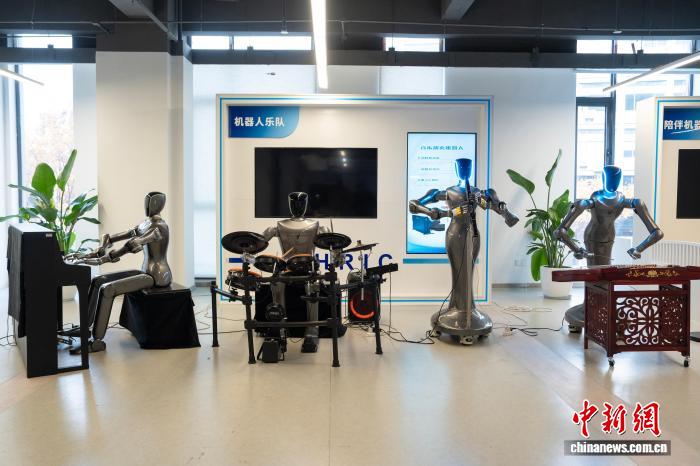
Group 1 - The core focus of the news is on the "He Xuan" robot band in Hangzhou, which has been actively performing and expanding its capabilities since its debut in August 2024, now featuring five types of musical instruments and over 60 songs [1][3] - The band is scheduled for eight performances during the 2026 New Year holiday and has a busy schedule with five to six outings per month in 2025, participating in significant events like the "Liangzhu Forum" and the World Internet Conference [1][3] - The development of the robot band is part of a broader trend in Hangzhou, where over 700 companies in the robotics industry have emerged, showcasing various applications of robots in daily life, such as robot dogs in nursing homes and robot police for traffic management [3][4] Group 2 - The engineering team at the Hangzhou Robotics Innovation Center has developed proprietary algorithms to enable precise musical performances by robots, requiring a deep understanding of each instrument's mechanics [3] - The initiative aims to enhance the dexterity of humanoid robots through musical performance, potentially paving the way for their integration into homes and workplaces [3] - Experts believe that the integration of intelligent terminals into household scenarios is expected to be realized during the 14th Five-Year Plan period, emphasizing the need for collaboration in productization, enterprise development, and ecosystem advantages [4]
荣耀CEO李健:AI重构人机交互关系
Zhong Guo Jing Ji Wang· 2025-11-10 14:34
Core Insights - The maturity of edge AI models is reshaping the smartphone experience, positioning smartphones as crucial personal smart terminals in the AI era [1] - Honor's CEO emphasizes the importance of AI in redefining human interactions with information and services, advocating for a user-centered approach in building AI terminals [1] - Honor has initiated a five-year plan with a $10 billion investment to transform into a leading AI terminal ecosystem company [1][2] Group 1: Smart Phone Development - Honor is progressing in its first step of creating smart phones, exemplified by the Magic8 series, which integrates AI to enhance user experience across over 3000 scenarios [2] - The upcoming Robot Phone aims to combine AI capabilities with high-definition imaging, representing a clear evolution from smart phones to AI phones and eventually to robot phones [2] Group 2: Building Smart Ecosystems - The second step involves constructing a smart ecosystem, addressing challenges of device and service silos by launching a system-level MCP architecture that connects over 4000 ecological MCPs [3] - Honor's "1×3×N" ecosystem strategy and HONOR AI Connect platform aim to create interconnected smart home and vehicle networks, enhancing user experience in AI-driven lifestyles [3] Group 3: Commitment to Innovation - Honor's confidence in its AI ecosystem strategy is backed by significant R&D investments, with over 70% of its global R&D team and an R&D expenditure accounting for 11.5% of revenue by 2025 [3] - The company has accumulated over 2100 AI-related patents, showcasing its technological foundation and commitment to innovation [3]