内阁支持率

Search documents
高市内阁支持率上升至72%,日美首脑会谈受好评
日经中文网· 2026-03-30 03:10
Group 1 - The approval rating of Prime Minister Kishi's cabinet has increased by 3 percentage points to 72%, marking the first time it has exceeded 70% since December 2025 [2][4] - 65% of respondents rated the recent Japan-U.S. summit positively, indicating strong public support for Kishi's diplomatic efforts [4] - The rise in approval ratings is attributed to positive evaluations of Kishi's foreign policy, with 65% of respondents believing the government's response to rising oil prices is appropriate [4] Group 2 - The most prioritized policy issue among respondents is "price control," with 50% selecting it, followed by "pension, medical care, and nursing" at 40% [4] - The ruling Liberal Democratic Party (LDP) maintains a support rate of 41%, unchanged from the previous survey [5] - Among opposition parties, the Democratic Party for the People is at 6%, the Constitutional Democratic Party at 4%, and the Communist Party at 4%, with a notable increase in the Constitutional Democratic Party from 2% [5] Group 3 - The survey was conducted by Nikkei Research from March 27 to 29, targeting individuals aged 18 and above across Japan, with a total of 941 responses and a response rate of 39% [6]

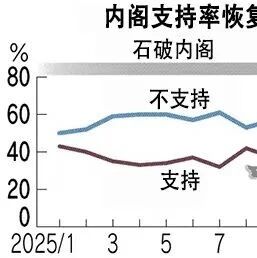
高市早苗内阁支持率开始下跌,民调最低到57%,解散众议院是拖累?
Sou Hu Cai Jing· 2026-01-26 08:01
Core Viewpoint - The political landscape in Japan is experiencing turbulence as Prime Minister Kishi's cabinet faces declining support rates ahead of the upcoming elections, raising concerns about its stability and effectiveness [1][3]. Group 1: Support Rate Trends - Kishi's cabinet support rate has dropped from 67% in December to 57% in January, marking a significant decline as it falls below 60% for the first time [1]. - The disapproval rate has risen sharply from 22% to 29%, reaching a historical high, indicating growing dissatisfaction among the public [1]. - Other surveys corroborate this trend, with support rates reported at 63.1% by Kyodo News, reflecting widespread public discontent with the cabinet's policies [3]. Group 2: Factors Influencing Support Rate Decline - The decision to dissolve the House of Representatives has faced substantial public opposition, with 41% of respondents disapproving of the move, and only 27% in support [3]. - Economic issues, particularly rising prices and living costs, are of paramount concern for voters, overshadowing political maneuvers like the dissolution of the House [6]. - Historical patterns indicate that new cabinets typically experience a decline in support over time, with Kishi's cabinet now stabilizing between 55-70% after an initial high of 65-80% [4]. Group 3: Economic Concerns and Public Sentiment - A significant 59.3% of the public prioritize government measures to combat rising prices when casting their votes, highlighting the importance of economic policy [6]. - Kishi's economic policies have not effectively addressed inflation and cost-of-living issues, leading to public disappointment and a decline in support [6]. - The cabinet's future success hinges on its ability to adapt its strategies to address public concerns and improve policy execution ahead of the elections [8].
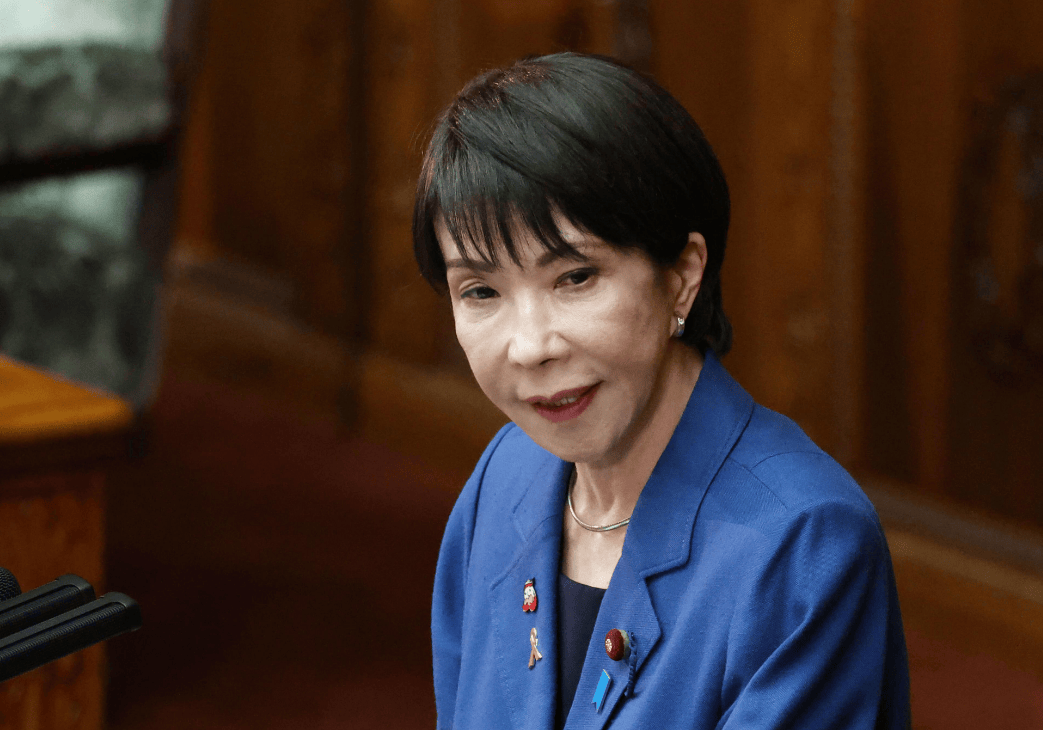
高市内阁支持率暴跌
Xin Jing Bao· 2026-01-25 08:45
Group 1 - The latest public opinion poll indicates a significant drop in support for Prime Minister Kishi's cabinet, with a decrease of 10% to 57% compared to the previous poll conducted in December [1] - 41% of respondents disapprove of Kishi's decision to dissolve the House of Representatives, while 27% approve, and 31% are unsure [1] - The dissolution of the House of Representatives on January 23 marks the first time in 60 years that it has occurred on the opening day of a parliamentary session, which may delay the normal budget approval process [1] Group 2 - Opposition party leaders criticized Kishi's decision to dissolve the House, stating that it lacks rationality given the current accumulation of issues facing Japan [1] - The National Democratic Party leader expressed regret that economic issues are being overshadowed by the dissolution [2] - The Japanese Communist Party leader criticized Kishi for avoiding proper discussions with the public and opting for dissolution instead [2]
内阁支持率高企 高市早苗拟于1月解散众议院举行大选
Xin Lang Cai Jing· 2026-01-09 14:34
Core Viewpoint - Japanese Prime Minister Sanna Takichi is considering dissolving the House of Representatives at the beginning of the upcoming regular Diet session scheduled for January 23, with a likely election in mid-February to gain public trust and advance policy goals [1] Group 1 - The ruling party currently holds a minority position in the House of Councillors, prompting the Prime Minister's consideration of a House dissolution to strengthen political support [1] - The Cabinet's approval rating has remained high, starting at 71% when established in October and reaching 73% by December, indicating favorable public sentiment [1] - If the House is dissolved, the Prime Minister's first policy speech after taking office will be postponed [1]
高市支持率连超70%,与小泉安倍开局相似
日经中文网· 2025-12-23 02:57
Group 1 - The core viewpoint of the article highlights the high approval ratings of Prime Minister Sanna Takashi's cabinet, which have consistently exceeded 70% from October to December, similar to the early stages of previous long-term administrations like those of Junichiro Koizumi and Shinzo Abe [2][4] - The approval rating of Takashi's cabinet reached 75% in a survey conducted from December 19 to 21, maintaining a high level since her administration began [4] - Factors contributing to the rise in approval ratings include public expectations regarding the Prime Minister's character and leadership abilities, with 41% citing trustworthiness and 38% citing leadership skills as primary reasons [6] Group 2 - Despite the high approval ratings for the cabinet, the support rate for the ruling Liberal Democratic Party (LDP) has declined, dropping 4 percentage points to 37% in December compared to November [7] - There is a prevailing view within the LDP that a general election will not occur until at least spring 2026, allowing time for the implementation of policies outlined in the supplementary budget [7] - The main risk factor for the administration is the cooling of Japan-China relations, particularly in light of Takashi's statements regarding Taiwan, which have drawn criticism from China [8]

高市早苗内阁支持率维持在75%
日经中文网· 2025-12-22 03:23
Group 1 - The approval rating of Prime Minister Sanna Takashi's cabinet is 75%, remaining stable since November, and has been above 70% for three consecutive months since taking office in October [2] - The Bank of Japan raised the policy interest rate to 0.75%, the highest level in 30 years, with 55% of respondents approving the decision [4] - The highest priority policy issue for respondents is addressing inflation, with 55% indicating this as a concern [4] Group 2 - The support rate for the ruling Liberal Democratic Party (LDP) is 37%, a decrease of 4 percentage points from the last survey [4] - The support rates for opposition parties include 9% for the Democratic Party for the People (up from 6%), 7% for the Constitutional Democratic Party (up from 6%), and 5% for the Shinsei Party (down from 7%) [5] - The survey conducted by Nikkei Research received 916 responses with a response rate of 40.1% [5]
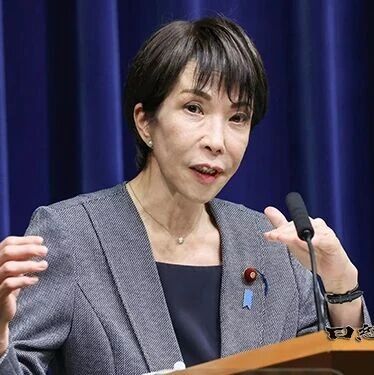
支持高市早苗的都是些什么人?
日经中文网· 2025-10-27 08:00
Core Viewpoint - The support rate for the new cabinet led by Takashi Sawa is significantly high among the working-age population, indicating a shift in political support dynamics in Japan [2][6]. Group 1: Support Rate Analysis - The support rate for Takashi Sawa's cabinet is 81% among the 18-39 age group, 82% among the 40-50 age group, and 66% among those aged 60 and above [2][6]. - Compared to the previous cabinet led by Ishiba Shigeru, the support rate among those under 30 has more than doubled, showing a strong appeal to younger voters [6]. - The support rate for the Liberal Democratic Party (LDP) has risen to 36%, although it has not yet returned to the 41% level seen at the establishment of Ishiba's cabinet [11]. Group 2: Political Dynamics - The current cabinet has garnered support not only from LDP supporters but also from those who previously supported opposition parties like the Democratic Party for the People and other minor parties [2][8]. - In the recent Senate election exit polls, fewer voters under 30 supported the LDP compared to those supporting the Democratic Party for the People and other opposition parties, indicating a potential recovery in support for the LDP among this demographic [8]. - The support rate among male voters for Takashi Sawa's cabinet is 75%, while for female voters it is 73%, showing a balanced appeal across genders [8]. Group 3: Comparison with Previous Cabinets - The support rate for Ishiba's cabinet among LDP supporters was less than 70% at its inception, while it has increased to 91% for Takashi Sawa's cabinet [8][10]. - The support rate for opposition party supporters for Ishiba's cabinet was around 10-20%, but it has risen to over 80% for Takashi Sawa's cabinet [10].
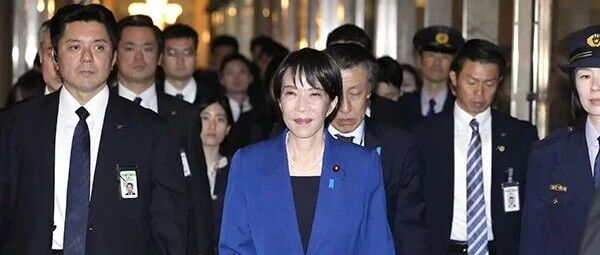
高市早苗内阁支持率达到74%
日经中文网· 2025-10-27 03:38
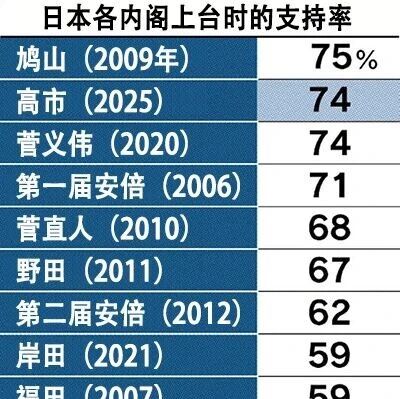
Core Viewpoint - The approval rating of the new cabinet led by Prime Minister Kishi Sanae is 74%, significantly higher than the previous cabinet led by Ishiba Shigeru, which had an approval rating of 51% at the time of its establishment [2][4]. Group 1: Cabinet Approval Ratings - Kishi Sanae's cabinet approval rating of 74% is comparable to previous cabinets, such as Yukio Hatoyama (75%) and Yoshihide Suga (74%) [4]. - The approval rating increased by 37 percentage points compared to the last survey of Ishiba's cabinet conducted in September [2]. Group 2: Public Support and Political Dynamics - The support for the ruling Liberal Democratic Party (LDP) has risen to 36%, an increase of 5 percentage points from the last survey [5]. - The approval rating for Kishi's cabinet and the new LDP leadership is positively viewed by 55% of respondents, surpassing the 29% who disapprove [5]. Group 3: Public Concerns and Policy Priorities - The top reasons for supporting Kishi's cabinet are "good policies" and "trustworthy character," each cited by 36% of respondents [7]. - The most pressing policy issue for the public is "price control," with 51% prioritizing it, followed by "economic growth" (33%) and "pensions" (27%) [7]. Group 4: Coalition Dynamics - The Japan Innovation Party (JIP) has opted for an "outside cooperation" model, with 50% of respondents supporting this approach, while only 19% believe they should send ministers to the cabinet [7].
民调:日本高市内阁支持率超60% 超过石破及岸田内阁
Zhong Guo Xin Wen Wang· 2025-10-23 06:10
Core Points - The latest public opinion poll indicates that the support rate for Prime Minister Fumio Kishida's cabinet is 64.4%, surpassing the initial support rates of previous cabinets led by Shigeru Ishiba and Yoshihide Suga [1] - A significant 70.2% of respondents believe that the appointment of Koichi Hagiuda, involved in the "black money" scandal, as acting secretary-general is "inappropriate" [1] - The poll shows that 76.5% of respondents welcome the idea of Japan having its first female prime minister, which is expected to promote women's active participation in society [1] Support and Opposition - The disapproval rate for Kishida's cabinet stands at 23.2%, which is lower than the previous cabinet's disapproval rate of 51.4% [1] - The support rate for Kishida's cabinet is slightly lower than the 66.4% support rate of Yoshihide Suga's cabinet when it first took office [1] Coalition and Public Perception - A total of 64.4% of respondents rated the ruling coalition between the Liberal Democratic Party (LDP) and the Japan Innovation Party as "good" or "fairly good" [1] - 66.2% of respondents expressed approval of the Komeito party's decision to withdraw from the coalition with the LDP [1] Reasons for Support - Among the reasons for supporting Kishida's cabinet, 26.6% of respondents cited "trust in the prime minister," while 22.5% believe that "economic policies are promising" [1]
石破茂内阁支持率回升至42%
日经中文网· 2025-09-01 03:18
Core Viewpoint - The Japanese Prime Minister Shigeru Ishiba faces internal pressure to resign as the leader of the Liberal Democratic Party (LDP) following multiple electoral defeats since 2024, despite a recent increase in cabinet approval ratings [2][4]. Group 1: Election Performance and Public Opinion - Since 2024, the LDP has experienced failures in various elections, leading to calls for Ishiba to step down as party leader [4]. - A recent public opinion poll indicates that 52% of respondents believe there should not be an early party leadership election, while only 39% support the idea of an early election [6]. - Ishiba's cabinet approval rating has risen to 42%, a 10 percentage point increase from the previous month, marking the first time it has returned to around 40% since February [2][6]. Group 2: Reasons for Support and Opposition - Among the reasons for supporting Ishiba's cabinet, the most cited is "trustworthy character" at 37%, followed by "it is a cabinet centered on the LDP" at 22% [6]. - The primary reason for opposition is "poor policies" at 38%, with "lack of leadership" and "poor government and party operation" both at 32% [6]. Group 3: Policy Priorities - In a survey regarding policy priorities, the most pressing issue identified by respondents is "price control," which received 49% of the votes, followed by "child-rearing, education, and declining birthrate measures" and "economic growth," both at 29% [6]. Group 4: Party Support Rates - The LDP's support rate has increased to 28% from 24% in July, while the support for the Constitutional Democratic Party has decreased to 7% from 9% in the same period [6].