内需筑基

Search documents
军工板块迎三重驱动,军工ETF(512660)飘红,连续3日资金净流入超1亿元
Mei Ri Jing Ji Xin Wen· 2026-02-10 13:47
Core Viewpoint - The Chinese military industry is transitioning from a model reliant on domestic demand to a new development pattern characterized by "domestic demand foundation, foreign trade expansion, and civilian backfeeding," leading to more diversified and sustainable growth [1] Group 1: Domestic Military Demand - The first growth curve focuses on domestic military demand, emphasizing "preparation for combat" and modernization of equipment, driven by stable growth in defense budgets and upgrades in military equipment [1] - Key growth directions include strong deterrence through high-precision technology and systematic unmanned low-cost solutions [1] Group 2: Military Trade Expansion - The second growth curve involves military trade expansion, leveraging cost-performance advantages, systematic combat capabilities, and geopolitical strategic cooperation [1] - China's share in global military trade continues to rise, establishing the country as a significant supplier in the global market [1] Group 3: Civilian Applications of Military Technology - The third growth curve represents the civilian application of military technology, resulting in the spillover of advanced military technologies into civilian sectors [1] - This trend is fostering the emergence of trillion-level new industries such as commercial aerospace, low-altitude economy, future energy, deep-sea technology, and large aircraft, thereby driving the development of new processes, materials, and components [1] - The cycle of "military technology for civilian use, backfeeding military industry" is forming a virtuous cycle [1]
军工行业迎三轮驱动新发展格局,军工ETF(512660)上涨1.6%,连续2日资金净流入超1亿元
Mei Ri Jing Ji Xin Wen· 2026-02-09 05:23
Core Viewpoint - The Chinese military industry is evolving from a reliance on domestic demand to a new development pattern driven by three engines: "domestic demand foundation, foreign trade expansion, and civilian backfeeding" [1] Group 1: Domestic Demand - The first curve focuses on domestic military demand, emphasizing "preparation for war" and equipment modernization, supported by stable growth in defense budgets and equipment upgrades [1] - Key growth directions include strong deterrence through high-precision and systematic unmanned low-cost solutions [1] Group 2: Foreign Trade - The second curve represents military trade expansion, where China's military trade share continues to rise due to cost-effectiveness, systematic combat capabilities, and geopolitical strategic cooperation [1] - China is becoming a significant global supplier in the military trade sector [1] Group 3: Civilian Applications - The third curve involves the civilian application of military technology, leading to the emergence of trillion-level new industries such as commercial aerospace, low-altitude economy, future energy, deep-sea technology, and large aircraft [1] - This trend fosters the development of new processes, materials, and devices, creating a virtuous cycle of "military technology for civilian use, backfeeding military industry" [1] Group 4: Investment Vehicle - The military ETF (512660) tracks the CSI Military Industry Index (399967), which selects listed companies related to the military industry from the Shanghai and Shenzhen markets [1] - The index covers sectors such as aviation, aerospace, shipbuilding, weaponry, military electronics, and satellites, reflecting the overall performance of military-themed listed companies [1] - The index has a relatively balanced industry allocation, with a focus on aviation equipment and military electronics, and presents a small to mid-cap style overall [1]
军工ETF(512660)收跌超1%,行业中长期驱动逻辑强,回调或可布局
Mei Ri Jing Ji Xin Wen· 2026-01-28 14:42
Group 1 - The military industry ETF (512660) experienced a decline of over 1% on January 28, indicating a potential opportunity for investment during the pullback, as the long-term driving logic of the industry remains strong [1] - The China military industry has evolved from relying solely on domestic demand to a new development pattern characterized by "domestic demand foundation, foreign trade expansion, and civilian backfeeding," leading to more diversified and sustainable growth [1] - The first growth curve focuses on domestic demand, driven by stable growth in defense budgets and equipment modernization, emphasizing high-precision deterrence and systematic unmanned low-cost capabilities [1] Group 2 - The second growth curve is military trade expansion, where China's military trade share continues to rise due to its cost-effectiveness, systematic combat capabilities, and geopolitical strategic cooperation, establishing China as a significant global supplier [1] - The third growth curve involves the civilian application of military technology, where cutting-edge technologies spill over into civilian sectors, creating new trillion-level industries such as commercial aerospace, low-altitude economy, future energy, deep-sea technology, and large aircraft, fostering a virtuous cycle of "military technology for civilian use, backfeeding military industry" [1] - The military industry ETF tracks the CSI Military Industry Index (399967), which focuses on publicly listed companies primarily controlled by the top ten military groups and other representative companies related to the military industry, covering various fields such as aviation, aerospace, shipbuilding, weaponry, military electronics, and satellites [2]
军工ETF(512660)领涨超3%,行业格局转向三轮驱动
Mei Ri Jing Ji Xin Wen· 2026-01-08 06:52
Core Viewpoint - The Chinese military industry has evolved from a model reliant on domestic demand to a new development pattern characterized by "domestic demand foundation, foreign trade expansion, and civilian backfeeding," transitioning from "cyclical growth" to "comprehensive growth" [1] Group 1: Domestic Military Demand - Domestic military demand is focused on "preparing for war" and equipment modernization, with major growth directions being high-precision deterrence and systematic unmanned low-cost solutions [1] Group 2: Military Trade Expansion - China's military trade share continues to increase, leveraging advantages in cost-effectiveness, systematic combat capabilities, and geopolitical strategic cooperation [1] Group 3: Civilian Applications of Military Technology - The dual-use of military technology is giving rise to new trillion-level industries such as commercial aerospace and low-altitude economy, creating a virtuous cycle of "military technology for civilian use, backfeeding military industry" [1] Group 4: Aerospace Activity Projections - By 2025, China's aerospace launch activities are expected to remain highly active, with a projected total of 73 space launch missions, setting a historical record, and the commercial aerospace sector entering a high-frequency networking phase, leading to strong demand in upstream satellite manufacturing and rocket launching [1]
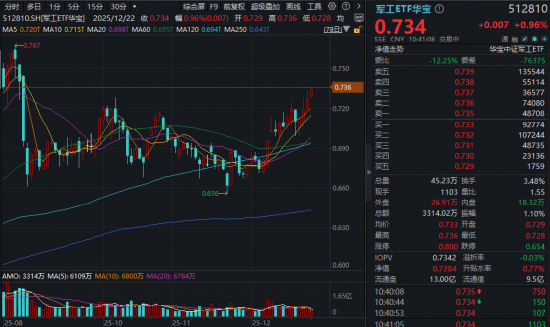
商业航天热度持续高涨,高德红外、北斗星通涨停!军工ETF华宝(512810)创9月4日以来新高!
Xin Lang Cai Jing· 2025-12-22 02:58
Core Viewpoint - The military industry sector is experiencing active performance, with commercial aerospace concept stocks leading the gains, indicating a shift in investment dynamics and growth potential in the sector [1][5]. Group 1: Market Performance - On December 22, the military sector showed strong activity, with stocks like High De Infrared and Beidou Star reaching their daily limit, and China Satellite rising nearly 8% [1][5]. - The popular military ETF, Huabao (512810), saw its price peak at 1.24%, marking a new high since September 4, with real-time transaction volume exceeding 330 million yuan [1][5]. Group 2: Industry Development - According to CITIC Securities, China's military industry has evolved from relying solely on domestic demand to a new development pattern driven by three engines: domestic demand foundation, foreign trade expansion, and civilian backfeeding [6][7]. - The industry is transitioning from "cyclical growth" to "comprehensive growth," reshaping its landscape and boundaries [6][7]. Group 3: Demand Drivers - The first curve focuses on domestic military demand, driven by stable growth in defense budgets and equipment modernization [7]. - The second curve emphasizes military trade expansion, where China's competitive pricing and strategic partnerships are enhancing its global supply share [7]. - The third curve highlights the spillover of military technology into civilian applications, fostering new industries like commercial aerospace and low-altitude economy, creating a virtuous cycle of "military technology benefiting civilian sectors" [7]. Group 4: Investment Tools - The Huabao military ETF (512810) covers both traditional military forces and emerging sectors, including commercial aerospace, deep-sea technology, military AI, low-altitude economy, and large aircraft, serving as an efficient investment tool for the defense sector [7].


午后,直线拉升!重磅驱动,突袭!
券商中国· 2025-11-19 07:28
Core Viewpoint - The military industry stocks have experienced a significant surge, driven by recent advancements in China's military capabilities and a shift in the industry's growth model towards a more diversified and sustainable approach [1][4]. Group 1: Market Performance - The military equipment sector saw a notable increase, with stocks such as Jianglong Shipbuilding, Yaguang Technology, and Tianhai Defense reaching their daily limit, while others like Tengjing Technology and Changyou Technology rose over 8% [2][3]. - According to data from Guoxin Securities, state-owned defense enterprises reported a 21.19% year-on-year revenue growth and an 8.93% increase in net profit for the first three quarters of 2025, indicating improved profitability and productivity [3]. Group 2: Industry Developments - China's military industry is transitioning from a reliance on domestic demand to a new development model characterized by three driving forces: domestic demand foundation, foreign trade expansion, and civil-military integration [4]. - Recent military advancements include the commissioning of the Fujian aircraft carrier, which is the world's first conventional-powered aircraft carrier using electromagnetic catapult technology, and the introduction of the Attack-11 drone, marking a new era of "manned-unmanned collaborative operations" [5]. Group 3: Investment Focus - The investment focus in the military sector is shifting towards four high-certainty areas: main battle equipment supply chains, advanced combat capabilities, technology-driven civil-military integration sectors, and the reform and asset securitization of military assets [6].






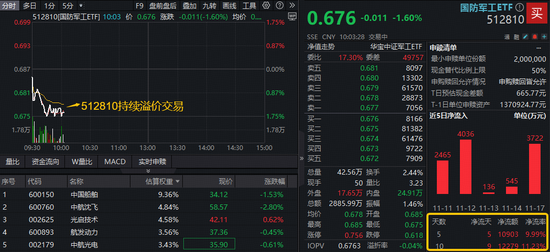
中字头军工股普跌,国防军工ETF回调逾1%触及半年线,场内溢价再起!资金连续6日净申购!
Xin Lang Ji Jin· 2025-11-18 02:11
Core Viewpoint - The defense and military industry sector is experiencing a significant pullback, with the popular defense ETF (512810) declining over 1% and hitting a six-month low, while major military stocks are also seeing declines [1][2]. Group 1: Market Performance - The defense military ETF (512810) has seen a decline of 1.60%, trading at 0.676, with a drop of 0.011 [2]. - Major military stocks such as AVIC Shenyang Aircraft Corporation and China Shipbuilding Industry Corporation have dropped nearly 3% and over 1% respectively [1]. Group 2: Investment Opportunities - The ETF has attracted over 100 million yuan in net subscriptions over the past six trading days, indicating active interest from investors [1]. - Analysts suggest that the fourth quarter may see the gradual realization of "14th Five-Year Plan" related orders, coupled with military trade catalysts, which could lead to a resurgence in the defense and military market [1]. - The defense industry is expected to benefit from geopolitical risks, technological advancements, and policy support, with potential for high-end weapon exports and a revaluation of core asset values [1]. Group 3: Strategic Insights - CITIC Securities' report indicates a shift in China's defense industry from "cyclical growth" to "comprehensive growth," driven by domestic demand, foreign trade expansion, and civilian contributions [3]. - The defense ETF (512810) is highlighted as an efficient tool for investing in core defense assets, covering various hot themes such as commercial aerospace, low-altitude economy, and military AI [3].