
军贸

Search documents
高端装备半月谈-重点方向推荐
2026-03-30 05:15
Summary of Key Points from Conference Call Records Company: Vico Technology Core Business and Financial Performance - Vico Technology's gross margin has rebounded to over 29%, with the proportion of high-margin precision molds increasing to 40%[1][2] - The company’s stock price has exceeded market expectations, with a 19% increase over the past five days, and institutional investor interest has significantly increased since February 2026[2] - Despite a decline in overall gross margin from 36% to 29% between 2020 and 2024 due to pressures in the home appliance sector, the company has achieved a continuous recovery in gross margin over three consecutive quarters starting in 2025[2] - Vico Technology's financial health is robust, with a strong cash flow reserve and a diversified business strategy that mitigates reliance on any single industry[2] Growth Areas and Strategic Developments - The MPO (Multi-fiber Push On) optical communication business is emerging as a new growth driver, with significant increases in component shipments in Q1 2026 and entry into the more technically demanding connector field[1][4] - The company is expected to achieve a revenue breakthrough in the MPO connector business by the second half of 2026, potentially becoming one of the few domestic suppliers for MPO connectors[5] - Vico Technology is also focusing on 3D printing technology, with the cost of titanium alloy frames dropping to approximately 270 RMB, making it competitive with CNC processing costs[1][10] Market Trends and Competitive Landscape - The global military trade landscape is shifting, with a decline in Russia's market share creating opportunities for Chinese companies in the Middle East and Southeast Asia[1][16] - The commercial aerospace sector is entering a growth phase in 2026, with significant orders for large satellite constellations expected to materialize[1][14] - The demand for conventional weapons and drones is increasing, particularly in the Middle East and Southeast Asia, driven by modern warfare needs[1][17] Industry Insights 3D Printing in Consumer Electronics - 3D printing technology is rapidly penetrating the consumer electronics sector, particularly in the production of titanium alloy components, with Apple integrating this technology into its products[7][8] - The cost of 3D printed titanium alloy frames has decreased by over 25% compared to 2023, indicating a significant economic viability for large-scale applications[10][11] - The market for 3D printing equipment and structural components is projected to reach approximately 70 billion RMB by 2027, with a total output value of around 150 billion RMB expected for structural components[11][12] Military and Aerospace Sector - The military sector's performance is sensitive to market risk preferences and liquidity, with demand driven by domestic procurement, military exports, and dual-use applications[13][14] - The commercial aerospace industry is expected to see significant growth, with new orders and technological breakthroughs anticipated in 2026[14][15] - Investment opportunities in the military sector are focused on drones, conventional munitions, and satellite communication services, particularly in light of geopolitical tensions[17][19] Investment Opportunities - Companies with strong technological foundations and the ability to integrate across the 3D printing value chain, such as Huazhu High-Tech and Dazhu Laser, are highlighted as having investment potential[12] - The military sector presents opportunities in drone technology, conventional munitions, and satellite information services, with specific companies recommended for further research[19]
美以伊冲突装备分析及未来军贸影响
2026-03-26 13:20
Summary of Key Points from the Conference Call Industry and Company Involvement - The analysis focuses on the military equipment and trade implications stemming from the conflict involving the United States, Israel, and Iran, highlighting the military capabilities and strategies of these nations [1][6]. Core Insights and Arguments - The U.S. military showcased a "large gradient" equipment system, utilizing advanced aircraft such as the F-35 and B-2, alongside low-cost drones like "Lucas," emphasizing its global base layout and logistical advantages [1][2]. - Iran's counterattacks heavily relied on missiles and drones, exhibiting a diverse range of models but with lower precision, such as a deviation of up to 700 meters, and facing challenges in replenishing these consumable weapons [1][5]. - China is approaching U.S. capabilities in fifth-generation fighter jets but still lags significantly in strategic bombers, special aircraft, and large transport aircraft, with a notable gap in the number of operational units compared to the U.S. [1][3]. - U.S. arms sales often come with political conditions, raising concerns among various countries. In contrast, China, with its no-strings-attached approach and advancements in high-end and autonomous weaponry, is poised to capture a larger share of the arms trade market in the fifth-generation era [1][7]. - The J-35 is positioned as a core growth point for future arms trade, expected to meet global demand for fourth and fifth-generation aircraft, leading to a reevaluation of the entire aircraft industry chain [1][8]. Additional Important Insights - The conflict revealed the disparity in military capabilities between the U.S. and China, particularly in bombers, special aircraft, transport aircraft, and drones, indicating a significant need for China to enhance its military equipment across these domains [1][8]. - The arms trade landscape may shift as countries reassess their procurement strategies in light of U.S. political conditions attached to military sales, potentially benefiting China's arms trade opportunities [6][7]. - The focus on aircraft remains paramount in global arms trade, with aircraft accounting for over 40% of trade in the past decade. The J-35 is expected to be the primary export model, while the J-20's advanced capabilities may limit its short-term export potential [8][9]. - Key companies to watch in the arms trade include AVIC Shenyang Aircraft Corporation (for J-35), AVIC Xi'an Aircraft Industrial Group (for Y-20), and other firms involved in missile and radar production, such as Hongdu Aviation and Aerospace Rainbow [8][9].


连接器-十五五-四大景气方向展望
2026-03-24 01:27AI Processing
Q&A 在 AI 算力、新能源汽车、商业航天和军贸这四大领域,连接器行业的核心发展 趋势和市场机遇是怎样的? 连接器"十五五"四大景气方向展望 20260323 摘要 英伟达 GB200NVL72 机柜内配 5,000+条铜缆,铜互联价值量占比达 4%-10%,ACC/AEC 技术路线主导 7 米内传输。 高速连接器成"十五"核心增长点,224G 传输需求驱动芯片与主板 Socket 方案及测试需求放量。 智能驾驶推动车载连接器由高压向高速演进,L2 级以上单车价值量从不 足 200 元跃升至 1,000 元以上。 商业航天 2025 年占比将达 84%,中航光电与航天电器分别在火箭与卫 星互联领域占据领先地位。 防空反导系统采购优先级升至"必选项",带动国内连接器企业 2026Q1 航天领域订单超预期增长。 连接器作为基础器件,其增长需要多元化的下游应用驱动。当前,连接器行业 正迎来算力、新能源汽车、商业航天及军贸四大领域的共振发展机遇。 在算力 领域,AI 集群规模的指数级增长、带宽需求的激增以及对功耗和延迟的严格约 束,共同推动了连接需求的剧增。在机柜内部 7 米以内的传输场景中,铜互联 方案因其在工程 ...
2026年国防军工行业春季投资策略:传统军工稳步推进强支撑,民用转化快速发展高弹性
Shenwan Hongyuan Securities· 2026-03-18 03:03
Core Insights - The report identifies a new cycle in China's defense equipment construction driven by "steady growth in traditional military industry" and "rapid development of civilian conversion of military technology" [4] - Traditional military industry is expected to continue its systematic and long-term progress, supported by key milestones such as the centenary of the People's Liberation Army in 2027 and the modernization goals by 2035 [4] - The civilian conversion of military technology is accelerating, creating new growth opportunities in various emerging industries, significantly enhancing the industry's elasticity [4] Group 1: Domestic and International Market Dynamics - The domestic market is expected to stabilize, while the international market presents new expansion opportunities for military trade [5][17] - The "14th Five-Year Plan" is initiating a new construction cycle, with a focus on enhancing military capabilities through mechanization and information technology [7][19] - The military trade landscape is evolving, with a shift towards a more integrated and systematic approach to military exports [52][56] Group 2: Military Technology Spillover - Military technology is increasingly spilling over into civilian applications, broadening the growth space and enhancing elasticity in the military industry [70][73] - Key areas of focus include commercial aerospace, advanced aircraft engines, controllable nuclear fusion, and deep-sea technology, which are expected to drive long-term growth [4][80] - The report emphasizes the importance of technological breakthroughs and cost reductions in facilitating the transition from military to civilian applications [76] Group 3: Investment Opportunities - The report highlights specific sectors for investment, including commercial aerospace, the dual-use aircraft industry, and controllable nuclear fusion [4][19] - The commercial aerospace sector is positioned for rapid growth, supported by national policies that prioritize aerospace as a key emerging industry [80][82] - The dual-use aircraft industry is expected to benefit from a resonance of military and commercial development, enhancing overall market potential [4][19]






军工行业2026年春季投资策略:发展先进战斗力,拓展出海民用新市场
Southwest Securities· 2026-03-11 07:29
Core Insights - The global defense spending is projected to reach $2.63 trillion in 2025, a 2.5% increase year-on-year, with defense spending as a percentage of global GDP rising from 1.89% to 2.01% [4] - China's defense budget for 2026 is set at 1.91 trillion yuan, reflecting a 7% increase from 2025, indicating a stable growth trajectory [4][36] - The upcoming 2027 milestone for China's military development will likely accelerate industry growth and equipment development [4][39] - The military-civilian integration and military trade are expected to open new market opportunities for defense companies [4][6] Section 1: Military Investment Growth - The report highlights the increasing military expenditures by various countries in response to global uncertainties and conflicts, with the U.S. defense budget for 2026 at $901 billion [4][34] - China's defense spending growth remains robust, with a 7% increase planned for 2026, maintaining a long-term upward trend [4][36] - The emphasis on achieving the centenary military goals by 2027 will drive new momentum in the defense sector [4][39] Section 2: Recommended Sectors - Key sectors to focus on include military technology for civilian use, military trade, and low-cost weaponry [6][42] - The commercial aerospace sector is expected to benefit from advancements in military aircraft development, with significant progress in the C919 program [42][44] - The military trade market is anticipated to experience rapid growth due to ongoing international conflicts [6][73] Section 3: Historical Performance and Future Outlook - The military industry has seen fluctuating performance, with a notable recovery in revenue and profit margins since 2025, driven by the end of previous disruptions [14][28] - The defense sector's revenue for Q1-Q3 2025 reached 540.57 billion yuan, a 16.2% year-on-year increase, indicating a positive trend [14][28] - The report suggests that the military industry will continue to recover and grow, supported by domestic demand and military trade opportunities [14][28] Section 4: Inventory and Order Demand - The military sector's inventory increased significantly, with total inventory reaching 366.65 billion yuan by Q3 2025, reflecting strong downstream order demand [21][24] - Prepayments and contract liabilities surged to 405.88 billion yuan, indicating a robust order pipeline [21][24] - The report emphasizes the correlation between inventory levels and order demand, suggesting a positive outlook for future revenue [21][24] Section 5: Cash Flow and Financial Health - The operating cash flow for the military industry showed improvement, with a net cash flow of -30.11 billion yuan for Q1-Q3 2025, an improvement from the previous year [28] - The long cash conversion cycle in the military sector continues to pose challenges, but the situation is expected to improve as previous disruptions are resolved [28]
26年国防预算增速7%,关注军贸机遇
HTSC· 2026-03-09 07:52
Investment Rating - The report maintains a "Buy" rating for key companies in the defense industry, including AVIC Shenyang Aircraft Corporation, Guorui Technology, Ruichuang Micro-Nano, Western Superconducting Technologies, Aerospace Intelligence Manufacturing, Guotai Group, and North Navigation [8][40]. Core Insights - In 2026, China's defense budget is set at 1,909.561 billion RMB, reflecting a 7% year-on-year increase, slightly down from 7.2% in 2025. This growth is consistent with the principle of "moderate" increase in defense spending [11][12]. - The ongoing conflict between the U.S. and Iran is expected to drive demand for military trade, particularly in missile and drone technologies, enhancing the international military trade market's activity [11][13]. - The "14th Five-Year Plan" is anticipated to shift the focus from quantity to quality in military modernization, with significant structural opportunities emerging in new domains, unmanned systems, advanced weaponry, and low-cost equipment [16][17]. Summary by Sections Defense Budget - The defense budget for 2026 is projected at 1,909.561 billion RMB, with a 7% increase compared to the previous year, indicating a stable growth trend [11][12]. - The report emphasizes that the growth rate is in line with the "moderate" principle, balancing national defense needs with economic development [11]. Military Trade Opportunities - The report highlights the potential for increased overseas demand for military equipment, as China is one of the few suppliers capable of providing comprehensive solutions [13][19]. - The international military trade market is expected to remain active, driven by geopolitical tensions and increased defense spending globally [11][19]. Key Companies to Watch - Recommended companies include AVIC Shenyang Aircraft Corporation, Guorui Technology, Ruichuang Micro-Nano, Western Superconducting Technologies, Aerospace Intelligence Manufacturing, Guotai Group, and North Navigation, all rated as "Buy" [8][40]. - The report suggests that these companies are well-positioned to benefit from the anticipated growth in military trade and modernization efforts [19][20]. Emerging Trends - The report identifies significant opportunities in new equipment construction, particularly in unmanned systems and advanced weaponry, as part of the military modernization strategy [16][18]. - The focus on military-civilian integration is expected to create new market spaces in commercial aerospace, low-altitude economy, deep-sea technology, and nuclear energy [20].


美以对伊朗发动联合打击事件点评:全球安全形势变化,关注军贸长逻辑
GUOTAI HAITONG SECURITIES· 2026-03-01 07:55
Investment Rating - The report assigns an "Accumulate" rating for the defense industry, indicating a positive outlook for investment opportunities in this sector [5]. Core Insights - The global security landscape is changing, prompting countries to increase military procurement as a necessary option. Equipment such as early warning radars and portable missiles are expected to become popular in the arms trade market. The report suggests focusing on listed companies within China's military trade industry chain [2][5]. Summary by Sections Industry Overview - The report highlights the recent military actions by the US and Israel against Iran, which have escalated tensions and led to retaliatory actions from Iran. This situation has contributed to a shift in the global security environment, with various armed conflicts emerging in recent years, including the Russia-Ukraine conflict and the US-Israel strikes on Iran [5]. Investment Opportunities - The report emphasizes that countries, particularly those with high external dependence on defense equipment, are likely to continue increasing their defense spending to safeguard their sovereignty and security interests. Low-cost, high-efficiency defense equipment is anticipated to be in high demand [5]. Recommended Stocks - The report lists several companies as recommended investment targets within the military trade sector, including: - Gaode Infrared (高德红外) - Aerospace South Lake (航天南湖) - Aerospace Electronics (航天电子) - North Navigation (北方导航) - Ruichuang Micro-Nano (睿创微纳) - Guobo Electronics (国博电子) - Guorui Technology (国睿科技) - AVIC Shenyang Aircraft (中航沈飞) - Zhong Unmanned Aerial Vehicle (中无人机) - Aerospace Rainbow (航天彩虹) [5][6].
ETF盘中资讯|军工攻势再起!高人气军工ETF华宝(512810)上演V型逆转!菲利华续创历史新高
Sou Hu Cai Jing· 2026-02-26 03:00
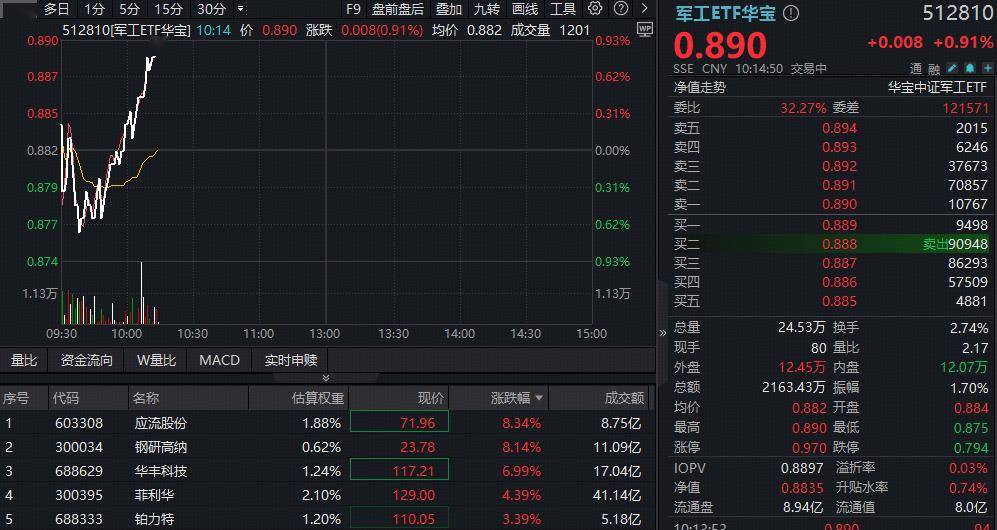
Core Viewpoint - The military industry sector is experiencing a significant upward movement, with notable gains in military ETFs and individual stocks, indicating strong market interest and potential growth opportunities [1]. Group 1: Short-term Outlook - The military industry is expected to benefit from a surge in demand for domestic commercial aerospace and aviation over the next five years, with both sectors projected to be trillion-yuan markets [1][2]. - The year 2026 marks the beginning of a new procurement cycle for major equipment, with upstream supply chains likely to benefit first, as order momentum is anticipated to start as early as the beginning of this year [1]. Group 2: Mid-term Outlook - A significant turning point in military trade demand is expected, leading to a simultaneous increase in both quantity and price of equipment, which will notably benefit manufacturers of main systems and key subsystems [2]. - Strong demand for AI in the power generation sector is anticipated to sustain the momentum in the gas turbine industry chain [2]. Group 3: Long-term Outlook - By 2027, coinciding with the centenary of the military, national defense spending is projected to maintain a high growth rate of around 7%, alongside accelerated iterations of next-generation main battle equipment and rising demands for new combat capabilities, suggesting continued high prosperity in the military industry [2].


军工攻势再起!高人气军工ETF华宝上演V型逆转!菲利华续创历史新高
Xin Lang Ji Jin· 2026-02-26 02:45
Core Viewpoint - The military industry sector is experiencing a significant upward movement, with the military ETF Huabao (512810) rising nearly 1% and achieving a five-day consecutive increase, driven by strong performances from constituent stocks like Gangyan Gaona and Feili Hua, which saw gains of over 9% and 4% respectively [1][2]. Group 1: Short-term Outlook - The demand for commercial aerospace and aviation is expected to grow significantly over the next five years, with both sectors representing trillion-level markets, likely to attract continued market interest [1]. - The year 2026 marks the beginning of a new inventory cycle as part of the "14th Five-Year Plan," with upstream supply chains expected to benefit first, and order momentum potentially starting as early as this year [1]. Group 2: Medium-term Outlook - Military trade demand is anticipated to reach a significant turning point, leading to a simultaneous increase in both quantity and price of equipment demand, benefiting main engine and key subsystem manufacturers [2]. - Strong demand for AI in the power generation sector is expected to sustain the momentum of the gas turbine industry chain [2]. Group 3: Long-term Outlook - By 2027, coinciding with the centenary of the military, national defense spending is projected to maintain a high growth rate of around 7%, alongside accelerated iterations of next-generation main battle equipment and rising demands for new combat capabilities, indicating sustained high prosperity in the military industry [2]. Group 4: Investment Tool - The military ETF Huabao (512810) covers various popular themes such as large aircraft, commercial aerospace, low-altitude economy, satellite navigation, military informatization, and controllable nuclear fusion, serving as an efficient tool for investing in core military assets [2].
军工攻势再起!高人气军工ETF华宝(512810)上演V型逆转!菲利华续创历史新高
Xin Lang Cai Jing· 2026-02-26 02:43
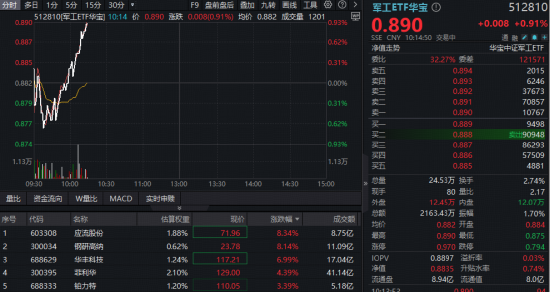
Core Viewpoint - The military industry sector is experiencing a significant upward movement, with the high-profile military ETF, Huabao (512810), rising nearly 1% and achieving a five-day consecutive increase in its daily line [1][4]. Group 1: Market Performance - The military ETF Huabao (512810) saw a price of 0.890, with an increase of 0.008 (0.91%) and an average price of 0.882, with a trading volume of 1201 [1][5]. - The constituent stock, Gangyan Gaona, led the gains with an increase of over 9%, while Feili Hua continued to rise by over 4%, reaching a new historical high [1][4]. Group 2: Industry Outlook - In the short term, the demand for commercial aerospace and aviation is expected to grow significantly over the next five years, with both sectors being trillion-level markets, likely to attract continued market interest [6]. - The year 2026 is anticipated to mark the beginning of a new inventory cycle for the main engine sector, with upstream supply chains expected to benefit first, and order traction starting as early as this year [6]. - In the medium term, military trade demand is expected to reach a significant turning point, driving both quantity and price increases in equipment demand, benefiting main engine and key subsystem manufacturers [6]. - Long-term projections indicate that defense spending is likely to maintain a high growth rate of around 7% leading up to the centenary of the military in 2027, alongside accelerated iterations of next-generation main battle equipment and rising demands for new combat capabilities [6]. Group 3: Investment Tools - The military ETF Huabao (512810) covers various popular themes such as large aircraft, commercial aerospace, low-altitude economy, satellite navigation, military informatization, and controllable nuclear fusion, serving as an efficient tool for investing in core military assets [6].
