净国际投资头寸(NIIP)

Search documents
特朗普关税“B计划”遭质疑,专家:美国经济现状并不符合“122条款”
Hua Er Jie Jian Wen· 2026-02-24 06:44
Core Viewpoint - The Trump administration has initiated a "Plan B" to impose tariffs of up to 15% on global imports after the U.S. Supreme Court rejected the use of the International Emergency Economic Powers Act (IEEPA) for this purpose, raising legal and economic concerns regarding the legitimacy of this action [1][2] Group 1: Legal and Economic Context - The new tariff measure allows the president to bypass investigation procedures but is constrained by a 15% tax rate cap and a 150-day validity period, leading to anticipated legal challenges from businesses seeking refunds for tariffs already paid [2] - The Trump administration's invocation of Section 122 of the Trade Act of 1974 is based on claims of a "huge and serious" trade and international balance of payments deficit, including a net international investment position (NIIP) of negative $26 trillion [1][3] - Legal experts argue that the current economic conditions do not exhibit typical symptoms of a balance of payments crisis, such as currency collapse or capital flight, which raises questions about the applicability of Section 122 [1][4] Group 2: Historical and Regulatory Framework - Section 122 of the Trade Act of 1974 was designed to allow the president to act without waiting for federal agency investigations in response to significant balance of payments deficits or imminent currency devaluation, with a historical context dating back to the Nixon Shock [6] - The limitations of this section include a maximum tariff rate of 15% and a maximum implementation period of 150 days, requiring congressional approval for any extension, which poses challenges for the sustainability of the new tariffs [6] Group 3: Economic Implications - Economists challenge the rationale behind the tariffs, arguing that the negative NIIP is largely due to foreign holdings of U.S. assets being significantly higher than U.S. holdings of foreign assets, and that a successful tariff implementation could paradoxically worsen the NIIP [4] - The absence of evidence indicating that the U.S. cannot meet its international obligations suggests that there is no actual "crisis," as a genuine crisis would typically lead to a sell-off of U.S. assets and a significant depreciation of the dollar [4]
27.6万亿美元失衡头寸暗藏杀机!全球资金“抛售美国”可行性几何?
Jin Shi Shu Ju· 2026-01-23 08:18
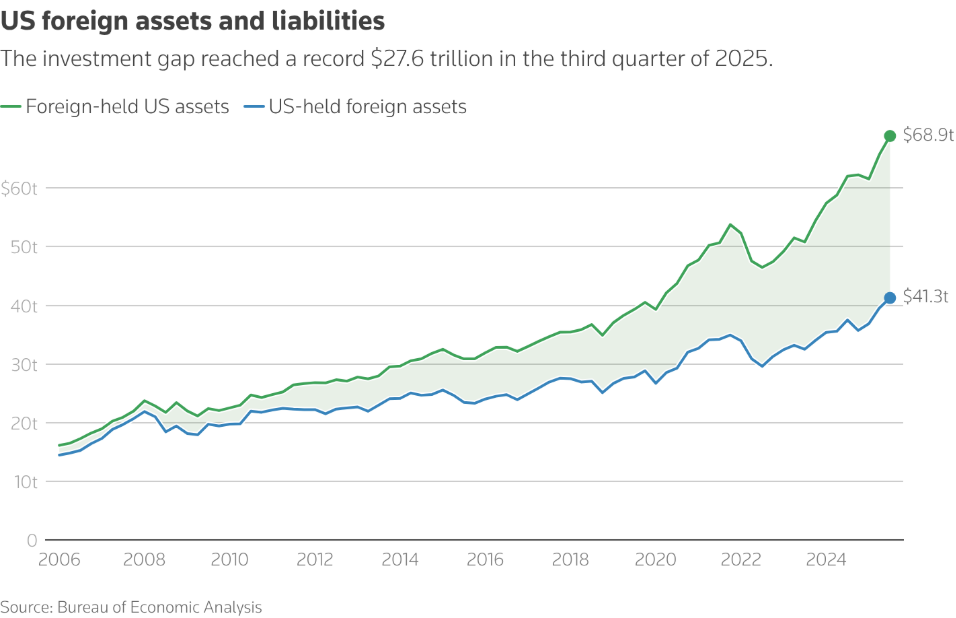
Core Viewpoint - The discussion around "selling off America" has resurfaced, despite a temporary easing due to potential agreements related to Greenland by President Trump. However, concerns about a significant reduction in exposure to U.S. assets remain prevalent [1]. Group 1: Market Sentiment and Investment Trends - Last year, the term "de-dollarization" gained popularity amid fears stemming from Trump's trade war, leading investors to consider reducing their exposure to U.S. assets. Ultimately, this concern did not materialize, as overseas investors net purchased $1.27 trillion in U.S. securities in the first 11 months of the year, largely driven by private investments attracted by the AI boom [1][5]. - The current net international investment position (NIIP) of the U.S. stands at approximately $27.6 trillion, indicating a significant net long position in U.S. assets globally. This figure reflects a disparity between $68.9 trillion in U.S. assets held by foreign investors and $41.3 trillion in foreign assets held by U.S. investors [5][6]. Group 2: Geopolitical Implications and Asset Allocation - Trump's controversial policies have disrupted the longstanding U.S.-Europe alliance and the rules-based global order, reigniting discussions about shorting U.S. assets. The core question now is whether global investors will maintain their high positions in U.S. assets or begin reallocating their investments [5][6]. - Some Nordic pension funds have indicated plans to reduce their holdings in U.S. bonds, but their impact on the market is expected to be minimal due to their relatively small size [6]. - The concept of "mutually assured destruction" in finance has resurfaced, reflecting concerns that if major economies like Europe begin to sell off U.S. debt, it could lead to increased yields and negatively impact the U.S. economy. However, historical trends show that reductions in U.S. debt holdings by countries like China have not led to significant market turmoil, as demand from European countries has filled the gap [6][7]. Group 3: Economic Fundamentals and Capital Flows - The U.S. continues to face a substantial current account deficit, requiring over $1 trillion in net capital inflows annually to support its economy. Although the current account deficit has narrowed recently, the sustainability of last year's capital inflows remains uncertain [8]. - In the first 11 months of last year, overseas investors net purchased $1.27 trillion in U.S. securities, with $663 billion attributed to equities, marking a more than twofold increase compared to the same period in 2024 [8]. - The challenge now lies not only in convincing investors to hold U.S. assets but also in persuading them to increase their holdings amid geopolitical tensions and shifting global dynamics [8].