
分部估值

Search documents
未知机构:国金通信炬光科技跟踪目标市值怎么看分部估值可插拔607-20260210
未知机构· 2026-02-10 02:10
Summary of Conference Call Records Company and Industry Overview - The analysis focuses on **炬光科技 (Juguang Technology)**, a company operating in the **optical communication** and **semiconductor** sectors, with a particular emphasis on its **OCS (Optical Communication Systems)** business segment [1][2]. Key Insights and Arguments - **Valuation Breakdown**: The company’s valuation is segmented as follows: - Plug-and-play modules: €60-70 million - OCS: €100-120 million - CPO (Chip-on-Board): €150 million - Other businesses: €100 million - Total estimated valuation: €450 million [1] - **Market Potential**: The total addressable market (TAM) for the industry in 2027 is projected to be €60-70 million. Assuming a 15% market share, this translates to a net profit of €2-3 million, leading to a price-to-earnings (PE) ratio of 20-25x, resulting in a valuation of €60-70 million [1]. - **Comparative Valuation**: Compared to other OCS companies, Juguang Technology is considered relatively undervalued. Other OCS companies are typically valued based on their end-state estimates, with projections for 2030 estimating 300,000 OCS units. If Juguang captures a 30% market share, with a unit value of €12,000-€13,000 and a net profit margin of 30%, this could yield profits of €3-4 million, leading to a valuation of approximately €100-120 million at a PE of 25-30x [1]. - **Competitive Landscape**: The competitive environment may be better than expected, with the market not fully pricing in the potential for scaling up. The company is well-positioned in the "out" domain and is expected to have similar potential in the "up" domain [1]. - **Profit Projections**: - For the "out" domain, with a forecast of 100,000 units in 2027, a unit value of €50,000, a 20% market share, and a 30% net profit margin, the projected profit is €3 million, leading to a valuation of €120 million at a PE of 40x [2]. - For 2030, with a forecast of 300,000 units and a unit value of €40,000, the projected profit is €7-8 million, resulting in a valuation of €150 million at a PE of 20x [2]. - **Stability in Related Industries**: Traditional industrial and semiconductor sectors are stabilizing, with automotive applications and healthcare growing at around 10%. Consumer electronics are expected to start contributing to revenue from Q3 2026 [2]. - **M&A Impact**: The negative impact of mergers and acquisitions is expected to diminish, with the SMO production line successfully relocated from Switzerland to Shaoguan, achieving profitability. The Heptagon acquisition is anticipated to break even within 6-8 quarters post-acquisition [2]. - **Market Sentiment and Performance**: The current market sentiment is cautious regarding the company's performance. However, the presence of CPO beta is expected to provide ongoing support for the stock price. The period before April is seen as relatively safe, with expectations of increased revenue from optical communications in the second half of the year, which could lead to profitability [2]. Additional Important Points - **Investment Strategy**: The suggested trading strategy involves buying during significant dips and smaller dips, with opportunities arising from daily long lower shadows or short-term corrections. Continuous monitoring and attention are recommended [3].

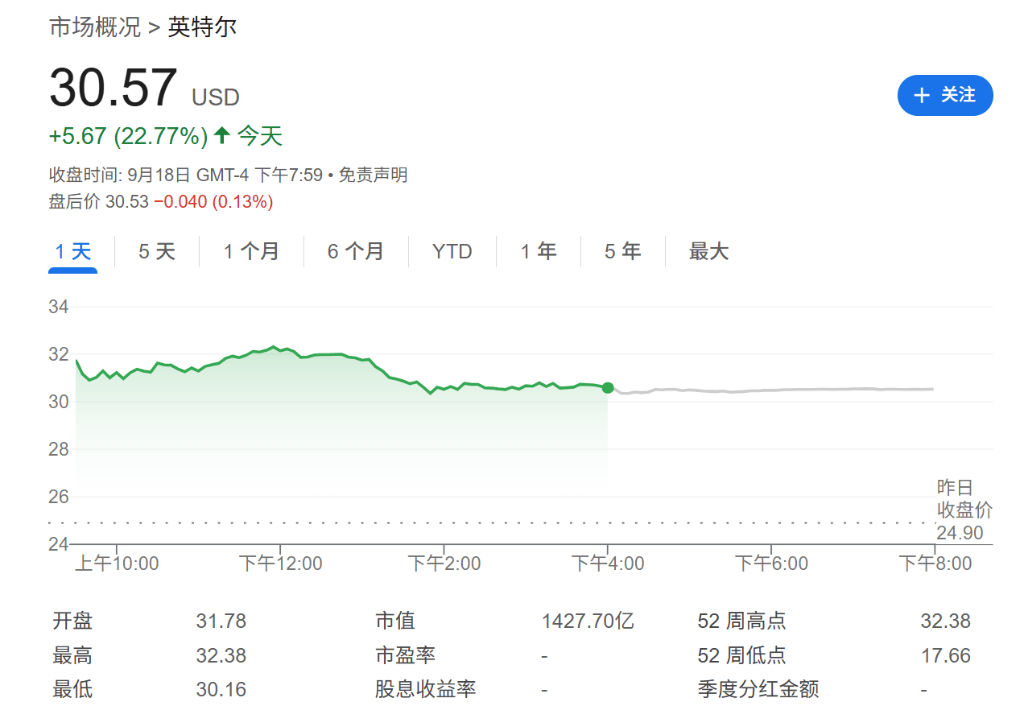
英伟达50亿美元投资,英特尔代工分拆或迎关键一步?
Sou Hu Cai Jing· 2025-09-19 07:53
Core Viewpoint - Nvidia's $5 billion investment in Intel is seen as a significant endorsement for Intel's foundry business, potentially leading to a separation of its product and foundry operations, which could enhance the company's valuation to $35-40 per share [1][3]. Group 1: Investment Impact - Nvidia's investment is expected to encourage other clients to invest in Intel, allowing the company to continue developing its 14A process technology, which is anticipated to be competitive [3]. - The investment is viewed as a milestone for Intel, indicating key customer recognition and support for its foundry business [3][4]. - UBS has raised its target price for Intel from $25 to $35, reflecting a shift towards independent valuation of Intel's various business segments [1][5]. Group 2: Competitive Landscape - The separation of Intel's product and foundry businesses could pose a challenge to competitors like AMD in the next 3-4 years, as it would provide Intel's product division with more flexibility in choosing foundry partners [4]. - In the short term, the investment is not expected to significantly impact Intel's product roadmap competitiveness, as it primarily focuses on the foundry side [4][5]. Group 3: Financial Metrics - Intel's product business is valued at $27 per share based on a 15x P/E ratio, while its foundry business is valued at $8 per share after excluding non-controlling interests [5][6]. - The total potential enterprise value for Intel is estimated at $165.8 billion, with a potential equity value of $152.2 billion after accounting for net debt [6].


SEA(SE US):利润好于预期,电商规模效应显现
HTSC· 2025-05-15 04:30
Investment Rating - The investment rating for the company is "Buy" with a target price of $168.00 [7][8]. Core Insights - The company's revenue for Q1 2025 was $4.84 billion, representing a year-over-year increase of 29.6%, slightly below the consensus estimate of 31.2%. The adjusted EBITDA was $950 million, exceeding the consensus estimate of $700 million. Management maintains a guidance of 20% growth in e-commerce GMV for 2025, with expectations of double-digit growth in active users and bookings in the gaming segment [1][5]. Summary by Sections E-commerce - E-commerce revenue grew by 28.3% year-over-year to $3.52 billion, slightly below the consensus estimate of 30.3%. The adjusted EBITDA for this segment was $260 million, with an EBITDA margin of 7.5%, improving by 8.3 percentage points year-over-year. The order volume and GMV increased by 19% and 22%, respectively. Management is focused on enhancing service quality for sellers to drive more usage of advertising tools, with the number of participating sellers and average ad spend increasing by 22% and 28%, respectively [2]. Digital Payments - Digital payments revenue surged by 57.6% year-over-year to $790 million, outperforming the consensus estimate of 51.3%. The adjusted EBITDA for this segment was $240 million, up 62.4%, with an EBITDA margin of 30.7%. As of the end of Q1 2025, the loan balance for Monee was approximately $5.8 billion, with a non-performing loan ratio of about 1.1%, showing a decrease quarter-over-quarter. The brand name was changed from SeaMoney to Monee to reflect synergy with Shopee [3]. Gaming - Gaming revenue increased by 8.2% year-over-year to $500 million, below the consensus estimate of 15.0%, primarily due to deferred revenue. The adjusted EBITDA for this segment was $460 million, up 56.8%, with an EBITDA margin of 92.5%. The net bookings reached $780 million, a year-over-year increase of 51.4%. The active user count for Q1 2025 was 660 million, up 11.3%, with paying users at 64.6 million, a 32.1% increase [4]. Profit Forecast and Valuation - The profit forecast for 2025, 2026, and 2027 has been raised by 15.7%, 14.7%, and 13.2% to $3.52 billion, $4.53 billion, and $5.39 billion, respectively. The target price has been adjusted to $168.00 based on a sum-of-the-parts valuation model [5][30]. Financial Metrics - The projected revenue for 2025 is $20.89 billion, with a year-over-year growth rate of 24.2%. The net profit attributable to the parent company is expected to reach $1.89 billion, reflecting a significant increase of 325.79% year-over-year. The EPS for 2025 is projected at $3.20, with a PE ratio of 48.23 [6][39].

Sea Limited(SE):季报点评:利润好于预期,电商规模效应显现
HTSC· 2025-05-15 03:04
Investment Rating - The investment rating for the company is "Buy" with a target price of $168.00 [7][8]. Core Insights - The company's revenue for Q1 2025 was $4.84 billion, representing a year-on-year increase of 29.6%, slightly below the consensus estimate of 31.2% due to deferred gaming revenue and lower-than-expected e-commerce revenue [1]. - Adjusted EBITDA for Q1 2025 was $950 million, exceeding the consensus estimate of $700 million, indicating a positive trend in profitability as scale effects become more apparent [1]. - The management maintains a guidance of 20% growth in e-commerce GMV for 2025, with expectations of double-digit growth in active users and bookings in the gaming segment [1]. E-commerce Segment - E-commerce revenue increased by 28.3% to $3.52 billion in Q1 2025, slightly below the consensus estimate of 30.3% [2]. - The adjusted EBITDA for the e-commerce segment was $260 million, with an EBITDA margin of 7.5%, improving by 8.3 percentage points year-on-year [2]. - The number of e-commerce orders and GMV grew by 19% and 22% respectively, with management focusing on enhancing service quality to drive more merchants to use advertising tools [2]. Electronic Payment Segment - Electronic payment revenue surged by 57.6% to $790 million in Q1 2025, outperforming the consensus estimate of 51.3% [3]. - Adjusted EBITDA for this segment was $240 million, reflecting a year-on-year increase of 62.4%, with an EBITDA margin of 30.7% [3]. - The company rebranded its payment service from SeaMoney to Monee to highlight its synergy with e-commerce, with a loan balance of approximately $5.8 billion at the end of Q1 2025 [3]. Gaming Segment - Gaming revenue grew by 8.2% to $500 million in Q1 2025, below the consensus estimate of 15.0% due to significant deferred revenue [4]. - Adjusted EBITDA for the gaming segment was $460 million, with an EBITDA margin of 92.5% [4]. - The net bookings reached $780 million, up 51.4% year-on-year, with management confident in achieving double-digit growth in active users and bookings for 2025 [4]. Profit Forecast and Valuation - The company has revised its adjusted EBITDA forecasts for 2025, 2026, and 2027 upwards by 15.7%, 14.7%, and 13.2% respectively, reflecting better-than-expected profit release from various business lines [5][27]. - The target price is set at $168.00 based on a sum-of-the-parts valuation, with the gaming segment valued at $38.8 per share, e-commerce at $104.0 per share, and electronic payments at $25.2 per share [30][31].