
创新共生

Search documents
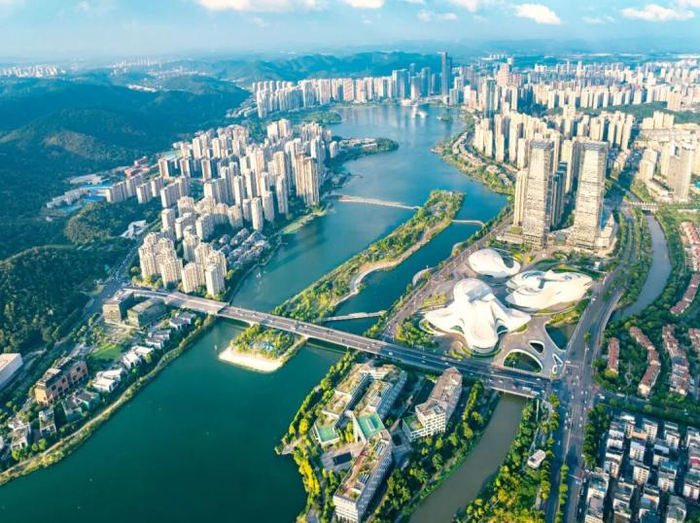
湖南湘江新区:一条产业“金腰带”
Zhong Guo Xin Wen Wang· 2026-01-12 09:49
Core Viewpoint - The article emphasizes the transformation of Hunan Xiangjiang New Area from a competitive landscape of individual enterprises to a collaborative ecosystem where companies thrive together, forming a robust industrial chain and enhancing regional economic strength [1][3][24]. Economic Growth - During the "14th Five-Year Plan" period, the GDP of Xiangjiang New Area is projected to cross three trillion yuan milestones, entering the "500 billion club" [1]. - The area is expected to develop three trillion-yuan industrial clusters in engineering machinery, electronic information, and new materials, accelerating the formation of a modern industrial system [1][4]. Industrial Ecosystem - The industrial development in Xiangjiang New Area follows a clear path from attracting single enterprises to forming collaborative industrial clusters, enhancing resource efficiency and innovation [3][4]. - The ecosystem is characterized by a "chain ecology" that supports innovation and value circulation, with significant contributions from major enterprises like Hunan Dongying Carbon Materials and others [5][7]. Collaborative Advantage - The engineering machinery cluster is projected to achieve a total output value exceeding 150 billion yuan by 2024, with the new generation information technology cluster generating over 130 billion yuan, accounting for 72.2% of the provincial output [10]. - The establishment of an "hourly industrial ecosystem" around leading companies like Zoomlion enhances production efficiency and resilience against market fluctuations [7][10]. Policy Support - A three-tier policy collaboration system has been established to support industrial upgrades, focusing on innovation-driven development and providing continuous subsidies to key industry players [19][21]. - The implementation of targeted policies has effectively addressed common challenges in industrial upgrades, fostering a unique path for collaborative industrial development [19][21]. Future Prospects - The Xiangjiang New Area is positioned to capitalize on future industrial opportunities in fields such as artificial intelligence, quantum technology, and life sciences, supported by a solid industrial foundation and a mature innovation ecosystem [23][24]. - The evolution of the industrial landscape from isolated enterprises to interconnected clusters signifies a shift towards a collaborative and symbiotic growth model, enhancing the region's competitive edge [24].

广东吸引外资三重跃迁背后的开放进阶
2 1 Shi Ji Jing Ji Bao Dao· 2025-09-29 23:22
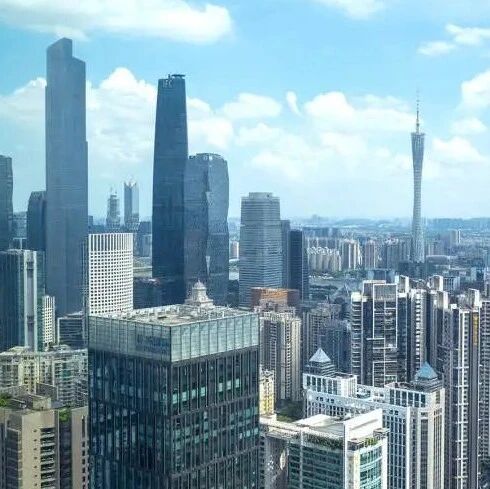
Core Insights - Guangdong is experiencing significant growth in foreign direct investment (FDI) despite a global decline, with new foreign enterprises increasing by 34% and actual FDI amounting to 70.87 billion yuan, a 9.4% increase year-on-year [1][2] - The province's ability to attract foreign investment is attributed to its strategic role in China's new development pattern and its strong industrial foundation [1][4] Summary by Sections Foreign Investment Growth - Guangdong established 21,000 new foreign enterprises from January to August this year, significantly outperforming the national average [1] - The actual FDI in Guangdong reached 70.87 billion yuan, contrasting with a national FDI decline of 13.4% in the same period [1][2] Historical Phases of Foreign Investment - The first phase (early reform to mid-1990s) saw Guangdong attract capital primarily from Hong Kong and Taiwan, focusing on labor-intensive industries [2] - The second phase (mid-1990s to around 2010) marked diversification of foreign investment sources, with a rise in technology-intensive sectors, establishing Guangdong as a global manufacturing hub [2][3] Current Trends in Foreign Investment - The third phase reflects a shift towards high-quality foreign investment, focusing on innovation and integration into local supply chains, with Guangdong becoming a center for advanced manufacturing [3][5] - The province is now a leader in strategic emerging industries like semiconductors, robotics, and biomedicine, with foreign investments increasingly directed towards R&D and innovation [5][6] Regional Development and Market Dynamics - The Guangdong-Hong Kong-Macau Greater Bay Area is transitioning from a "world factory" to a "global innovation hub," attracting foreign investment through high-level openness and industrial transformation [4][6] - Guangdong's large consumer market and geographical advantages are prompting foreign companies to shift their focus from international manufacturing to meeting local demand [7][8] Investment Environment and Policy Support - Guangdong has implemented a series of policies to enhance its investment environment, including measures to protect foreign investment rights and attract multinational corporations [9][10] - The province's proactive approach has resulted in over 100 investment promotion events this year, reinforcing its appeal to foreign investors [9] Future Outlook - The region is positioned as a key player in the global supply chain, with ongoing projects enhancing its manufacturing capabilities and market responsiveness [8][9] - Guangdong's commitment to innovation and collaboration is expected to further solidify its status as a preferred destination for foreign investment [12]
广东外资三重跃迁背后的开放进阶
21世纪经济报道· 2025-09-27 09:21
Core Viewpoint - Guangdong is successfully attracting foreign investment despite a global trend of caution, showcasing a strong "magnetic effect" that contributes to high-level openness and economic growth [1][3]. Summary by Sections Foreign Investment Performance - In the first eight months of this year, Guangdong established 21,000 new foreign-funded enterprises, a year-on-year increase of 34%, with actual foreign direct investment (FDI) amounting to 70.87 billion yuan, up 9.4% year-on-year, both significantly outperforming national averages [1][3]. Stages of Foreign Investment Utilization - The evolution of foreign investment in Guangdong can be divided into three significant stages, each reflecting changes in national development and global industrial patterns [4][5]. - The initial stage (early reform to mid-1990s) focused on labor-intensive industries, leveraging proximity to Hong Kong and Macau for capital and market access [5][6]. - The second stage (mid-1990s to around 2010) saw diversification of foreign investment sources, with a rise in technology-intensive sectors, establishing Guangdong as a global manufacturing hub [6][8]. - The current stage emphasizes high-quality development, with foreign investment shifting towards innovation-driven sectors, aligning with China's new development paradigm [8][9]. Transformation of Foreign Investment Structure - Guangdong is transitioning from a manufacturing base to a hub for advanced manufacturing and emerging industries, with a focus on sectors like semiconductors, robotics, and biomedicine [11][12]. - The region has become the largest producer of intelligent robots in China, accounting for 44% of the national output, and is attracting significant foreign investment in R&D and manufacturing [11][12]. Regional Market Dynamics - With a population of 128 million and a leading retail market, Guangdong is shifting foreign investment strategies from international manufacturing to catering to domestic demand [14][16]. - Major foreign companies are establishing production and R&D facilities in Guangdong to enhance local supply chain responsiveness [14][16]. Investment Environment Optimization - Guangdong has implemented a series of policies to attract foreign investment, including measures for investment promotion, rights protection, and enhancing the operational environment for foreign enterprises [18][19]. - The region has organized over 100 investment promotion activities this year, reinforcing its appeal to foreign investors [18][19]. Economic Transformation and Innovation - Guangdong's economic success is attributed to the synergy between reform and economic transformation, fostering a competitive environment for innovation and attracting global resources [20][21]. - The Guangdong-Hong Kong-Macau Greater Bay Area is positioned as a strategic region for innovation, with a strong emphasis on technology and manufacturing integration [21][22].
两岸青年艺术家在沪携手探寻“创新共生”
Xin Hua Wang· 2025-06-29 03:07
Group 1 - The "2025 Cross-Strait Youth Artists Exchange Exhibition" opened in Shanghai, featuring works from 17 mainland artists and 12 Taiwanese artists, emphasizing the theme of "same origin and shared flow, innovation and symbiosis" [1][2] - The exhibition aims to foster deep exchanges between young artists from both sides, exploring cultural identity and future collaborative paths [1] - The event is organized by the Shanghai Taiwan Association's Cultural and Creative Committee and will be open to the public until July 27 [2] Group 2 - The exhibition is seen as a significant cultural project under the "Shanghai Minhang·Taiwan Month" series, highlighting the importance of artistic dialogue between the two regions [1] - Participants expressed a desire for more creative collaborations and exchanges, emphasizing the unique connection and resonance felt during face-to-face interactions [1] - The exhibition is not only a showcase of artistic talent but also a representation of the aspirations and voices of young artists from both sides of the Taiwan Strait [2]