
利差优势

Search documents
Exness: 宏观分化、联储独立性危机与美元的结构性前景
Sou Hu Cai Jing· 2026-02-11 06:46
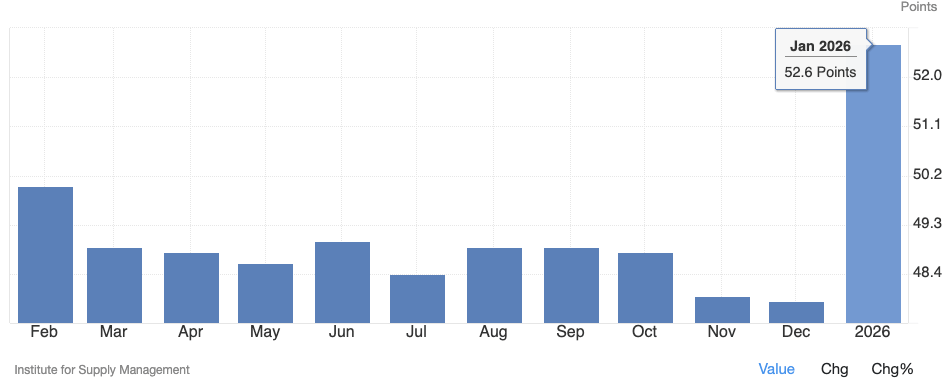
Group 1: Manufacturing Sector - The ISM Manufacturing PMI for January recorded at 52.6, significantly higher than the previous value of 47.9, indicating a shift into the expansion zone [1] - The surge in the new orders index suggests a proactive inventory replenishment by businesses, indicating a solid demand for future production [3] - The stability in the prices index, despite the recovery in demand, presents a favorable scenario for the Federal Reserve, as it indicates economic growth without immediate inflationary pressures [3] Group 2: Consumer Confidence - The Conference Board's consumer confidence index plummeted to 84.5, the lowest level since May 2014, signaling a significant psychological alarm despite the manufacturing sector's strength [6] - The Michigan Consumer Sentiment Index showed a slight rebound to 57.3, but this reflects more on the wealth effect from rising stock markets rather than the broader middle-class sentiment [8] - The key "expectations index" fell to 65.1, historically indicating a potential recession when below 80, highlighting consumer pessimism despite stable unemployment rates [11] Group 3: Economic Implications - Consumer spending, which constitutes 70% of the US GDP, is at risk if low confidence translates into reduced retail sales, potentially undermining the manufacturing recovery [13] - The upcoming retail sales data is critical, as a validation of the confidence index's decline could lead to a rapid loss of the dollar's growth premium [13] - The labor market data, particularly the non-farm payroll (NFP) report, is delayed, creating uncertainty in market expectations regarding employment and economic health [14] Group 4: Labor Market Dynamics - The consensus expectation for January's NFP is a weak 70,000 jobs, significantly below the 150,000 to 200,000 needed to maintain labor market balance, raising concerns about potential downward revisions of previous employment data [14][15] - The JOLTS data indicates a sharp decline in job openings to 6.54 million, the lowest in over five years, suggesting a cooling demand in the labor market [17] - If the NFP data confirms the downward trend in job openings, it could lead to a significant reassessment of the Federal Reserve's interest rate policies and negatively impact the dollar [17][21] Group 5: Federal Reserve and Monetary Policy - The Federal Reserve's current stance of maintaining higher interest rates is under pressure from political and economic uncertainties, potentially leading to a more cautious approach to rate cuts [18][21] - The market is pricing in a potential shift in monetary policy, with the probability of a rate cut in March being closely monitored [20][21] - The dual pressures of political noise and economic data deterioration could challenge the Fed's resolve to keep rates high, impacting the dollar's strength [22]

澳元鹰派政策 利差优势凸显
Jin Tou Wang· 2026-01-30 03:01
Core Viewpoint - The Australian dollar (AUD) has shown strong performance against the US dollar (USD) and is positioned as a leading currency among G10 currencies, driven by monetary policy divergence and robust commodity prices [1][2][3]. Group 1: Currency Performance - As of January 30, 2026, the AUD/USD exchange rate reached 0.7016, with a year-to-date increase of nearly 4% [1]. - The AUD has consistently broken key resistance levels against the USD, reaching a 16-month high of 0.6931 on January 26 and further climbing to 0.7050 [1]. - The AUD/CNY exchange rate has shown high volatility, fluctuating between 4.86 and 4.90, indicating a strong overall performance since the beginning of the year [1]. Group 2: Monetary Policy Divergence - The Reserve Bank of Australia (RBA) has maintained a benchmark interest rate of 3.6% and indicated a shift towards potential rate hikes, contrasting with the US Federal Reserve's recent rate cuts [2]. - Australia's consumer inflation expectations rose to 4.7% in December 2025, exceeding the RBA's target range, which has strengthened the case for interest rate increases [2]. - The market is pricing in a nearly 50% chance of a rate hike in March, with predictions that the benchmark rate could rise to 3.85% [2]. Group 3: Commodity Prices and Economic Indicators - The AUD is closely linked to commodity prices, with recent strong performances in gold, copper, and iron ore, benefiting Australia's trade balance [3]. - Australia's GDP grew by 2.1% year-on-year in Q3 2025, and the unemployment rate fell to 4.1%, indicating a robust economic environment [3]. - The National Australia Bank's business survey showed a capacity utilization rate of 83.3%, reflecting strong operational performance across sectors [3]. Group 4: Market Sentiment and Technical Analysis - The USD index has weakened due to expectations of coordinated intervention to support the Japanese yen and rising concerns over US government debt [4]. - The AUD is viewed as a preferred alternative investment due to its high yield and solid fundamentals, with analysts expressing optimism about its future performance [4]. - Technical indicators suggest a clear bullish trend for the AUD/USD, with significant support levels identified at 0.7000 and 0.6931 [4]. Group 5: Future Outlook - Analysts from major banks predict that the AUD/USD could reach the 0.70 mark by the end of March 2026, with a probability exceeding 70% according to options market data [5]. - Despite the positive outlook, potential risks include a downturn in commodity prices, lower-than-expected interest rate hikes, and geopolitical tensions that could affect the AUD's performance [6]. - Key variables to monitor include the RBA's upcoming policy meeting, the Federal Reserve's meeting minutes, and changes in Chinese demand and commodity prices [6].
强势延续!英央行政策立场谨 慎利差优势支撑英镑
Jin Tou Wang· 2026-01-30 02:30
Core Viewpoint - The British pound is experiencing strength against major currencies, driven by a recovering UK economy and diverging monetary policies between the Bank of England and the Federal Reserve. Group 1: Economic Indicators - The UK economy shows unexpected recovery, with the S&P Global Composite PMI rising from 51.4 to 53.9, the highest in 21 months, surpassing market expectations of 52.0 [2] - December retail sales increased by 0.4% year-on-year, rebounding significantly from November's -0.3%, while wage growth of 3.8% exceeds the inflation rate of 3.2%, indicating stable purchasing power [2] - The unemployment rate rose to 5.1% in August-October 2025, the highest since 2021, with forecasts suggesting it may remain around 5.0% in 2026, potentially limiting economic recovery momentum [2] Group 2: Monetary Policy - The Bank of England cut the benchmark interest rate to 3.75% on December 18, 2025, marking the sixth cut since the easing cycle began in August 2024, with internal divisions among policymakers regarding further cuts [3] - Inflation showed signs of stickiness, with the CPI rising from a low of 3.2% in November to 3.4% in December, driven by increased tobacco taxes and holiday demand, leading to a cautious stance from the Bank of England [3] - Market expectations for rate cuts in February have dissipated, with predictions suggesting only 1-2 cuts throughout 2026, potentially delaying the first cut until after April [3] Group 3: Currency Trends - Diverging monetary policy expectations between the Bank of England and the Federal Reserve are enhancing the relative strength of the pound, with market expectations for two rate cuts by the Fed exceeding 70% [4] - The pound is benefiting from a weaker dollar, with the dollar index hitting its lowest since October, which has contributed to the pound's strength against the dollar [4] - The pound's technical indicators show a bullish trend, with the price breaking above previous resistance levels and maintaining an upward trajectory [4][5] Group 4: Market Predictions - Analysts have differing views on the pound's trajectory for 2026, with optimistic forecasts suggesting it could reach 1.40 against the dollar by mid-year, while cautious predictions indicate a potential drop below 1.3450 by March [6] - Concerns about slowing economic growth and political uncertainties are prevalent, with predictions of GDP growth slowing to 1.0% in 2026, which could impact market confidence [6]
法兴银行:澳元兑英镑汇率具备上行空间
Xin Lang Cai Jing· 2025-12-31 09:31
Group 1 - The strengthening of commodity and resource prices is expected to boost the Australian dollar [1] - The interest rate advantage of the British pound may gradually weaken by 2026 [1] - The current benchmark interest rate of the Bank of England is 3.75%, with expectations of at least a 25 basis point cut by 2026 [1] - The benchmark interest rate in Australia is 3.60%, with expectations of at least a 25 basis point increase next year [1] - The British pound has depreciated by 0.3% against the Australian dollar, reaching 2.0102 AUD [1]
利差优势+政策空间 印尼债券或成美联储降息最大赢家
Zhi Tong Cai Jing· 2025-08-07 04:08
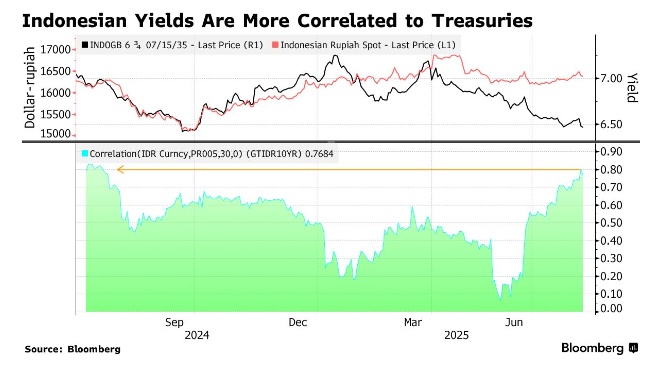
Group 1 - The expectation of interest rate cuts by the Federal Reserve is boosting the Asian bond market, with Indonesian bonds positioned to be the biggest beneficiaries [1][4] - Indonesian benchmark government bond yields are close to 6.5%, making them one of the highest-yielding sovereign bonds in Asia, which enhances the attractiveness of Indonesian rupiah bonds [1] - The Indonesian central bank's focus on stabilizing the currency allows for further monetary easing without the concern of currency depreciation, especially in a weakening dollar environment [1][3] Group 2 - The correlation between the dollar and Indonesian 10-year government bond yields has reached its highest level since July 2024, indicating that a weaker dollar will support the appreciation of the rupiah and lower bond yields [3] - Indonesian 10-year government bond yields fell by 9 basis points, marking the largest decline in emerging Asia, following a drop in U.S. Treasury yields due to disappointing non-farm payroll data [3] - The current yield spread between Indonesian and U.S. 10-year government bonds is approximately 220 basis points, which is 1.1 standard deviations below the five-year average, indicating increased sensitivity of Indonesian bonds to U.S. Treasury yield fluctuations [3] Group 3 - The expectation of further interest rate cuts by the Indonesian central bank is anticipated to alleviate some concerns regarding fiscal deficits, with the central bank having already cut rates by 75 basis points this year [3] - GAMA's De Mello predicts that the Indonesian central bank will implement at least two more 25 basis point cuts by the end of the year, supported by the Federal Reserve's easing cycle [4]
通胀超预期压制降息 澳元重获利差优势支撑
Jin Tou Wang· 2025-05-09 04:02
Group 1 - The Australian dollar (AUD) has strengthened against the US dollar (USD), currently trading around 0.6400, following a significant rise in Australian consumer inflation data that exceeded market expectations [1] - The unexpected increase in inflation has diminished market bets on further interest rate cuts by the Reserve Bank of Australia (RBA), leading to a reassessment of the AUD's interest rate differential advantage [1] - The current upward momentum of the AUD is supported by a robust domestic economic outlook compared to the uncertainty surrounding Federal Reserve policies, as well as a technical breakout that has attracted trend traders [1] Group 2 - A daily closing price for AUD/USD above the resistance zone of 0.6515-0.65156 would confirm a breakout and potentially open the path to 0.6549, which corresponds to the 38.2% retracement level of the decline from September to April [2] - Stronger upward momentum could extend to levels of 0.6699 and 0.6758, both of which are within long-term retracement ranges [2] - If the AUD fails to maintain above the 200-day moving average at 0.6461 and the short-term 50.0% retracement level at 0.6428, bearish sentiment may increase, with the previous range high at 0.6380 becoming a key support level [2]