
利率竞争

Search documents
2026全球数字货币新格局:三极分化与秩序重构丨未来实验室
Di Yi Cai Jing· 2026-01-12 12:40
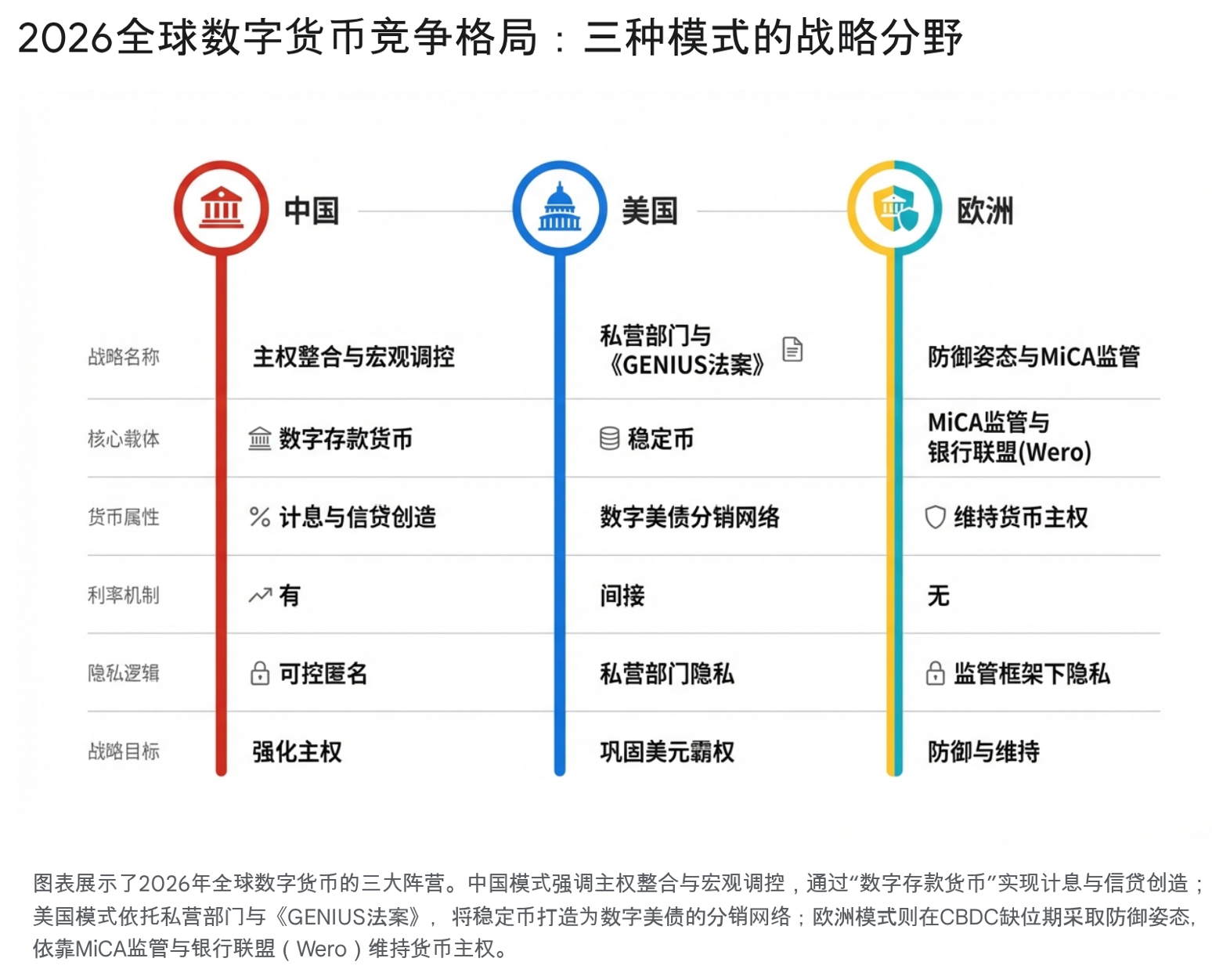
Core Viewpoint - The global monetary financial system has entered a new phase of "triple differentiation" as of January 2026, driven by the implementation of China's digital yuan (e-CNY), the U.S. GENIUS Act, and Europe's defensive alliances, marking a shift from mere payment efficiency improvements to a profound restructuring of the post-World War II Bretton Woods system [1] Group 1: China's Paradigm - The new digital yuan framework effective from January 1, 2026, signifies an expansion of monetary banking theory, transitioning from "M0 replacement" to a more financially expansive "digital deposit currency" paradigm [4] - The new framework introduces a dual balance sheet structure, where e-CNY balances are legally defined as commercial bank liabilities, allowing digital currency to participate in the fractional reserve system and enabling banks to use e-CNY as a stable source of liabilities for credit issuance [5] - The introduction of a market-based interest rate mechanism allows commercial banks to pay interest on e-CNY wallets, transforming e-CNY into a high-liquidity interest-bearing asset, enhancing its appeal for global trade partners seeking asset preservation [6] Group 2: U.S. Strategy - The U.S. GENIUS Act establishes a unique digital currency strategy by abandoning retail CBDC development and instead regulating private digital currencies to serve as digital extensions of U.S. dollar hegemony [8] - The Act mandates that compliant digital currencies maintain a 1:1 liquidity asset reserve, effectively converting global demand for liquidity into a rigid demand for U.S. Treasury securities, creating a decentralized "digital treasury bond" distribution network [8][9] - The U.S. retains control through stringent regulations on centralized issuers, allowing for immediate and irreversible actions against specific blockchain addresses, enhancing its regulatory reach [9] Group 3: Europe's Dilemma - Europe is in a defensive phase, delaying the digital euro until 2029 due to privacy concerns and legislative challenges, adopting a mixed strategy of regulatory barriers and banking alliances [10] - The MiCA regulation establishes strict localization requirements for digital currencies, driving out non-compliant offshore entities while creating space for compliant institutions [10] - The digital euro's legislative focus has shifted towards a conservative "offline-first" principle, limiting its programmability and online compatibility, while public debates continue regarding the necessity of a robust public digital euro [11] Group 4: Core Variables Reshaping Competition - Interest rate competition is emerging as a key variable, with the introduction of interest-bearing e-CNY challenging the traditional dominance of non-interest-bearing digital dollars [12] - Infrastructure is critical, with China's mBridge creating a decentralized network that bypasses traditional SWIFT structures, while the U.S. attempts to upgrade existing systems [12] - The rise of smart contracts is leading to a contest over the definition of rules, with China promoting state-defined codes and the U.S. favoring private sector standards [12] Conclusion - The year 2026 marks a significant differentiation in global digital currencies, where currency transcends mere value measurement to become an extension of state will, necessitating adaptation to these profound changes for future survival and development [13]

月内两家券商上调两融业务规模上限
Zheng Quan Ri Bao· 2025-09-25 23:31
Core Viewpoint - The brokerage industry is rapidly expanding its credit business, with several firms increasing their financing business limits in response to a favorable market environment for credit services [1][2]. Group 1: Industry Trends - As of June 30, 2023, the A-share market's margin trading balance reached 1.85 trillion yuan, leading to a 24% year-on-year increase in net interest income for the securities industry [2]. - By September 24, 2023, the margin trading balance in the A-share market hit a new high of 2.43 trillion yuan, accounting for 12.25% of the total A-share trading volume [2]. - Multiple brokerages, including Zheshang Securities and Hualin Securities, have raised their margin trading limits, indicating a strong belief in the growth potential of credit business [1][3]. Group 2: Company Strategies - Zheshang Securities increased its financing business limit from 40 billion yuan to 50 billion yuan to capitalize on market recovery opportunities, despite its margin trading balance being slightly below the market average [2]. - The company aims to enhance customer engagement through refined operations and improved service experiences, alongside expanding its client base for margin trading [2]. - Risk management is a priority for Zheshang Securities, employing strict pre-approval processes, various credit risk management tools, and ongoing post-investment risk management [3]. Group 3: Competitive Landscape - The surge in market financing demand is driving brokerages to increase their business scales, with smaller firms seeking to attract high-net-worth clients and active traders by raising their credit business limits [4]. - Despite the overall market recovery, brokerages face challenges in balancing scale and profitability due to competitive pressure on interest rates, with some smaller firms lowering rates below 4% [5]. - Leading brokerages like Guotai Junan and Huatai Securities dominate the market, while some listed firms reported negative net interest income in the first half of the year [5]. Group 4: Differentiation Strategies - Brokerages are adopting differentiated competition strategies, such as Oriental Securities focusing on high-net-worth client services and Guolian Minsheng utilizing precise customer targeting and tiered pricing [6].
