基础设施竞争

Search documents
为何比亚迪和蔚来都在疯狂“织网”?因为补能真的是下一张王牌
3 6 Ke· 2026-03-31 01:02
Core Viewpoint - The competition in the electric vehicle (EV) industry has shifted from product competition to infrastructure competition, focusing on charging efficiency as a critical factor for consumer experience and market dominance [1][3]. Group 1: Charging Network Models - BYD's fast charging network emphasizes broad coverage, where the value of each charging station is determined by its proximity and availability to users [5][6]. - NIO and CATL's battery swapping network focuses on compatibility and standardization, creating a platform that enhances user experience and reduces costs for car manufacturers [7][8]. - The fast charging network operates on a linear, one-dimensional externality model, while the battery swapping network benefits from cross-side network effects, leading to exponential growth as more users and manufacturers join [9][10]. Group 2: Cost Structures and Expansion Strategies - BYD's fast charging network has a clear cost model, allowing for rapid expansion through existing infrastructure, resulting in a high-speed growth characteristic [11][12]. - The battery swapping network requires significant capital investment in battery assets, leading to a slower, more cautious expansion strategy focused on high-density user areas [13][14]. Group 3: Capital Market Interest - The capital market is drawn to both fast charging and battery swapping models due to their distinct paths to infrastructure financialization, each representing significant asset transformation potential [15][20]. - Fast charging networks can be viewed as stable cash flow-generating assets, while battery swapping networks offer a more complex financialization opportunity through battery lifecycle management and data utilization [18][22]. Group 4: Competitive Landscape and Future Outlook - Both fast charging and battery swapping networks are expected to coexist, serving different market segments and user needs, with fast charging dominating the mainstream market due to its convenience [23][24]. - The future of the EV infrastructure will depend on standard-setting entities, with CATL's push for interoperability standards potentially reshaping the competitive landscape [26][25]. - The dual role of fast charging as a broad user service and battery swapping as a high-end service ecosystem will create a complementary relationship within the national energy strategy [27][29].



2026全球数字货币新格局:三极分化与秩序重构丨未来实验室
Di Yi Cai Jing· 2026-01-12 12:40
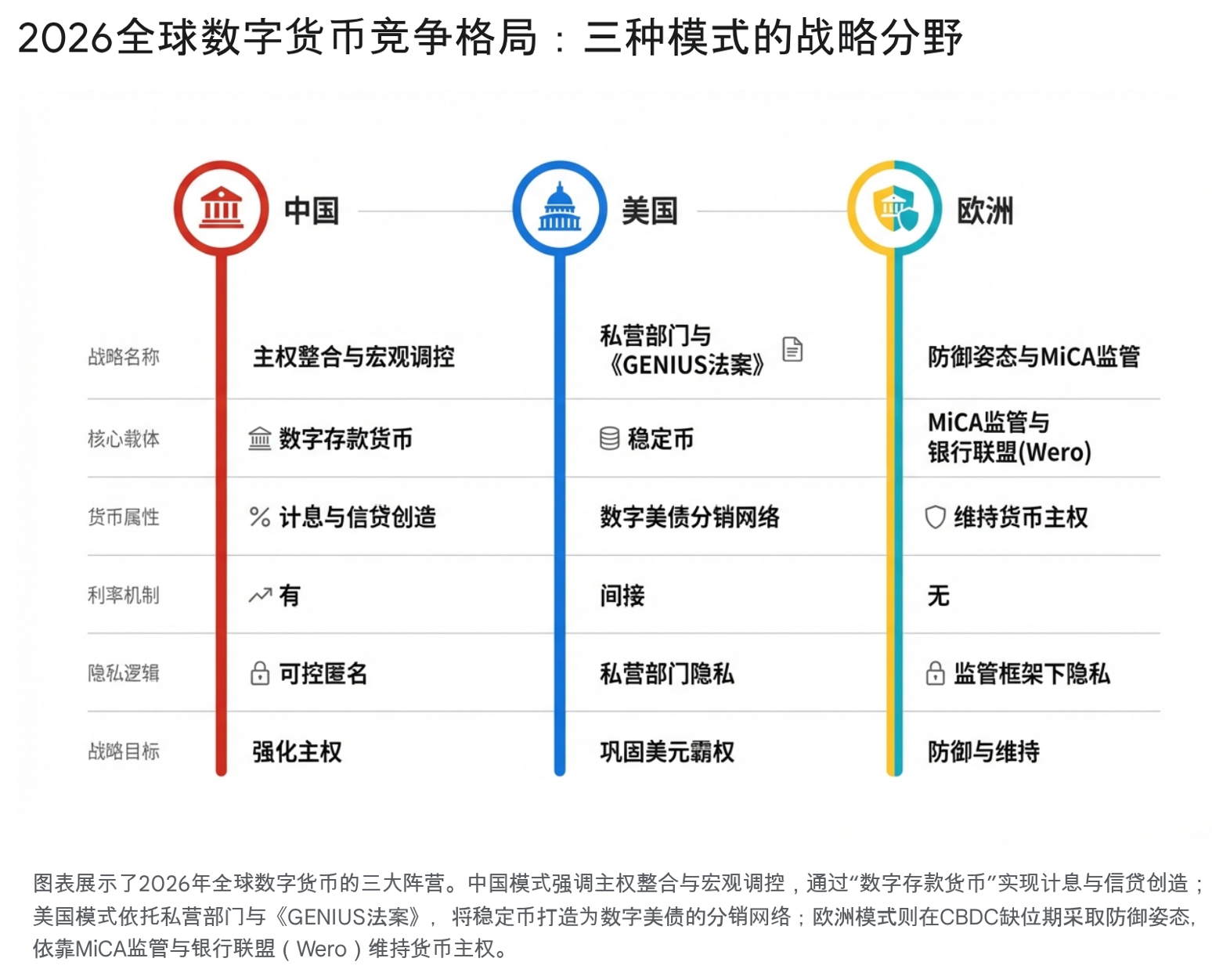
Core Viewpoint - The global monetary financial system has entered a new phase of "triple differentiation" as of January 2026, driven by the implementation of China's digital yuan (e-CNY), the U.S. GENIUS Act, and Europe's defensive alliances, marking a shift from mere payment efficiency improvements to a profound restructuring of the post-World War II Bretton Woods system [1] Group 1: China's Paradigm - The new digital yuan framework effective from January 1, 2026, signifies an expansion of monetary banking theory, transitioning from "M0 replacement" to a more financially expansive "digital deposit currency" paradigm [4] - The new framework introduces a dual balance sheet structure, where e-CNY balances are legally defined as commercial bank liabilities, allowing digital currency to participate in the fractional reserve system and enabling banks to use e-CNY as a stable source of liabilities for credit issuance [5] - The introduction of a market-based interest rate mechanism allows commercial banks to pay interest on e-CNY wallets, transforming e-CNY into a high-liquidity interest-bearing asset, enhancing its appeal for global trade partners seeking asset preservation [6] Group 2: U.S. Strategy - The U.S. GENIUS Act establishes a unique digital currency strategy by abandoning retail CBDC development and instead regulating private digital currencies to serve as digital extensions of U.S. dollar hegemony [8] - The Act mandates that compliant digital currencies maintain a 1:1 liquidity asset reserve, effectively converting global demand for liquidity into a rigid demand for U.S. Treasury securities, creating a decentralized "digital treasury bond" distribution network [8][9] - The U.S. retains control through stringent regulations on centralized issuers, allowing for immediate and irreversible actions against specific blockchain addresses, enhancing its regulatory reach [9] Group 3: Europe's Dilemma - Europe is in a defensive phase, delaying the digital euro until 2029 due to privacy concerns and legislative challenges, adopting a mixed strategy of regulatory barriers and banking alliances [10] - The MiCA regulation establishes strict localization requirements for digital currencies, driving out non-compliant offshore entities while creating space for compliant institutions [10] - The digital euro's legislative focus has shifted towards a conservative "offline-first" principle, limiting its programmability and online compatibility, while public debates continue regarding the necessity of a robust public digital euro [11] Group 4: Core Variables Reshaping Competition - Interest rate competition is emerging as a key variable, with the introduction of interest-bearing e-CNY challenging the traditional dominance of non-interest-bearing digital dollars [12] - Infrastructure is critical, with China's mBridge creating a decentralized network that bypasses traditional SWIFT structures, while the U.S. attempts to upgrade existing systems [12] - The rise of smart contracts is leading to a contest over the definition of rules, with China promoting state-defined codes and the U.S. favoring private sector standards [12] Conclusion - The year 2026 marks a significant differentiation in global digital currencies, where currency transcends mere value measurement to become an extension of state will, necessitating adaptation to these profound changes for future survival and development [13]