制造业竞争

Search documents
来自印度教授的自信:2026年,印度的制造业比中国要强的多
Sou Hu Cai Jing· 2026-02-23 02:43
Core Viewpoint - The article discusses the contrasting views on India's manufacturing sector, particularly the claim that it will surpass China's by 2026, highlighting the gap between optimistic projections and current data [3][4]. Group 1: Manufacturing Rankings and Data - According to the 2026 Asia Manufacturing Index by Synergy Consulting, China ranks first while India remains at sixth, unchanged from the previous year [4]. - The report evaluates 11 Asian economies across eight dimensions, confirming China's leading position in manufacturing [4]. Group 2: India's Strengths and Weaknesses - India has advantages such as a large labor force and a growing domestic market, supported by government incentives for manufacturing [6]. - However, India's manufacturing sector suffers from high logistics costs, complex tax compliance, and weak infrastructure, which hinder its overall competitiveness [6][10]. Group 3: Comparison with China - The article emphasizes that manufacturing strength is determined by scale, efficiency, and supply chain capabilities, not just low costs [8]. - China maintains its position as a global manufacturing hub due to its comprehensive control over the entire supply chain, while India primarily functions as an assembly hub [8][12]. Group 4: Current Challenges for India - India's manufacturing PMI growth has slowed significantly, with declines in production, exports, hiring, and procurement [10]. - External pressures such as geopolitical tensions, trade fragmentation, and tightening global financing are particularly detrimental to India's manufacturing sector [10]. Group 5: Future Outlook - While India's manufacturing sector is expected to strengthen by 2026, it is unlikely to fully surpass China based on current data and structural conditions [17]. - The article concludes that manufacturing success is not determined by bold predictions but by the ability to manage every aspect of production and logistics effectively [17].


多么痛的领悟,美国专家:这辈子,美国都别想赢过中国制造业
Sou Hu Cai Jing· 2025-10-13 02:48
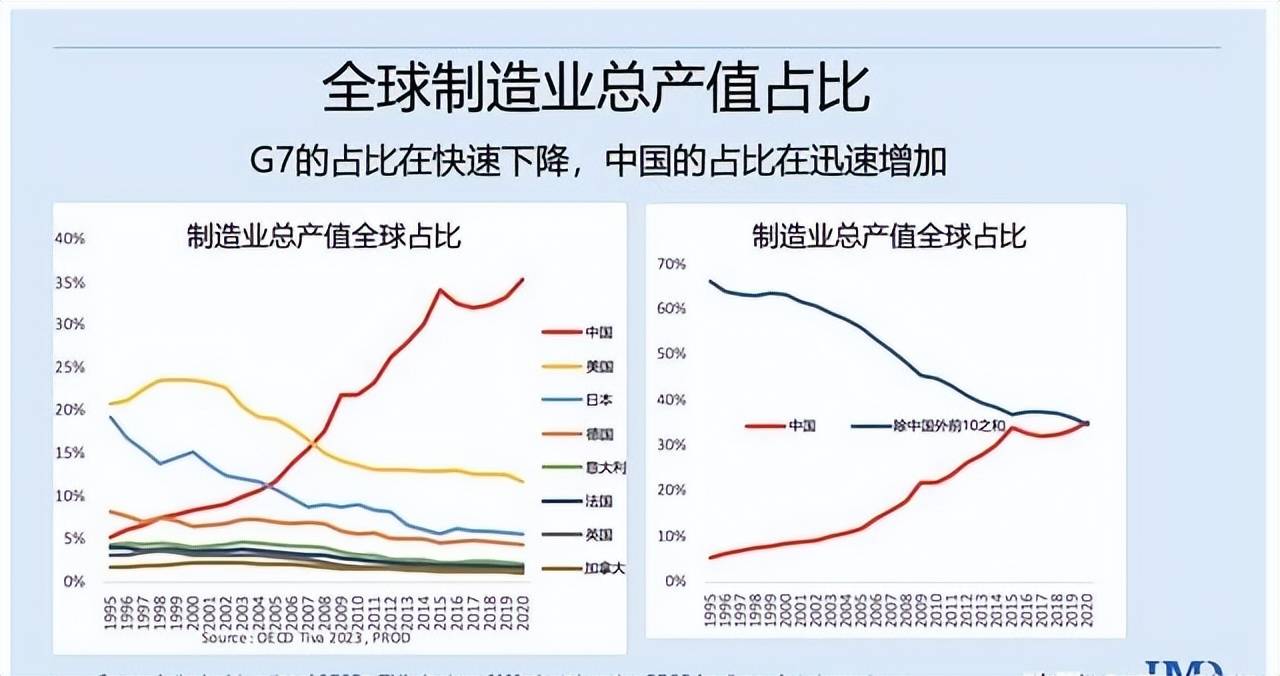
Group 1 - The decline of the U.S. manufacturing sector began as early as the 1960s, with cities like Detroit now facing desolation and abandoned factories [2] - The U.S. economy benefits from the global dominance of the dollar, capturing 80% of global profits, while manufacturing profits remain low at around 10% [4] - The U.S. manufacturing capacity has significantly diminished, with the shipbuilding industry now only at 1/200th of China's capacity [4] Group 2 - China's manufacturing sector has grown robustly, accounting for 35% of global manufacturing output, surpassing the combined total of the U.S., Japan, and Germany [5] - In 2023, China's automobile exports exceeded those of Japan, marking a significant shift in global market dynamics [6] - China's trade surplus is projected to rise from $380 billion in 2014 to $992 billion in 2024, while the U.S. trade deficit is expected to grow from $342.6 billion to $918.4 billion in the same period [6] Group 3 - China has surpassed the EU in R&D investment, ranking second globally after the U.S., leading to numerous innovative achievements [7] - The rapid development of Chinese companies in AI and biotechnology showcases the country's growing competitiveness in high-tech sectors [7] - The competition in manufacturing is fundamentally about talent and institutional frameworks, with China having cultivated a large pool of technical talent over decades [10]