加密货币安全

Search documents
Jupiter 强制导入助记词领 ASR 奖励引发安全争议
Xin Lang Cai Jing· 2026-01-31 09:10
Core Viewpoint - The launch of Q4 staking ASR rewards by the Solana ecosystem trading platform Jupiter has sparked community controversy due to security concerns related to requiring users to import their seed phrases into the Jupiter wallet to claim rewards [1] Group 1 - Jupiter's new reward system is perceived as posing security risks for users, particularly those using non-custodial wallets or wallets without private keys [1] - The company has acknowledged the concerns and stated that it will support direct reward claims from other wallets within 1-2 weeks [1]
500枚比特币,黑客盗走490枚,留了10枚给“我”当作生活费
Sou Hu Cai Jing· 2025-12-22 12:41
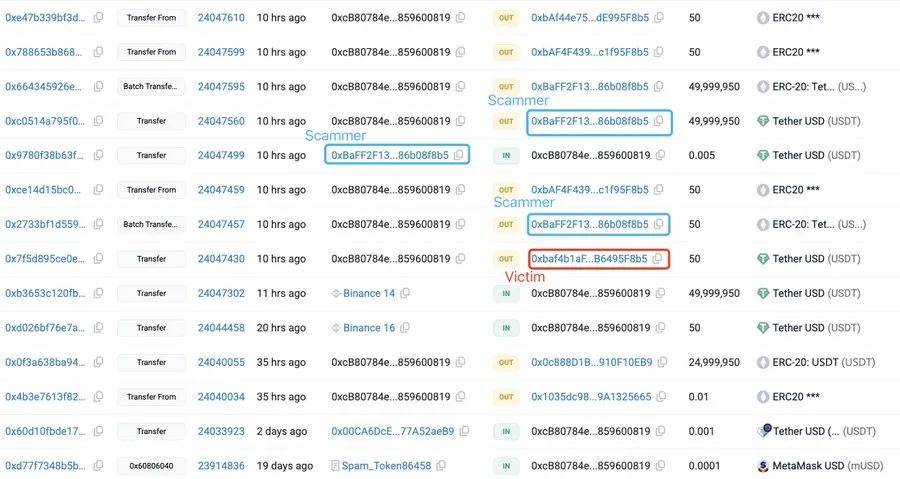
Core Insights - The cryptocurrency world is depicted as a "dark forest" filled with both extraordinary wealth and significant risks, highlighted by contrasting experiences of individuals within the space [1] - A recent incident involving a trader losing nearly $50 million in a sophisticated "address poisoning attack" underscores the vulnerabilities in cryptocurrency transactions [2][3] - The narrative emphasizes the importance of security practices in the cryptocurrency industry, particularly regarding private key management and transaction verification [7][10] Group 1: Incident Analysis - Chun Wang, co-founder of F2Pool, shared a personal experience of losing 490 bitcoins while testing the security of a wallet address, which sparked widespread discussion in the crypto community [1][2] - The trader's loss was a result of a meticulously planned attack that exploited human error and trust in transaction history, leading to a significant financial loss [3] - The attack involved creating a fake address that closely resembled the victim's real address, demonstrating the need for heightened awareness and security measures among users [3] Group 2: Broader Implications - The incident reflects a growing trend of cryptocurrency-related crimes extending beyond the digital realm, as evidenced by bomb threats made to major companies in South Korea demanding bitcoin payments [4][6] - The psychological impact of such threats on businesses and society highlights the need for improved security protocols and user education within the cryptocurrency sector [6] - The industry must take responsibility for enhancing security features in wallets and educating users about emerging threats to prevent similar incidents in the future [7][10] Group 3: Security Recommendations - Users are advised to always copy addresses from original, trusted sources and to avoid selecting addresses from transaction history to mitigate risks [8] - Implementing multi-step verification processes and using address books or domain name services can help reduce the likelihood of errors during transactions [8] - The overarching message is that individuals must take personal responsibility for their asset security in the decentralized cryptocurrency landscape [10]

12.7万枚比特币“黑吃黑”背后:加密货币的安全困局与洗钱暗网
Hua Xia Shi Bao· 2025-11-14 13:37
Core Insights - The article discusses the significant rise in the value of 127,000 Bitcoins, from $3.5 billion five years ago to $15 billion today, linked to a hacking incident involving the LuBian mining pool and the subsequent seizure by the U.S. government, highlighting the complexities of cryptocurrency security and crime [2][7]. Group 1: Incident Overview - The LuBian mining pool was hacked on December 29, 2020, resulting in the theft of approximately 127,000 Bitcoins, valued at around $3.5 billion at the time, which has now increased to $15 billion [2][4]. - The stolen Bitcoins were linked to Chen Zhi, the chairman of the Cambodian Prince Group, who attempted to negotiate with the hackers for their return but received no response [4][6]. - The U.S. government announced the seizure of these Bitcoins in October 2025, claiming they were obtained through hacking, indicating a "black eats black" scenario [2][5]. Group 2: Security Implications - The incident reveals vulnerabilities in the security of non-custodial wallets, which are often perceived as safe havens for cryptocurrency [3][5]. - The LuBian mining pool's private key generation algorithm was flawed, relying on a 32-bit random number instead of the recommended 256-bit standard, making it easier for hackers to exploit [5][6]. - The event underscores the importance of robust cybersecurity measures in the digital economy and the need for better random number generation practices in cryptocurrency systems [6][9]. Group 3: Criminal Activity and Money Laundering - Chen Zhi's operations involved a complex money laundering scheme utilizing Bitcoin, with a significant portion of illicit funds being funneled through various transactions to evade detection [8][10]. - The global scale of cryptocurrency-related money laundering has reached over $120 billion, accounting for 15% of criminal financial flows, indicating a growing trend in the use of digital currencies for illegal activities [8][10]. - The article emphasizes the challenges faced by law enforcement in tracking and regulating cryptocurrency transactions due to the anonymity and cross-border nature of these assets [9][10].

美国司法部没收12.7万枚比特币,所谓绝对安全的加密钱包为何如此不堪一击?
Sou Hu Cai Jing· 2025-10-27 05:07
Core Insights - A significant technical vulnerability has led to the seizure of $15 billion worth of cryptocurrency by the U.S. Department of Justice, marking the largest cryptocurrency confiscation in its history [1][3] - The seized Bitcoin was not stored in regulated exchanges but in a non-custodial wallet controlled by the founder of the criminal group, Chen Zhi, which was expected to be secure [1][3] Group 1: Criminal Activities and Financial Losses - Chen Zhi, a dual national of the UK and Cambodia, has been accused of using his business network to operate at least ten fraudulent "forced labor camps" in Cambodia since 2015 [3] - The U.S. Treasury estimates that losses from online investment scams in the U.S. have exceeded $50 billion in recent years, with a 66% increase in losses due to Southeast Asian scams in 2024 alone [3] Group 2: Money Laundering Techniques - The criminal group established a complex money laundering system using "spraying" and "funneling" techniques to manage illicit funds [3] - "Spraying" involves breaking large sums into numerous small amounts and distributing them across many new Bitcoin addresses, while "funneling" consolidates these dispersed funds back into a few core addresses [3] Group 3: Technical Vulnerabilities - Experts suggest that the U.S. government may have cracked the non-custodial wallet through various means, including potential cooperation from the group's technical staff under judicial pressure [6] - A critical flaw identified was the use of a 32-bit integer for the random number generator, drastically reducing the private key space and making it susceptible to brute-force attacks [6][8] Group 4: Regulatory Implications - The U.S. government is shifting its stance on Bitcoin, viewing it as a strategic national asset rather than merely a tool for crime, as evidenced by recent executive orders and proposed legislation [11] - The establishment of a comprehensive public plan for the custody of federal digital assets indicates a move towards regulatory oversight in the cryptocurrency space [11] Group 5: Security Myths and Recommendations - The incident highlights a critical vulnerability in the perceived security of Bitcoin, emphasizing that randomness quality is essential for private key security [8][14] - Experts recommend using verified, open-source non-custodial wallets and hardware wallets to enhance security, along with strict measures to protect mnemonic phrases and private keys [14][16]

吴说每日精选加密新闻 - 美联储下调利率上限至 4.25%,符合市场预期
Sou Hu Cai Jing· 2025-09-18 14:29
Group 1 - The Federal Reserve has lowered the federal funds rate ceiling by 25 basis points to 4.25%, aligning with market expectations, with indications of at least three more rate cuts expected this year [1] - Initial jobless claims in the U.S. for the week ending September 13 were reported at 231,000, below the expected 240,000, with the previous week's figure revised to 264,000 [1] - Binance founder CZ has warned crypto projects about North Korean hacking threats, advising them to carefully screen candidates and train employees to avoid downloading files [1] Group 2 - Vitalik Buterin addressed the controversy surrounding Ethereum staking exit times, stating that quick exits could undermine trust in offline nodes, and noted that the current exit queue design has room for improvement [2] - The Ethereum validator exit queue currently holds a total of 2,497,293 ETH, with an estimated wait time of 43 days and 9 hours, while the entry queue has 466,560 ETH with an estimated wait time of 8 days and 2 hours [2] Group 3 - Ramil Ventura Palafox, CEO of Praetorian Group International, has pleaded guilty to operating a $200 million Bitcoin Ponzi scheme, facing charges of telecommunications fraud and money laundering [3] - Palafox misled over 90,000 investors globally, raising more than $201 million, resulting in total investor losses of at least $62.69 million [3] - Sentencing for Palafox is scheduled for February 3, 2026, where he could face up to 40 years in prison [3]
Bitget启动第二年度“反诈骗月”活动,旨在打击日益猖獗的网络诈骗
Globenewswire· 2025-06-04 12:05
Core Viewpoint - Bitget has launched its second annual "Anti-Scam Month" to enhance public awareness of cryptocurrency security, emphasizing that safety is a shared responsibility between the platform and its users [2][3]. Group 1: Anti-Scam Month Initiative - The initiative aims to transform fear into empowerment and confidence under the theme "Smarter Eyes, Stronger Shields," incorporating gamified education, community storytelling, and interactive content [3]. - Bitget has established an Anti-Scam Center, featuring various interactive resources, a social media campaign, a series of safety blogs, and a mini-game called "Wise Eye Challenge" [3][4]. - The initiative is supported by a growing network of security experts and top security companies, including GoPlus, SlowMist, OneKey, BlockSec, and Security Alliance, to promote safety awareness [3][4]. Group 2: Collaboration and Community Engagement - The campaign has received strategic support from other notable Web3 participants like Bitget Wallet, Morph, and Tapswap, reflecting a broader commitment to a safer Web3 ecosystem [4]. - Bitget's CEO, Gracy Chen, stated that building a secure Web3 future is a collective mission, emphasizing that protecting users is not just a technical responsibility but a shared goal [4][5]. - In addition to user-focused activities, Bitget will collaborate with Slowmist and Elliptic to release the "2025 Anti-Scam Report," analyzing evolving scam tactics and showcasing how Bitget enhances its internal systems to mitigate security threats [4][5]. Group 3: Industry Context and Future Outlook - The cryptocurrency sector has seen a significant rise in scams, with losses exceeding $9.9 billion in 2024 and a 24% annual growth rate since 2020 [2][5]. - As the industry grows, the need for enhanced security measures and awareness becomes increasingly critical, with predictions that deepfake technology could account for about 70% of cryptocurrency crimes in the next two years [5]. - Bitget is committed to promoting safety awareness and education in collaboration with the global community and renowned security institutions [5].

美国最大加密货币交易所Coinbase陷数据泄露危机,损失或高达4亿美元,加密货币安全如何保障?
Mei Ri Jing Ji Xin Wen· 2025-05-17 01:54
Core Insights - Coinbase disclosed a significant data breach involving bribery of overseas customer service personnel to steal customer data for social engineering attacks, with estimated costs and customer compensation ranging from $180 million to $400 million [1][5][6] - The incident occurred just before Coinbase's inclusion in the S&P 500 index, effective May 19, raising concerns about the company's internal security management [2][9] Financial Impact - The breach led to a 7.2% drop in Coinbase's stock price, resulting in a market value loss of $4.8 billion in a single trading day [1][6] - Coinbase has committed to fully compensating affected users and is cooperating with law enforcement to identify the attackers [5][6] Security Challenges - The incident highlights multiple security challenges faced by cryptocurrency exchanges, particularly in internal trust systems and the application of new technologies [2][12] - Analysts emphasize the need for implementing the "least privilege principle" and advanced privacy protection technologies to safeguard sensitive data [2][12][13] Data Breach Details - The stolen data included names, contact information, partial social security numbers, bank account identifiers, government ID photos, and certain company and account data, affecting less than 1% of total users [5][6] - The attackers demanded a ransom of $20 million in Bitcoin, which Coinbase refused, instead offering a reward for information about the criminals [6][12] Industry Context - This breach follows a series of high-profile attacks in the cryptocurrency sector, including the recent hack of Bybit, which resulted in estimated losses of nearly $1.5 billion [11] - The evolving tactics of cybercriminals underscore the ongoing arms race between hackers and security professionals in the cryptocurrency ecosystem [10][12]