原创性科研

Search documents
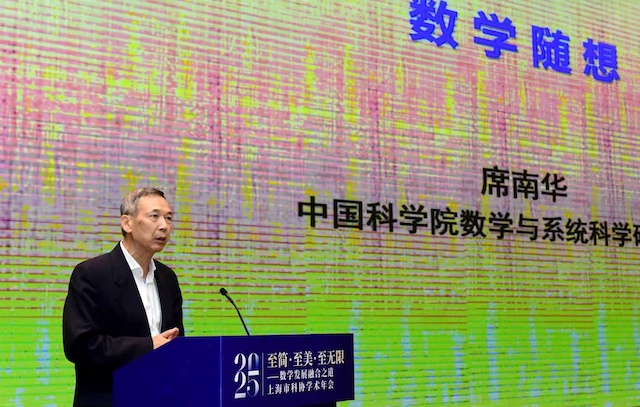
席南华院士:减少对顶级期刊的盲目崇拜
Di Yi Cai Jing· 2025-11-04 06:35
Core Viewpoint - The article discusses the need for China’s mathematics discipline to transition from a "follower" to a leading position in originality, emphasizing the importance of institutional adjustments and cultural changes in academic attitudes [1]. Group 1: Current State of Mathematics in China - China's mathematics has made significant progress but remains largely in a "follower" position, primarily developing in fields pioneered by others rather than creating original contributions [1]. - The underlying cultural and institutional factors contribute to this status, necessitating improvements in evaluation systems, academic independence, and emotional investment in scholarship [1]. Group 2: The Beauty of Mathematics - The beauty of mathematics is categorized into two types: aesthetic beauty in forms and logical beauty in abstract thinking and proofs, exemplified by classic proofs such as the infinitude of primes and the irrationality of the square root of 2 [2]. - The richness of mathematical objects and the depth of thought are highlighted through the work of Riemann on prime distribution, showcasing the profound nature of mathematics [2]. Group 3: Role of Educators and Academic Environment - The role of teachers is crucial in helping students appreciate the beauty of mathematics; reducing utilitarian pressures can enhance students' engagement with the structural and proof-based beauty of mathematics [3]. - Encouraging academic independence and a genuine pursuit of knowledge, rather than blind worship of top journals, is essential for fostering originality in research [3][4]. - A more tolerant academic ecosystem that allows for failure and long-term exploration is necessary, as true originality often faces misunderstanding or challenges in existing review mechanisms [4]. Group 4: Long-term Perspective in Research - A long-term perspective and independent spirit in research are vital, with scholars encouraged to find joy in the pursuit of knowledge rather than in the chase for accolades [4]. - Historical contributions of mathematicians who did not receive awards should remind young scholars to focus on the lasting value of their work rather than short-term recognition [4].

“新基石50 论坛”在深圳开幕
Zhong Zheng Wang· 2025-09-22 04:52
Core Insights - The "New Cornerstone 50 Forum" focuses on the theme of "Technological Innovation Driving Sustainable Development" and aims to foster discussions on the relationship between fundamental research, disruptive technologies, and sustainable development [1][2] - The forum has been held annually for five years, providing a platform for scientists from various fields to engage in cross-disciplinary dialogue [1] - The event gathered around 500 participants, including renowned scholars and award winners, to discuss enhancing China's originality in scientific research [1][2] Group 1: Forum Overview - The forum is co-hosted by Tencent's Sustainable Social Value Division, the New Cornerstone Science Foundation, and Southern University of Science and Technology [1] - The "Square Dialogue" roundtable will be introduced in 2025 to facilitate discussions on optimizing research environments and reforming evaluation systems [1] Group 2: Scientific Contributions - Professor Yu Hongtao emphasized the need for scientists to avoid biases in familiar fields to recognize original contributions [2] - Academician Zheng Nanfeng highlighted that originality can stem from both novel ideas and innovative combinations of existing principles [2] - Academician Xie Xiaoliang discussed the transformative impact of big data and AI on biomedical research, providing sustainable solutions for long-standing health risks [2] Group 3: Breakthroughs and Future Directions - Academician Xue Qikun shared breakthroughs in unconventional high-temperature superconductors, stressing the importance of curiosity and collaboration in achieving original innovations [3] - Tencent's Senior Vice President Xi Dan noted that interdisciplinary integration is becoming a core engine for technological innovation and will define future research paradigms [3]

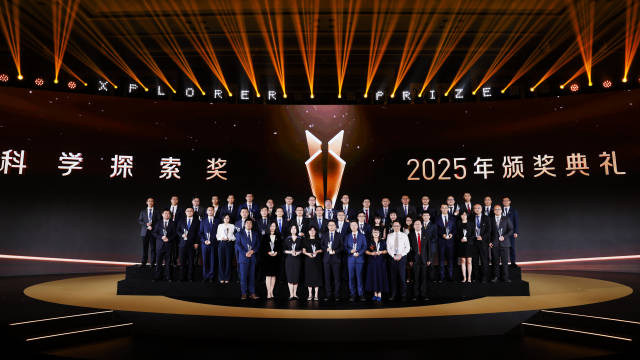
50位科学家获科学探索奖,颜宁向马化腾提出关于“生命”的建议
2 1 Shi Ji Jing Ji Bao Dao· 2025-09-21 03:26
Core Points - The "Science Exploration Award" ceremony was held on September 20 in Shenzhen, celebrating 50 award-winning scientists who are addressing significant scientific questions [1] - The award, funded by Tencent and operated by the New Cornerstone Science Foundation, aims to support top young scientists in China with a total of 3 million yuan over five years for each winner [3][10] - The award focuses on original innovation and aligns with national needs, with past winners achieving notable recognition in top scientific journals [4] Group 1: Award Details - This year, the award recognized research in various cutting-edge fields, including artificial retina repair, life identification in Martian rocks, and drug development for neurogenic hearing loss [3] - The award has a history of supporting 347 scientists over seven years, with 11 winners' research recognized as "Top Ten Scientific Advances in China" [4] - The award has expanded to cover 10 fields and has seen a broader representation from various regions and institutions, with winners from 15 cities and 33 institutions [8] Group 2: Demographics and Inclusivity - This year saw a record number of young scientists and female scientists among the winners, with 13 young scientists, including 6 born in the 1990s, and 9 female winners, making up 18% of the total [5][7] - The award has adjusted age criteria to encourage more female participation, reflecting a commitment to supporting women in research [7] - The introduction of "new star quotas" has attracted more young applicants, with 261 young scientists applying this year, nearly double from the previous year [7] Group 3: Long-term Commitment - Tencent's involvement in the award reflects a long-term commitment to supporting basic scientific research without commercial motives, aiming to contribute positively to society [10] - The initiative is seen as a way to leverage private funding to complement national scientific investment, allowing young scientists to focus more on research rather than financial concerns [10]