
原油波动率

Search documents
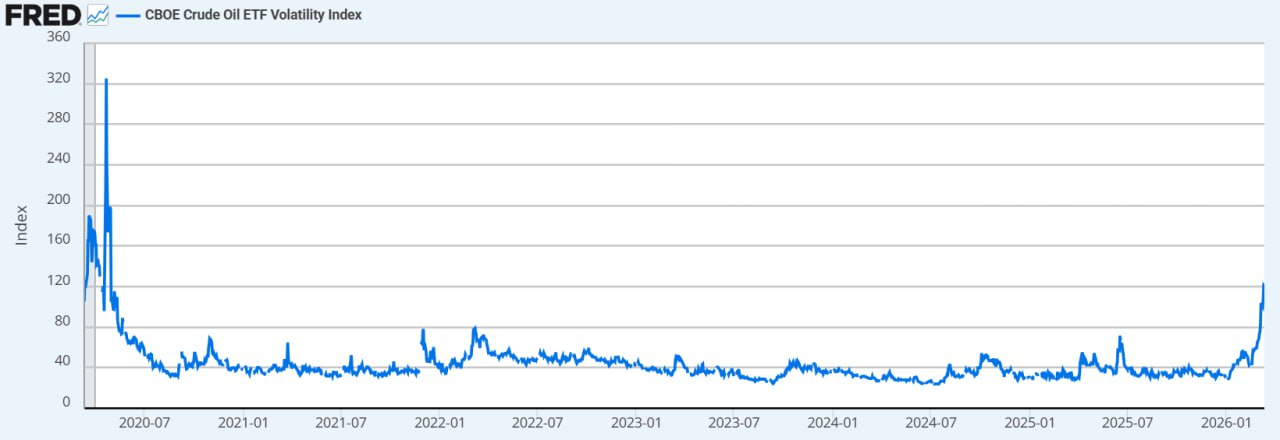
原油波动率 CBOE Crude Oil ETF Volatility 指数超过 120,创 2020 年负油价危机以来新高
Xin Lang Cai Jing· 2026-03-16 09:36
Group 1 - The core point of the article highlights that the CBOE Crude Oil ETF Volatility Index has surged to over 120, marking the highest level since the negative oil price crisis in 2020 [1] - The increase in oil volatility is primarily driven by conflicts in the Middle East and supply risks associated with the Strait of Hormuz, with oil prices briefly exceeding $100 [1] - Hyperliquid has emerged as a significant platform for oil trading during the weekend period [1]


长安期货范磊:中东政治动荡但波动维持 节前注意仓位控制可布局期权
Xin Lang Cai Jing· 2026-02-09 02:15
Financial Attributes - The U.S. Labor Statistics Bureau announced a delay in the release of the January non-farm payroll report to February 11 and CPI data to February 13 due to a recent government shutdown [3] - ADP data indicated that private sector employment in January increased by only 22,000 jobs, significantly below market expectations, reflecting a cooling labor market [3] - Market expectations for a potential interest rate cut by the Federal Reserve have increased following Trump's comments regarding his support for a candidate who does not advocate for rate hikes [3] Political Attributes - Recent geopolitical events have influenced oil prices, particularly the indirect negotiations between Iran and the U.S. in Muscat, Oman, which have eased market concerns about Middle Eastern tensions [4] - Despite positive initial negotiations, the situation remains uncertain as the U.S. has previously shot down an Iranian drone and Trump has urged American citizens to leave Iran, indicating potential challenges in reaching a substantial agreement [4][17] Fundamental Attributes - The commodity attributes of crude oil have not shown significant changes, but the EIA is expected to release its January energy outlook report, which previously lowered market demand expectations and increased forecasts for U.S. production declines [8][21] - OPEC+ has maintained its pause on production increases, but the market remains skeptical, trading on the premise of a loose supply side, which could become a core factor affecting oil prices as geopolitical tensions ease [21] Volatility Attributes - The crude oil volatility index has been on an upward trend, reaching nearly 52, matching last year's peak, indicating a loss of directional judgment in the market despite stable commodity and macro attributes [10][24] - Future geopolitical escalations in the Middle East could lead to rapid price increases, while any de-escalation may result in a quick retraction of geopolitical risk premiums, suggesting significant volatility potential regardless of the direction of oil prices [10][24] Overall Market Sentiment - Oil prices have shown weakness as the market begins to retract previous geopolitical risk premiums amid ongoing U.S.-Iran negotiations [13][27] - The fundamental supply-demand dynamics remain unchanged, but macroeconomic pressures from anticipated Fed rate cuts may alleviate some downward pressure on oil prices [27][28] - The core influencing factor on oil prices remains political attributes, with high uncertainty persisting, suggesting that energy markets will face considerable external volatility during the upcoming holiday period [28]

长安期货范磊:地缘不定波动率高涨,关注能源期权多配机会
Xin Lang Cai Jing· 2026-02-02 03:01
Financial Aspects - The Federal Reserve paused interest rate hikes as expected, indicating a stable approach before Powell's departure, with the U.S. economy showing steady expansion and a stabilizing unemployment rate, although inflation remains slightly high [3][13] - The Fed's statement removed references to rising "downside risks to employment" while emphasizing risks related to both employment and inflation, suggesting ongoing concerns about uncontrollable inflation [3][13] - Trump's nomination of Kevin Walsh as the next Fed Chair, who has promised to consider rate cuts, may lead to market volatility, especially with some Congressional opposition to the nomination [3][13] - Recent tariff changes include raising tariffs on certain goods from South Korea to 25% and imposing new tariffs on countries selling oil to Cuba, which could contribute to financial market instability [3][13] Political Aspects - The focus remains on U.S.-Iran relations, with Trump convening discussions with Saudi and Israeli representatives, interpreted as a sign of Gulf states' concerns about potential conflict [4][14] - Trump's comments on the nuclear deal negotiations indicate a narrowing window for resolution, with Iran facing a choice between abandoning nuclear ambitions or facing U.S. military action, heightening market expectations for conflict [4][14] - Trump's request to Putin to halt attacks on Kyiv has led to a temporary ceasefire, potentially easing tensions in Eastern Europe [4][14] Fundamental Aspects - The overall market performance showed no significant changes, with ongoing disputes over nuclear energy between the U.S. and Iran, and concerns about the Strait of Hormuz, where a potential escalation could disrupt nearly 20% of global oil flow [6][17] - The U.S. has increased its focus on South America, which may affect oil flows in and out of the region [6][17] Inventory Aspects - For the week ending January 23, API crude oil inventory decreased by 247,000 barrels, while EIA crude oil inventory fell by 2.295 million barrels, attributed to rising U.S. crude exports and a slight decline in domestic production [7][18] - Gasoline inventory increased for the 11th consecutive week, while refined oil inventory also rose, indicating continued accumulation that may pressure downstream prices [7][18] Options Market - Geopolitical disturbances have led to increased oil price volatility, with expectations that any escalation in U.S.-Iran conflict could further heighten volatility and impact option prices [9][20] - Oil prices have recently surged, breaking past highs since September, with significant upward movement observed over the past month and a half [9][20] - The energy sector is experiencing heightened volatility due to geopolitical factors, suggesting cautious trading strategies in the short term while considering options strategies [9][20]