合营模式

Search documents
全国招募,京东整治幽灵食堂动真格了
Sou Hu Cai Jing· 2025-12-29 16:45
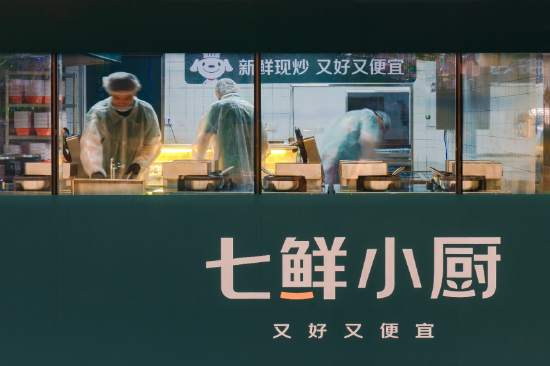
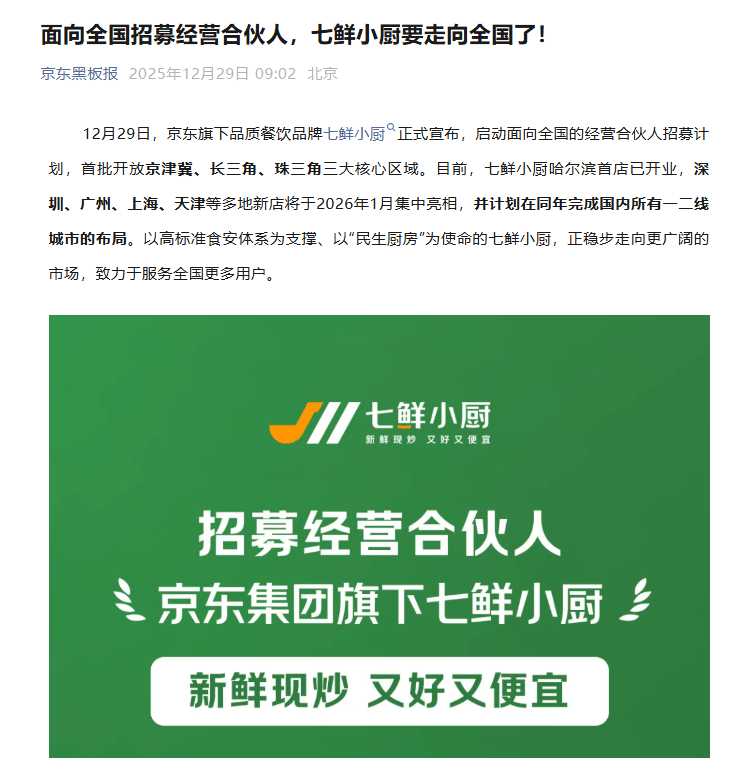
Core Viewpoint - JD's quality dining brand, Qixian Xiaochu, is accelerating its national expansion by launching a partner recruitment plan, targeting major economic regions and aiming for first and second-tier cities in China [1][4]. Group 1: Expansion Strategy - Qixian Xiaochu's expansion focuses on the most economically robust and high-demand delivery areas, employing a strategy of "core city breakthroughs and economic zone coverage" [4]. - The brand has already opened its first store in Harbin, with additional locations in Shenzhen, Guangzhou, Shanghai, and Tianjin set to launch in January 2026 [1][10]. Group 2: Quality and Transparency - The brand emphasizes transparency and quality, addressing issues in the delivery market by ensuring fresh cooking, ingredient transparency, and live kitchen broadcasts [4][6]. - Qixian Xiaochu's pricing strategy targets a range of 10 to 20 yuan, balancing quality and cost-effectiveness to differentiate itself in the competitive first-tier city market [4]. Group 3: Performance and Consumer Engagement - In Beijing, Qixian Xiaochu opened 30 stores within four months, achieving significant market penetration [6]. - A recent promotional event resulted in a surge of 16,000 orders within three hours, demonstrating the brand's ability to drive local dining consumption [6]. Group 4: Innovative Partnership Model - The brand utilizes an innovative "cooperation" model rather than traditional franchising, where Qixian Xiaochu provides comprehensive support, including supply chain management and operational standards, while partners focus on local operations [8]. - This clear division of responsibilities ensures consistent quality across locations while adapting to local consumer preferences, enhancing the efficiency of expansion [8]. Group 5: Future Outlook - With the opening of the Harbin store and the upcoming launch of multiple new locations, Qixian Xiaochu is transitioning from a regional to a national brand [10]. - The national partner recruitment plan signals the brand's intent to extend its quality dining experience across China, marking the beginning of its expansion journey [10].


星巴克中国,卖了!
Nan Fang Du Shi Bao· 2025-11-04 08:03
Core Insights - Starbucks has announced a joint venture with private equity firm Boyu Capital to operate its retail business in China, with Boyu holding up to 60% and Starbucks retaining 40% [1][2] - The partnership aims to expand Starbucks' store count in China to 20,000, representing an approximate 1.5 times increase from the current number [1][2] - Boyu Capital will acquire its stake based on an enterprise value of around $4 billion, excluding cash and debt, with Starbucks estimating the total value of its retail business in China to exceed $13 billion [1][2] Group 1: Joint Venture Details - The joint venture will leverage Boyu Capital's local market expertise to accelerate Starbucks' expansion, particularly in smaller cities and emerging regions [3] - Starbucks has previously utilized joint ventures in various markets, including Japan and South Korea, but has shifted towards direct ownership in China until this recent decision [1][4][5] Group 2: Market Context and Competition - Starbucks has faced declining revenues in China, with three consecutive quarters of year-over-year revenue decline until a slight recovery in the first quarter of fiscal 2025 [6][7] - In contrast, Luckin Coffee has surpassed Starbucks in quarterly revenue for the first time in Q2 2023, highlighting the competitive pressures Starbucks faces in the Chinese market [6][7] - The current competitive landscape includes brands like Kudi and New Coffee, which have established significant market presence, making it challenging for Starbucks to regain its leading position [8] Group 3: Strategic Implications - The partnership with Boyu Capital is seen as a strategic move to enhance localization and adapt to changing consumer preferences among younger Chinese consumers [7][8] - Future adjustments may include adopting a lightweight store model and exploring franchise opportunities to penetrate lower-tier markets [7][8]

经济热力站|京东七鲜小厨:10亿现金招募“菜品合伙人” 3年建设10000家门店
Xin Lang Ke Ji· 2025-08-02 12:27
Core Insights - JD.com has launched a nationwide recruitment for "Dish Partners" under its "Seven Fresh Kitchen" initiative, with over 66,000 applications received in the first week [1] - The company plans to invest 10 billion yuan to recruit partners for 1,000 signature dishes and aims to establish over 10,000 Seven Fresh Kitchens nationwide within three years [1] - The initiative addresses the traditional restaurant industry's challenges, including high rent and labor costs, and aims to promote healthy development in the food delivery sector through supply chain innovation [1] Recruitment and Partnership Model - The "Dish Partner" recruitment allows partners to provide recipes and participate in development without incurring startup costs or labor expenses, enabling nationwide sales [3] - Winning partners will receive a guaranteed cash share of 1 million yuan, with no cap on subsequent sales revenue [3] - JD.com will cover all rental, labor, and operational costs, allowing partners to focus solely on recipe development and quality ingredient supply chain collaboration [3] Sales and Market Performance - The first store of Seven Fresh Kitchen achieved an average of over 1,000 orders per day in its first week, with a 220% higher repurchase rate compared to industry averages [3] - The initiative has positively impacted surrounding restaurants, with a 12% increase in overall orders within a 3-kilometer radius [3] Food Safety Measures - Seven Fresh Kitchen implements four key food safety measures: sourcing from reputable suppliers, using high-quality processing facilities, maintaining a transparent kitchen environment, and live-streaming the cooking process [6] - The initiative aims to resolve consumer concerns regarding food safety and enhance the quality of food delivery services [6] Commitment to Partners - JD.com emphasizes its commitment to ensuring that partner merchants do not incur losses and aims to prevent exploitation of restaurants by delivery platforms [4]