品牌全球化战略

Search documents
彪马待价而沽 安踏李宁回应收购传闻
Zheng Quan Ri Bao Wang· 2025-11-28 11:39
Core Viewpoint - Anta Sports is considering a potential acquisition of the German sports brand Puma, possibly in collaboration with private equity firms, while other companies like Li Ning and Asics are also seen as potential bidders [1][2] Group 1: Company Strategies - Anta's potential acquisition of Puma aligns with its multi-brand and globalization strategy, focusing on whether it complements its international market development [2] - Li Ning is currently in a period of adjustment and emphasizes its focus on its own brand growth, indicating that it is not engaged in any substantial negotiations regarding the acquisition [1][2] Group 2: Market Context - Puma represents significant global strategic value, with its brand recognition and established distribution networks providing advantages in entering European and Latin American markets [1] - The European sports market is primarily dominated by Adidas, making the acquisition of Puma a strategic move for Anta to effectively compete in this region [2] Group 3: Financial Performance - Puma's Q3 2025 financial report showed a 10.4% year-on-year decline in sales to €1.9557 billion, with a net loss of €62.3 million (approximately ¥511 million) and a gross margin decrease to 45.2% [3] - The decline in performance is attributed to significant drops in wholesale business in Greater China, while direct-to-consumer (DTC) growth partially offset this decline [3] Group 4: Future Outlook - Puma anticipates continued challenges in 2025 due to geopolitical and macroeconomic fluctuations, predicting a low double-digit percentage decline in sales for the year [4] - The long-term success of any acquisition will depend on Puma's ability to rejuvenate its brand and leverage its membership, data assets, and community resources for platform reconstruction [4]


小商品城(600415)2025年三季报业绩点评报告:全球数贸中心提速增效 2025Q3业绩增速亮眼
Xin Lang Cai Jing· 2025-10-20 08:27
Core Viewpoint - The company reported impressive growth in its Q3 2025 performance, with significant increases in revenue and net profit, driven by its core business and technological advancements [1][2]. Financial Performance - For Q1-Q3 2025, the company achieved revenue of 13.061 billion yuan, a year-on-year increase of 23.07%, and a net profit attributable to shareholders of 3.457 billion yuan, up 48.45% [1]. - In Q3 2025, the company recorded revenue of 5.348 billion yuan, representing a 39.02% year-on-year growth, and a net profit of 1.766 billion yuan, which is a remarkable increase of 100.52% [1][2]. Business Development - The company's global trade center is accelerating efficiency, with early completion of major projects and exceeding expectations in recruitment, attracting over 10,000 entities for various sectors [2]. - The AI-enabled "Chinagoods" platform has seen significant engagement, with over 1 billion visits, and has developed advanced AI tools for global market access [2]. International Expansion - The company’s cross-border payment service, YiwuPay, surpassed $2.5 billion in transactions, marking a 47% increase, and is now operational in over 170 countries [3]. - The company is actively pursuing financial licenses in Hong Kong to support its international operations, establishing a foundation for its global business strategy [3]. Global Branding Strategy - The company is advancing its global branding strategy for "Yiwu China Small Commodity City," focusing on emerging markets such as the Middle East, South America, and Africa, with 13 new overseas projects initiated [3]. - The opening of the Osaka Yiwu market in Japan marks a significant milestone in the company's international expansion efforts [3]. Profit Forecast - The company maintains its revenue forecasts for 2025, 2026, and 2027 at 19.637 billion yuan, 24.313 billion yuan, and 29.638 billion yuan, respectively, with expected growth rates of 24.78%, 23.81%, and 21.90% [4]. - Projected net profits for the same years are 3.910 billion yuan, 5.003 billion yuan, and 6.416 billion yuan, with growth rates of 27.20%, 27.97%, and 28.23% [4].

港资券商掀赴美上市热潮,6家又启动,赴美上市在于三重考量
Xin Lang Cai Jing· 2025-08-22 06:53
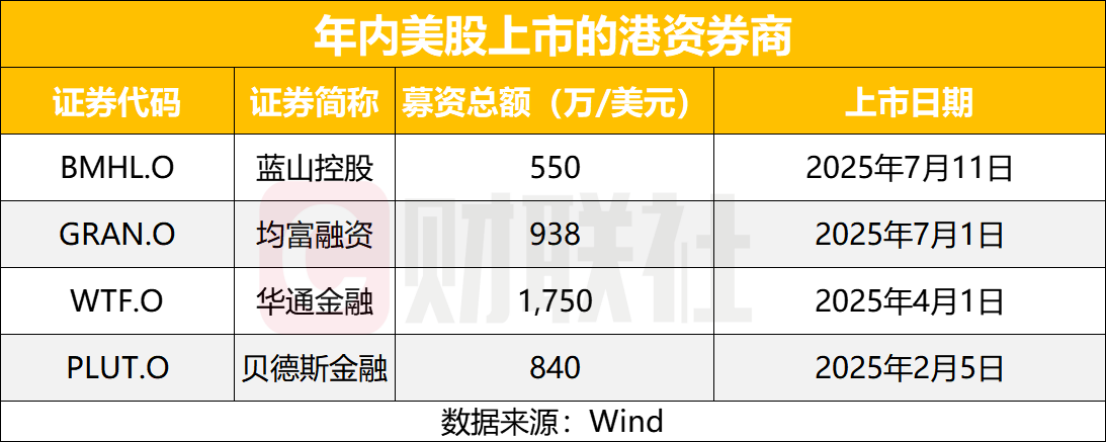
Core Viewpoint - Hong Kong-based financial firms, particularly securities companies, are increasingly targeting the U.S. capital market for overseas listings, with a notable surge in IPO activities on NASDAQ in 2023 [1][5]. Group 1: Successful Listings - A total of 32 Hong Kong enterprises have successfully listed in the U.S. this year, including 4 securities firms that have gone public on NASDAQ, raising a total of $40.775 million [1][4]. - The four successful Hong Kong securities firms listed on NASDAQ are Bluemount Holdings Limited, Grande Group Limited, Waton Financial Limited, and Plutus Financial Group Limited, with listing dates ranging from February to July 2025 [2][3]. Group 2: Characteristics of Listed Firms - The listed securities firms exhibit two main characteristics: small to medium fundraising sizes, typically between $5 million and $10 million, and diversified business structures [4]. - Specific allocations of raised funds include 30% for AI systems by Waton Financial, 25% for enhancing IPO teams by Grande Group, and 20% for acquiring U.S. and Southeast Asian brokerage licenses by Plutus Financial [4]. Group 3: Upcoming Listings - At least 27 additional Hong Kong enterprises are preparing for U.S. listings, with six securities firms, including Beta Financial Technology and Hobo Capital, having disclosed their plans [5][6]. - The upcoming listings include various strategies, such as Beta Financial's plan to raise up to $10 million and Mango Financial's intention to merge with a SPAC for its listing [6][7]. Group 4: Motivations for U.S. Listings - Hong Kong financial institutions are attracted to the U.S. market for several reasons: diversified financing channels, enhanced global brand recognition, and the potential to replicate the success of peers like Futu Holdings [8]. - The current trend of Hong Kong securities firms listing in the U.S. is also influenced by the favorable market conditions in Hong Kong, allowing firms to capitalize on the bullish sentiment [8].