鞋类

Search documents
【安踏体育(2020.HK)】业绩好于预期,26年期待多品牌全球化战略进一步推进——2025年度业绩点评(姜浩/孙未未/朱洁宇)
光大证券研究· 2026-03-26 23:05
Core Viewpoint - Anta Sports reported a revenue of 80.22 billion yuan for 2025, representing a year-on-year growth of 13.3%, while the net profit attributable to shareholders, including the impact of AMER, was 13.59 billion yuan, a decline of 12.9% year-on-year. Excluding AMER's impact, the net profit was 12.39 billion yuan, showing a growth of 5.6% year-on-year [4]. Financial Performance - The company achieved an EPS of 4.89 yuan and proposed a final cash dividend of 1.08 HKD per share, with a total payout ratio of 50.1% for the year [4]. - The gross margin for 2025 slightly decreased by 0.2 percentage points to 62%, while the operating profit margin increased by 0.4 percentage points to 23.8% [7][8]. - The net profit margin, including and excluding AMER's impact, was 16.9% and 15.4%, respectively, reflecting a decline of 5.1 and 1.2 percentage points year-on-year [4]. Revenue Breakdown - The main brand Anta, FILA, and other brands saw revenue growth of low single digits, mid single digits, and 45-50%, respectively, in 2025 [5]. - For the year, the revenue from footwear, apparel, and accessories accounted for 39.3%, 57.1%, and 3.6% of total revenue, with year-on-year growth rates of 7.9%, 16.3%, and 29.8%, respectively [6]. - Online sales increased by 15.5%, contributing to 35.8% of total revenue, which is a 0.7 percentage point increase year-on-year [6]. Brand Performance - The revenue contribution from Anta, FILA, and other brands was 43.3%, 35.5%, and 21.2%, with respective year-on-year growth rates of 3.7%, 6.9%, and 59.2% [6]. - The DTC (Direct-to-Consumer) channels for Anta brand showed positive growth, with revenue from DTC direct sales, DTC franchise, e-commerce, and traditional wholesale contributing 35.4%, 18.4%, 37%, and 9.2% of total revenue, respectively [6]. Cost and Expenses - The expense ratio increased by 0.3 percentage points to 40.5%, with sales, management, and financial expense ratios at 35.5%, 6.5%, and -1.4%, respectively [8]. - Advertising and promotional expenses, employee costs, and R&D expenses accounted for 8%, 15.3%, and 2.7% of revenue, with year-on-year changes of -1%, +0.5%, and -0.1%, respectively [8]. Inventory and Cash Flow - Inventory at the end of 2025 increased by 12.9% to 12.15 billion yuan, with an inventory turnover period of 137 days, an increase of 14 days year-on-year [9]. - Operating net cash flow for 2025 was 21 billion yuan, reflecting a year-on-year increase of 25.4% [9].

纺服ODM行业专家交流
2026-03-26 13:20
Summary of Key Points from Conference Call Records Industry Overview - The global outdoor sports ODM market is expected to see growth in 2026, with Nike projected to achieve a turnaround with a 0.1% increase, Adidas expecting a 5% growth, and emerging brands like Vory experiencing over 60% order growth [1][2]. - The apparel industry is facing cost pressures due to rising crude oil prices, with fabric costs accounting for 42.5%-51% of total costs, and specific materials like TPU increasing by 15% and polyester by over 20% [1][3]. Company Insights - The company operates as a vertically integrated large ODM entity, covering the entire supply chain from spinning to finished garment production, with domestic revenue of 1.83 billion RMB in 2025, expected to grow by approximately 11% to 2.04 billion RMB in 2026 [2]. - The company serves major global sports brands including Nike, Adidas, Under Armour, and emerging brands like Lululemon and Alo Yoga, maintaining a growth rate of around 20% annually [2]. Cost Impact and Price Transmission - The cyclical nature of commodity prices affects the apparel industry, with significant impacts from oil and coal prices. Despite expectations for a price decline in 2026, geopolitical tensions have led to an unexpected rise in oil prices [3][4]. - Dye prices have increased significantly, with certain dyes rising by 40%, while polyester prices have risen by 20%, affecting overall production costs [3][4]. - The industry has a mature price transmission mechanism, where price adjustments occur when commodity price fluctuations exceed 10%, with a typical lag of about three months for new prices to take effect on new orders [4][6]. Brand Strategies and Consumer Behavior - Different brand clients have varying strategies for handling cost increases. Fast fashion brands like H&M and ZARA tend to absorb costs to maintain sales volume, while brands like Uniqlo have adopted price increase strategies similar to Nike and Adidas [7][9]. - The average price of sports apparel increased by 7.4% and outdoor apparel by 8.8% in Q4 2025, surpassing the increase in commodity prices, indicating brands are leveraging cost increases for higher profits [7][9]. Market Dynamics and Future Outlook - The anticipated increase in tariffs in the U.S. is expected to contribute to a 1.8% price increase in apparel, with brands likely to retain additional profits from this adjustment [8][9]. - The U.S. apparel market is characterized by low price sensitivity, with consumer decisions influenced more by style and design than by price, allowing brands to maintain stable demand even during price increases [9][10]. - For 2026, Adidas is expected to grow by 5%, while Nike is projected to achieve a slight recovery with a 0.1% growth, indicating a positive trend for both major brands [10][11]. Inventory and Production Capacity - The decline in production capacity utilization in the second half of 2025 was primarily due to inventory management in response to tariff policies, rather than a deterioration in fundamental demand [11][12]. - Companies with low-cost inventory from previous quarters stand to benefit significantly from price increases, while those unable to store finished goods face greater pressure [6][11]. Conclusion - The apparel industry is navigating significant cost pressures and evolving consumer behaviors, with major brands adapting their strategies to maintain profitability amidst rising costs. The outlook for 2026 appears cautiously optimistic, with growth expected for key players in the market.
安踏体育(02020):全年业绩符合预期,推进全球化
CSC SECURITIES (HK) LTD· 2026-03-26 07:05
Investment Rating - The report assigns a "BUY" rating for the company, indicating a potential upside in the stock price [7][8]. Core Insights - The company achieved a revenue of RMB 80.22 billion in 2025, representing a year-on-year increase of 13.3%. However, the net profit attributable to shareholders decreased by 12.9% to RMB 13.59 billion. Excluding the impact of Amer Sports' listing, the net profit increased by 13.9% year-on-year [8][9]. - The company plans to expand its global operations, aiming to establish 1,000 retail outlets in Southeast Asia by 2028 and entering markets in South Asia, Australia, New Zealand, and India [9]. - The company has made strategic acquisitions, including the purchase of shares in Wolf Claw and PUMA, and invested in the South Korean fashion e-commerce platform MUSINSA, which is expected to enhance its brand portfolio and market coverage [9]. Summary by Sections Company Overview - The company operates in the textile and apparel industry, with a current stock price of HKD 75.75 and a market capitalization of HKD 215.85 billion [2]. Recent Ratings - The company has consistently received "BUY" ratings in recent reports, with the last rating issued on January 27, 2026, at a closing price of HKD 76.35 [3]. Product Mix - The product portfolio consists of footwear (39.3%), apparel (57.1%), and accessories (3.6%) [4]. Financial Performance - The company reported a gross margin of 62% for the reporting period, a decrease of 0.2 percentage points year-on-year, attributed to the rising proportion of lower-margin e-commerce business and increased costs [9]. - The projected net profits for 2026, 2027, and 2028 are RMB 14.6 billion, RMB 16.27 billion, and RMB 18.27 billion, respectively, with corresponding year-on-year growth rates of 7.4%, 11.4%, and 12.3% [9][11]. Dividend Policy - The company announced a cash dividend of HKD 1.08 per share for the reporting period [8].

安踏体育:全年业绩符合预期,推进全球化-20260326
CSC SECURITIES (HK) LTD· 2026-03-26 05:24
Investment Rating - The investment rating for the company is "BUY" with a target price of HKD 89, indicating a potential upside from the current price of HKD 75.75 [1][7]. Core Insights - The company achieved a revenue of RMB 80.22 billion in 2025, representing a year-on-year increase of 13.3%. However, the net profit attributable to shareholders decreased by 12.9% to RMB 13.59 billion. Excluding the impact of Amer Sports' listing, the net profit increased by 13.9% [8][9]. - The company plans to expand its global operations, aiming to establish 1,000 retail outlets in Southeast Asia by 2028 and entering markets in South Asia, Australia, New Zealand, and India [9]. - The company has made strategic acquisitions, including the purchase of shares in Wolf Claw and PUMA, and invested in the South Korean fashion e-commerce platform MUSINSA, which is expected to enhance its brand portfolio and market coverage [9]. Summary by Sections Company Overview - The company operates in the textile and apparel industry, with a market capitalization of HKD 215.846 billion and a total share count of 2,796.65 million [2]. Recent Ratings - The company has consistently received "BUY" ratings in recent reports, with the last rating issued on January 27, 2026, at a closing price of HKD 76.35 [3]. Product Mix - The product mix consists of footwear (39.3%), apparel (57.1%), and accessories (3.6%) [4]. Financial Performance - The company reported a gross profit margin of 62% for the reporting period, a decrease of 0.2 percentage points year-on-year, attributed to the increased proportion of lower-margin e-commerce business and rising costs [9]. - The company expects net profits for 2026, 2027, and 2028 to be RMB 14.6 billion, RMB 16.27 billion, and RMB 18.27 billion, respectively, with corresponding year-on-year growth rates of 7.4%, 11.4%, and 12.3% [9][11]. Dividend Policy - The company announced a cash dividend of HKD 1.08 per share for the reporting period [8].
李宁(02331.HK)2025年报点评:营收增速保持稳健 利润超预期表现
Ge Long Hui· 2026-03-24 23:24
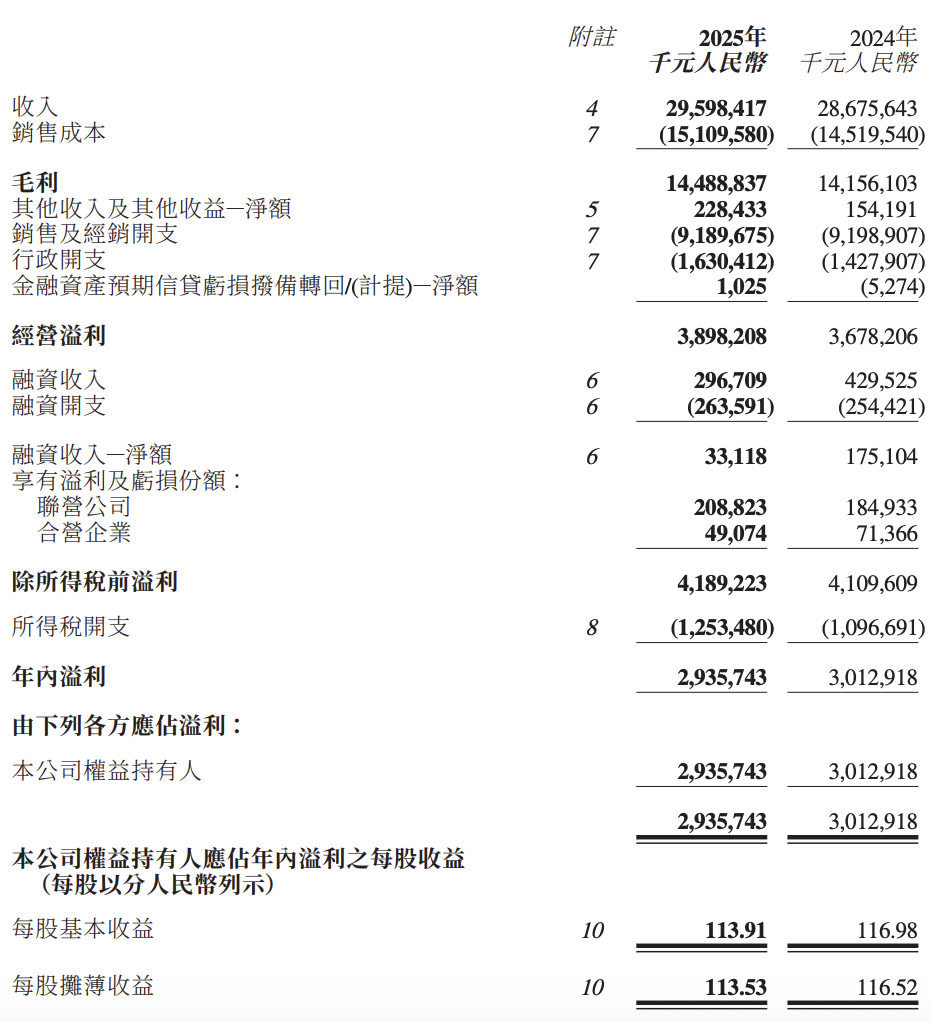
Core Viewpoint - The company reported a 3.2% year-on-year increase in revenue for 2025, reaching 29.6 billion yuan, while net profit attributable to shareholders decreased by 2.6% to 2.94 billion yuan [1][2]. Revenue Performance - Revenue growth remained stable, with the second half of 2025 continuing the steady growth trend observed in the first half. By category, revenue from footwear, apparel, and equipment & accessories grew by 2.4%, 2.3%, and 12.7% respectively, totaling 14.65 billion, 12.33 billion, and 2.62 billion yuan [1]. - The running and cross-training categories showed strong performance, with running category sales increasing by over 10% year-on-year and cross-training category sales up by 5% [1]. Channel Strategy - The company maintained a steady channel strategy, with revenue from distribution, direct sales, and e-commerce channels increasing by 6.3%, decreasing by 3.3%, and increasing by 5.3% respectively, totaling 13.77 billion, 6.66 billion, and 8.74 billion yuan [1]. - As of the end of the reporting period, the number of sales points (excluding Li Ning YOUNG) decreased by 26 to 6,091. The number of distribution and direct sales stores changed by +33 and -59 to 4,853 and 1,238 respectively, while Li Ning YOUNG sales points increased by 50 to 1,518 [1]. Profitability - The company's gross margin decreased by 0.4 percentage points to 49%, primarily due to a decline in the proportion of revenue from direct sales and increased discounts in a volatile consumer environment [2]. - The net profit margin fell by 0.6 percentage points to 9.9%, influenced by a 1.1 percentage point decrease in sales and distribution expenses as a percentage of revenue and a 0.5 percentage point increase in administrative expenses [2]. Operational Status - The company reported a 3.7% year-on-year increase in inventory, reaching 2.69 billion yuan, with inventory turnover days remaining stable at 63 days. Accounts receivable and payable turnover days increased by 1 day and remained stable at 15 and 42 days respectively, indicating a stable operational status [2]. - The company plans to distribute a dividend of 0.5695 yuan per share, maintaining a payout ratio of 50% [2]. Investment Outlook - The company is expected to maintain revenue growth resilience in a volatile consumer environment, with ongoing marketing investments aimed at strengthening brand competitiveness. Projected revenue growth for 2026-2028 is estimated at 7.6%, 6.1%, and 5.7%, reaching 31.86 billion, 33.81 billion, and 35.74 billion yuan respectively, while net profit is expected to grow by 4.6%, 11.3%, and 10% to 3.07 billion, 3.42 billion, and 3.76 billion yuan [2].

李宁(02331):2025年业绩优秀,2026年奥运周期蓄势待发
Xinda Securities· 2026-03-23 09:06
Investment Rating - The investment rating for the company is maintained as optimistic, with expectations of high single-digit revenue growth and net profit margin in the high single-digit range for 2026 [5]. Core Insights - The company achieved a total revenue of 29.598 billion RMB in 2025, representing a year-on-year increase of 3.22%, while the net profit attributable to shareholders was 2.936 billion RMB, a decrease of 2.56% year-on-year [1]. - The company has a stable dividend policy, distributing a total of 0.5695 RMB per share for 2025, maintaining a dividend payout ratio of approximately 50% [2]. - The footwear segment remains a stronghold, with revenue contributions of 14.651 billion RMB, while the equipment and accessories segment showed the highest growth rate of 12.7% [3]. - The company’s gross profit margin for 2025 was 49.0%, a slight decline of 0.4 percentage points year-on-year, primarily due to changes in channel structure and increased promotional discounts [4]. - The company has signed a partnership with the Chinese Olympic Committee for the 2025-2028 period, enhancing its brand positioning in the professional sports market [4]. Financial Summary - For 2025, the company reported operating cash flow of 4.852 billion RMB, a decrease of 7.9% year-on-year, but still maintaining a healthy cash flow position [1]. - The projected revenue for 2026 is estimated at 32.338 billion RMB, with a year-on-year growth rate of 9% [6]. - The expected net profit for 2026 is projected to be 3.205 billion RMB, reflecting a recovery with a year-on-year growth of 9% [6]. - The company’s earnings per share (EPS) for 2025 was 1.14 RMB, with projections of 1.24 RMB for 2026 [6].
李宁(02331):营收增速保持稳健,利润超预期表现
NORTHEAST SECURITIES· 2026-03-23 08:12
Investment Rating - The report maintains a "Buy" rating for the company, expecting a price increase exceeding 15% over the next six months [9]. Core Insights - The company reported a 3.2% year-on-year increase in revenue for 2025, reaching 29.6 billion RMB, while net profit attributable to shareholders decreased by 2.6% to 2.94 billion RMB [2][4]. - Revenue growth was steady, with footwear, apparel, and equipment & accessories categories showing year-on-year increases of 2.4%, 2.3%, and 12.7% respectively [3]. - The company continues to optimize its store strategy, with a net decrease of 26 sales points to 6091, while maintaining a focus on single-store optimization [3]. Financial Summary - The gross profit margin slightly declined by 0.4 percentage points to 49%, attributed to a decrease in direct sales channel revenue proportion and increased discounts in a volatile consumer environment [4]. - The company plans to distribute a dividend of 0.5695 RMB per share, maintaining a payout ratio of 50% [4]. - Forecasts for 2026-2028 indicate expected revenue growth of 7.6%, 6.1%, and 5.7% respectively, with net profit growth of 4.6%, 11.3%, and 10% [4][10].
促销竞争拖累毛利率,李宁连续三年增收不增利
Shen Zhen Shang Bao· 2026-03-21 15:13
Core Viewpoint - Li Ning's annual report indicates an increase in revenue but a decrease in profit, with a decline in gross margin due to structural adjustments in sales channels and increased competition leading to higher discounting [1][3]. Financial Performance - For the fiscal year ending December 31, 2025, Li Ning reported a revenue of 29.598 billion RMB, a year-on-year increase of 3.22% [2]. - The net profit attributable to equity holders was 2.936 billion RMB, a decrease of 2.56% compared to the previous year [2]. - The gross margin fell by 0.4 percentage points to 49% [3]. Business Segments - All three main business segments showed revenue growth: footwear increased by 2.4%, apparel by 2.3%, and equipment and accessories by 12.7% [3]. - Footwear and apparel remain the primary revenue contributors, accounting for 49.5% and 41.6% of total revenue, respectively [3]. Cost Structure - Employee costs as a percentage of revenue decreased by 0.3 percentage points to 8.3% [3]. - Advertising and marketing expenses increased by 1.2 percentage points, while research and product development expenses remained stable at 2.4% of revenue [3]. Retail and Distribution - Overall retail sales, including online and offline, remained flat year-on-year, with offline new product sales accounting for 83% of total offline sales [3]. - As of December 31, 2025, the total number of sales points for Li Ning brands was 7,609, a net increase of 24 stores, representing a year-on-year growth of 0.3% [3]. Investment and Development - A subsidiary of the company signed an investment agreement to acquire land for a supply chain base in Guangxi, with an estimated maximum investment of 3.3 billion RMB [4]. - As of the reporting period, the book value of non-current assets related to this investment was 2.058 billion RMB, accounting for approximately 5.5% of the group's total assets [4]. Consumer Complaints - There have been significant consumer complaints regarding product quality, with nearly 20,000 complaints mentioning "Li Ning" on a consumer complaint platform, including issues related to product durability [4].
原材料的周期弹性与品牌的分化性成长
GUOTAI HAITONG SECURITIES· 2026-03-21 12:01
Investment Rating - The report assigns an investment rating of "A" for the textile and apparel industry for the fiscal year 2025/2026 [2]. Core Insights - The textile and apparel sector has experienced a decline of 3.2% year-to-date, underperforming the CSI 300 index by 1.9 percentage points, ranking 23rd among 31 industries [5][6]. - The performance of individual stocks has varied, with notable gains in companies diversifying into emerging technology sectors and those benefiting from moderate raw material price increases [5]. - In the U.S. market, the textile and apparel sector has seen a decline of 10.7%, with only a few companies like Under Armour and Tapestry showing positive growth [9][10]. Summary by Sections Year-to-Date Performance - The SW textile and apparel index has decreased by 3.2%, while the SW apparel and home textiles and SW textile manufacturing indices have dropped by 2.0% and 5.9%, respectively [5][7]. - In the Hong Kong market, the SW textile and apparel index fell by 3.7%, with the apparel and home textiles and textile manufacturing indices down by 2.3% and 4.9% [7][8]. Stock Performance - Top-performing stocks include Harsen Co. (+46.4%), Jujie Microfiber (+23.8%), and Tanshan Road (+20.4%) in the mainland market, while Tianhong International Group (+48.5%) and Li Ning (+14.8%) led in Hong Kong [5][7]. Retail Sales Growth - In January-February 2026, China's textile and apparel retail sales grew by 10.4%, significantly outpacing the overall retail sales growth of 2.8%, ranking 4th among 16 major industries [14][15]. Export Trends - For 2025, China's textile and apparel exports are projected to grow by 0.5% and decline by 5.0%, respectively, while Vietnam's textile and apparel exports are expected to increase by 9.3% and 5.4% [18][19]. Cotton Prices - As of March 19, 2026, cotton prices have increased by 7.5% for 3128B cotton, 5.3% for ICE 2 cotton, and 6.8% for the Cotlook A index since the beginning of the year [20][21]. Supply Chain Dynamics - The report highlights that the manufacturing landscape is shifting towards multi-origin sourcing, with stricter traceability across the supply chain, which may impact order cycles and production capabilities [39][40].
李宁公布全年业绩:营收近300亿,净利为何连续三年下滑?
Nan Fang Du Shi Bao· 2026-03-20 09:14
Core Viewpoint - Li Ning, as the first among the four major domestic sports brands to disclose its annual report, reported total revenue growth but a decline in net profit, highlighting ongoing challenges in balancing scale expansion and profitability [2][3][12] Revenue Performance - For the fiscal year 2025, Li Ning's total revenue reached 29.598 billion yuan, a year-on-year increase of 3.2% [3][4] - The footwear segment remained the main revenue contributor, generating 14.651 billion yuan (49.5% of total revenue), while apparel and equipment & accessories contributed 12.327 billion yuan (41.6%) and 2.621 billion yuan (8.9%) respectively [4] - Franchise and e-commerce channels were the primary growth drivers, with revenues increasing by 6.3% and 5.3%, respectively, together accounting for over 76% of total revenue [3][4] Profitability Challenges - Despite revenue growth, net profit fell by 2.6% to 2.936 billion yuan, marking the third consecutive year of "revenue growth without profit growth" since 2023 [2][7] - The decline in net profit was attributed to a significant increase in the effective tax rate, which rose from 26.7% in 2024 to 29.9% in 2025 due to adjustments in the company's funding structure [7] Margin Analysis - The overall gross margin for 2025 was 49.0%, a slight decrease of 0.4 percentage points, primarily due to increased promotional discounts and strategic channel adjustments [8] - The net profit margin also declined from 10.5% to 9.9% as a result of the combined effects of lower gross margins and higher tax rates [8] Strategic Focus - Li Ning emphasized its "single brand, multi-category, multi-channel" strategy, focusing on product innovation and market differentiation through technology and sports marketing [11] - The company aims to deepen its core brand while exploring sub-brands like "China Li Ning" and "LI-NING 1990" for category extension and audience segmentation [11] Future Outlook - Looking ahead, Li Ning plans to continue leveraging technological innovation and Olympic marketing as dual drivers for growth, aiming to resolve the "revenue growth without profit growth" issue and achieve high-quality growth [12]