
品牌控制权争夺

Search documents
“两个汇源”对立!资方“白嫖”商标又另寻产能,创始人朱新礼背水一战
Guan Cha Zhe Wang· 2026-01-20 09:25
Core Viewpoint - The capital restructuring of Huiyuan Juice has reached a critical breakthrough with a recent settlement between Guangdong Min Investment and 12 related entities of Wensheng Assets, potentially paving the way for Huiyuan Juice's return to the A-share market [1][3]. Group 1: Legal and Financial Developments - Guangdong Min Investment has applied to withdraw its lawsuit and lift the equity freeze on Zhuji Wensheng Hui, which was previously frozen due to litigation [1]. - Wensheng Assets, as the restructuring investor, is accused of failing to fulfill a 1.6 billion yuan capital increase obligation, leading to the freezing of its shares in Beijing Huiyuan [1][9]. - National Water Services has indirectly held a 21.89% stake in Beijing Huiyuan through Zhuji Wensheng Hui, and its investment in Huiyuan Juice has been crucial for its financial recovery [5][9]. Group 2: Control and Brand Conflict - A control war has erupted between the founding family of Huiyuan and the restructuring party, with both sides publicly accusing each other of violations and misconduct [2][10]. - The emergence of two competing entities claiming the Huiyuan brand has created confusion in the market, with one side controlling the brand and sales channels, while the other holds production capabilities [19][20]. - The ongoing disputes and public infighting are eroding the brand's value, as consumers associate Huiyuan more with legal battles than with quality products [22]. Group 3: Future Outlook - The situation has created a "triangular deadlock," where each party holds critical leverage over the others, but none can decisively break the stalemate [22]. - The potential return of founder Zhu Xinli to a controlling position is seen as a significant factor in the ongoing struggle for Huiyuan's future [20][22]. - The prolonged conflict risks diminishing consumer trust and brand reputation, which could lead to a significant loss in value for the Huiyuan brand, regardless of which party ultimately gains control [22].

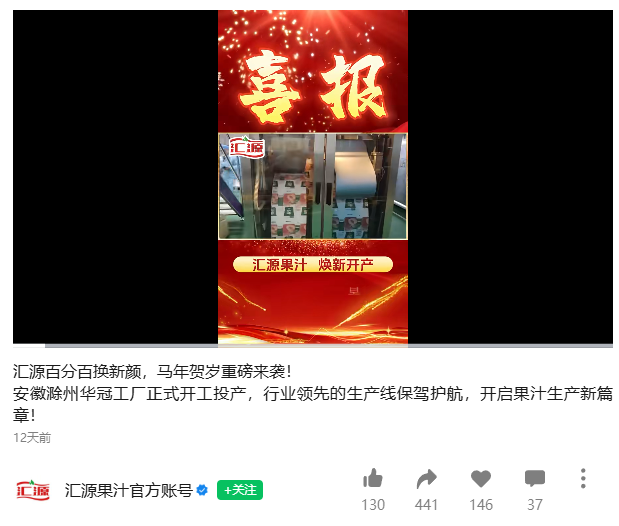
“两个汇源”矛盾激化: 文盛资产寻代工另起炉灶 汇源集团宣称重新接管汇源品牌
Di Yi Cai Jing· 2026-01-08 09:54
Group 1 - The core conflict between Huiyuan Group and Wensheng Assets has intensified, with Huiyuan Group announcing a full takeover of the Huiyuan brand due to alleged fundamental breaches by Wensheng Assets in the restructuring case of Beijing Huiyuan [1] - Wensheng Assets has partnered with a new factory to produce "Huiyuan" products independently, leading to a competitive situation in the market with two entities using the same brand [2] - The key issue at stake is the control of the trademark, with Beijing Huiyuan holding the rights to the "Huiyuan" trademark, while currently being under the control of Wensheng Assets [2] Group 2 - Beijing Huiyuan operates primarily on a light asset model, leasing 80% of its production lines back to Huiyuan Group and sourcing finished products from them [2] - The legal proceedings initiated by Huiyuan Group against Wensheng Assets include a lawsuit for breach of contract and a request for asset preservation, which has led to the freezing of Wensheng Assets' 640 million yuan equity in Beijing Huiyuan [1] - Industry experts believe that the brand dispute between Huiyuan and Wensheng Assets may not escalate into a prolonged battle similar to other brand disputes, as Wensheng Assets lacks a strong background in the beverage industry [3]
汇源集团宣称重新接管汇源品牌
第一财经· 2026-01-08 09:52
Core Viewpoint - The conflict between Huiyuan Group and Wensheng Assets over the Huiyuan juice brand has intensified, with Huiyuan Group announcing a full takeover of the brand due to alleged fundamental breaches by Wensheng Assets in the restructuring process [3][4]. Group 1: Company Actions and Legal Proceedings - Huiyuan Group has accused Wensheng Assets of fundamental breach in the restructuring case of Beijing Huiyuan, leading to a complete takeover of the brand and its orders [4]. - Wensheng Assets has reportedly failed to inject funds as agreed, resulting in a rapid deterioration of relations since 2025, culminating in Huiyuan Group filing a lawsuit for contract enforcement and asset preservation [4][5]. - The court has accepted Huiyuan Group's lawsuit and frozen Wensheng Assets' 640 million yuan equity in Beijing Huiyuan [4][5]. Group 2: Production and Supply Chain Dynamics - Beijing Huiyuan operates on a light asset model, with most production lines retained by Huiyuan Group, which also leases back 80% of its production lines to Beijing Huiyuan [5]. - Following the breakdown in relations, Wensheng Assets has partnered with Anhui Chuzhou Huaguan Factory for production, leading to market competition between two entities using the "Huiyuan" brand [5]. Group 3: Trademark Control and Legal Implications - The key contention between the two parties revolves around trademark control, with Beijing Huiyuan holding the rights to the "Huiyuan" trademark, currently under Wensheng Assets' control [5]. - Legal experts indicate that the resolution of trademark ownership will depend on the court's ruling regarding the breach of contract and control rights, with Huiyuan Group's claims having legal grounds [5][6]. Group 4: Industry Context and Competitive Landscape - Industry analysts suggest that the Huiyuan brand dispute may not escalate into a prolonged battle like the Red Bull case, as Wensheng Assets lacks a background in the beverage industry and relies heavily on Huiyuan Group's established distribution and production systems [6].
十余年权杖之争再起:lululemon创始人博弈董事会
Zhong Guo Jing Ying Bao· 2026-01-05 02:41
Core Viewpoint - Chip Wilson, the founder of lululemon, is attempting to regain control of the board after losing it over a decade ago, by nominating three independent director candidates for the 2026 shareholder meeting, coinciding with the announcement of CEO Calvin McDonald's departure [1][3][12] Group 1: Company Performance and Market Position - lululemon's market value once exceeded $60 billion, but by 2025, its stock price had dropped by 46.40%, resulting in a loss of approximately $25 billion in market capitalization [1][3] - The company reported a third-quarter revenue increase of over 40% year-on-year in the Chinese market, with same-store sales rising over 20% [1][10] - Despite recent growth, lululemon faces challenges such as declining stock prices and slowing growth in the North American market, with a 2% year-on-year decline in revenue for the latest fiscal quarter [3][4] Group 2: Board Control and Governance Issues - Wilson, holding about 9% of lululemon's shares, initiated a proxy fight to restructure the board, citing a lack of retail experience among current board members and ineffective management in addressing inventory issues [3][4] - The board's praise for McDonald is viewed by Wilson as neglecting shareholder interests, as he believes the board has failed to hold management accountable for product innovation [3][4] - Wilson's past experiences with the board highlight his struggle to maintain control after introducing private equity, which diluted his influence over board decisions [6][7][9] Group 3: Strategic Implications for the Chinese Market - The Chinese market has become a crucial growth engine for lululemon, with significant revenue increases and a growing number of stores [10][11] - Experts express concern that the outcome of the board's power struggle could impact lululemon's strategy in China, with potential shifts towards either high-end positioning or continued multi-category expansion [11][12] - The board's future direction will significantly influence lululemon's competitive landscape and growth potential in the Chinese market [11][12]
