
商事调解

Search documents
聚界别智慧 护营商沃土
Xin Lang Cai Jing· 2026-02-09 22:25
Core Viewpoint - The continuous optimization of the business environment is crucial for activating market vitality and fostering development synergy in Yangzhou, Jiangsu Province [1] Group 1: Business Environment Initiatives - Yangzhou has prioritized the construction of the business environment, issuing optimization documents for 12 consecutive years and establishing the "Yangzhou Business Environment Optimization Regulations" [1] - During the Yangzhou Municipal Political Consultative Conference, members from various sectors provided targeted suggestions for improving the business environment, emphasizing the importance of professional insights in addressing development challenges [1] Group 2: Taxation Services - The quality and efficiency of tax services directly impact enterprise operational experiences and confidence in development [2] - The Yangzhou tax system has achieved notable results, including the establishment of a "half-hour" tax service circle and a national taxpayer satisfaction ranking of third overall and second in Jiangsu Province [1][2] Group 3: Dispute Resolution - The long duration, complex processes, and high costs associated with resolving business disputes are significant pain points for market entities [2] - The introduction of the "Commercial Mediation Regulations" is seen as a step towards creating an efficient and convenient multi-channel dispute resolution system, leveraging the unique advantages of commercial mediation [2][3] Group 4: Credit System and Regulation - A robust social credit system is essential for a market economy, and a new regulatory mechanism based on credit is key to optimizing the business environment [3][4] - Suggestions include enhancing graded and classified regulation, developing targeted evaluation criteria, and promoting credit building experiences from various sectors [4] Group 5: Talent Ecosystem - Talent is identified as the primary resource, with a high-quality talent ecosystem being a core competitive advantage for the business environment [4][5] - Proposed measures to address talent shortages include strengthening recruitment efforts, enhancing cross-provincial vocational education cooperation, and optimizing talent policy implementation [5] Group 6: Future Goals - The year 2026 is highlighted as a critical year for Yangzhou to achieve its goal of becoming a "trillion-yuan city," with a focus on addressing key challenges in business environment construction [6]
《商事调解条例》正式公布!填补国内商事调解立法空位
Sou Hu Cai Jing· 2026-01-24 02:53
Core Viewpoint - The introduction of the Commercial Mediation Regulations marks a significant step towards the standardization and legalization of commercial mediation in China, aiming to enhance the resolution of commercial disputes and improve the business environment [1] Group 1: Framework Establishment - The Regulations clearly define core concepts and principles of commercial mediation, providing explicit guidance for practical work [2] - The scope of commercial mediation is specified to include disputes in trade, investment, finance, transportation, real estate, engineering, and intellectual property, reflecting its professional focus [3] - Commercial mediation organizations are defined as non-profit legal entities established in accordance with the law, clarifying the basic organizational form and social function of the industry [4] Group 2: Activity Foundation - The Regulations establish four fundamental principles for commercial mediation activities: voluntariness, legality, integrity, and confidentiality, which form the basis for the fairness of the mediation process and the acceptability of outcomes [5] Group 3: Subject Regulation - The Regulations set clear standards for the core implementing entities of commercial mediation—mediation organizations and mediators, aiming to enhance the overall credibility and professionalism of the industry [6] - A standardized admission mechanism is established for mediation organizations, requiring registration with judicial administrative departments and compliance with legal conditions, including having at least five qualified mediators [7] Group 4: Procedure Optimization - The Regulations emphasize the predictability of procedures and reliability of outcomes as key factors for gaining market trust in commercial mediation [8] - The mediation process respects the autonomy of the parties involved, with confidentiality as a principle and a comprehensive avoidance system to create a safe negotiation environment [8] Group 5: International Integration - The Regulations reflect a significant openness and international perspective, supporting mediation organizations in enhancing international competitiveness and conducting foreign-related mediation activities [9] - They allow foreign mediation organizations to operate legally in designated areas, such as free trade zones, and support the Guangdong-Hong Kong-Macao Greater Bay Area in aligning mediation rules and mechanisms [9] Group 6: Industry Revitalization - For Shenzhen, the Regulations provide a legal framework that supports the deepening development of commercial mediation, reinforcing its leading advantages and promoting higher levels of professionalism and internationalization [10] - The Shenzhen judicial authority plans to actively promote the learning and implementation of the Regulations, explore cross-border mediation rule alignment, and optimize the business environment to support high-quality economic development [10]

上海自贸区构建国际化、专业化调解服务体系 多元解决国际商事纠纷
Xin Lang Cai Jing· 2026-01-19 15:09
Core Viewpoint - The innovation and improvement of commercial dispute resolution mechanisms are crucial for optimizing the business environment in Shanghai's Free Trade Zone, as international trade activities increase [1][2]. Group 1: Commercial Dispute Resolution Mechanisms - The Shanghai Economic and Trade Commercial Mediation Center emphasizes the importance of mediation, litigation, and arbitration as a multi-faceted dispute resolution mechanism, highlighting its voluntary, flexible, economical, efficient, confidential, and amicable characteristics that suit international trade disputes [1]. - The center has established a one-stop multi-dispute resolution platform in the Free Trade Zone, providing legal guarantees for enterprises going global [1]. - The center has 126 mediators, including 13 foreign experts, covering various professional fields such as maritime commerce and environmental protection [1]. Group 2: International Collaboration and Legal Services - The center has invested in foreign legal service capabilities for over a decade, establishing cooperation with international organizations in more than 20 cities globally, including the World Intellectual Property Organization (WIPO) and the European Union Intellectual Property Office [2]. - The center has created a commercial mediation model that aligns with international practices while incorporating Chinese characteristics, facilitating enterprises' participation in international competition and addressing the risks of commercial disputes [2]. - By setting up overseas legal service stations, the center promotes the global reach of Chinese commercial mediation services, providing replicable and scalable solutions for international commercial dispute resolution [2].
明确鼓励AI+ 《商事调解条例》强调国际标准、行政法规定位
Zhong Guo Jing Ying Bao· 2026-01-08 07:50
Core Viewpoint - The State Council has released the "Commercial Mediation Regulations," which will take effect on May 1, 2026, marking the first administrative regulation specifically governing commercial mediation activities in China. This regulation aims to enhance the efficiency and quality of commercial mediation, aligning with international standards and addressing the current underdeveloped state of the commercial mediation industry in China [1]. Group 1: Encouragement of Technology in Mediation - The regulations explicitly encourage commercial mediation organizations to utilize artificial intelligence and big data to improve mediation quality and efficiency [2]. - Online mediation is recognized as having the same legal effect as offline mediation, addressing concerns about the legal enforceability of online mediation agreements [2]. - The regulations signal a clear policy direction from the state to support technology-enabled mediation, aiming to enhance the professional level of mediation through improved processes [2]. Group 2: Compliance and Boundaries - There is a need for further clarification on the role of artificial intelligence in commercial mediation, emphasizing that AI should serve as an auxiliary tool while legal professionals' judgment remains paramount [3]. - Users are advised to carefully assess the compliance and data protection measures of mediation platforms, ensuring confidentiality and transparency in the use of technology [3]. - The improved commercial mediation system is expected to offer greater flexibility and efficiency compared to traditional litigation, contributing to a healthier development of the mediation industry and fostering a better business environment [3].
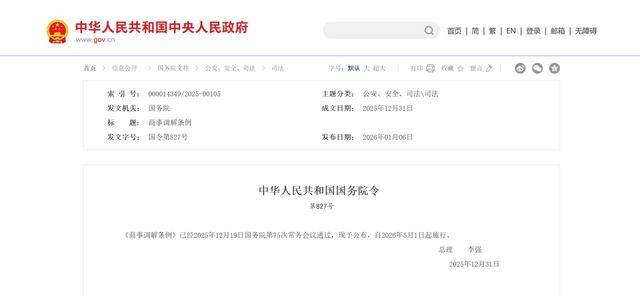
受权发布丨商事调解条例
Xin Hua She· 2026-01-07 06:44
Core Points - The regulation aims to standardize commercial mediation activities, effectively resolve commercial disputes, protect the legal rights of parties, promote the development of the commercial mediation industry, and optimize the business environment [2] - Commercial mediation activities refer to voluntary and friendly negotiations to resolve disputes in various fields such as trade, investment, finance, transportation, real estate, construction, and intellectual property [2] - The regulation emphasizes the development of the commercial mediation industry in line with national policies and aims to serve high-quality development and high-level opening up [3][4] Summary by Sections - The State Council's judicial administrative department is responsible for guiding and regulating national commercial mediation work and planning the development of the commercial mediation industry [2] - Local judicial administrative departments are tasked with supervising and managing commercial mediation activities within their jurisdictions [2] - Commercial mediation organizations must meet specific conditions, including being non-profit, having a standardized name, and possessing a minimum asset of 300,000 yuan [8][7] - The establishment of commercial mediation organizations requires an application to the local judicial administrative department, which must be reviewed within 20 working days [5] - Commercial mediation organizations must maintain internal management systems for business management, conflict of interest review, and complaint handling [10] - Commercial mediation activities should adhere to principles of voluntariness, legality, integrity, and confidentiality [12] - Commercial mediation agreements have legal binding force, and parties are required to fulfill them [20] - The regulation encourages the use of technology such as artificial intelligence and big data to improve the quality and efficiency of commercial mediation [16] - The regulation supports the establishment of business institutions by commercial mediation organizations abroad and encourages cooperation with international organizations [21][25]
商事调解条例
Xin Hua Wang· 2026-01-06 19:19
Group 1 - The regulation aims to standardize commercial mediation activities, effectively resolve commercial disputes, protect the legal rights of parties, promote the development of the commercial mediation industry, and optimize the business environment [2] - Commercial mediation activities refer to voluntary and friendly negotiations to resolve disputes in areas such as trade, investment, finance, transportation, real estate, engineering, and intellectual property, excluding family, inheritance, guardianship, labor, consumer rights disputes, and other disputes that should be resolved by other means [2] - The commercial mediation industry development adheres to the policies and decisions of the Party and the state, serving the high-quality development and high-level opening up of the country [3] Group 2 - The State Council's judicial administrative department is responsible for guiding and regulating national commercial mediation work and planning the development of the commercial mediation industry [3] - Local judicial administrative departments at or above the county level are responsible for guiding and regulating commercial mediation work within their administrative regions and supervising commercial mediation organizations [3] - The state aims to cultivate internationally influential commercial mediation organizations to enhance their international competitiveness [3] Group 3 - The establishment of commercial mediation organizations requires compliance with specific conditions, including being a non-profit legal entity, having a standardized name containing "commercial mediation," possessing assets of over 300,000 yuan, and employing at least five mediators [6][8] - The application process for establishing a commercial mediation organization involves submitting an application to the local judicial administrative department, which must review the application within 20 working days [6][8] - Commercial mediation organizations must maintain internal management systems for business management, conflict of interest review, and complaint handling [10] Group 4 - Commercial mediation activities must adhere to principles of voluntariness, legality, integrity, and confidentiality [11] - Parties involved in a commercial dispute can apply for mediation from a commercial mediation organization, and if one party explicitly refuses mediation, it cannot proceed [11] - Commercial mediation organizations may charge mediation fees, which should be based on fairness and reasonableness and made public [12][13] Group 5 - Commercial mediation agreements reached through mediation have legal binding force, and parties are required to fulfill them [18] - Parties can apply for judicial confirmation of the commercial mediation agreement according to relevant provisions of the Civil Procedure Law of the People's Republic of China [18] - The regulation encourages commercial mediation organizations to establish business institutions abroad and engage in international commercial mediation activities [19] Group 6 - The regulation will come into effect on May 1, 2026, and organizations already engaged in commercial mediation must comply with the new regulations within one year of its implementation [24][31]
李强签署国务院令 公布《商事调解条例》
蓝色柳林财税室· 2026-01-06 13:39
Core Viewpoint - The "Commercial Mediation Regulations" aims to standardize commercial mediation activities, effectively resolve commercial disputes, protect the legal rights of parties involved, promote the development of the commercial mediation industry, and optimize the business environment. The regulations will be implemented starting May 1, 2026 [1]. Group 1: Definition and Scope - Commercial mediation activities refer to voluntary and friendly negotiations to resolve disputes in areas such as trade, investment, finance, transportation, real estate, construction, and intellectual property, facilitated by a commercial mediation organization [1][2]. - The regulations do not apply to disputes related to marriage and family, inheritance, guardianship, labor relations, consumer rights, or other disputes that must be resolved by other means [1]. Group 2: Organizational Structure and Responsibilities - The State Council's judicial administrative department is responsible for guiding and regulating national commercial mediation work and planning the development of the commercial mediation industry [1]. - Local judicial administrative departments at or above the county level are tasked with guiding and regulating commercial mediation work within their jurisdictions and supervising commercial mediation organizations [1][2]. Group 3: Establishment and Management of Mediation Organizations - To establish a commercial mediation organization, certain conditions must be met, including having at least five mediators and appropriate staff, a non-profit nature, and a minimum asset of 300,000 yuan [3][4]. - The application for establishing a commercial mediation organization must be submitted to the local judicial administrative department, which will review the application within 20 working days [3][4]. Group 4: Mediator Qualifications and Conduct - Commercial mediators must possess good professional qualities and meet specific qualifications, such as having legal qualifications or relevant professional knowledge and experience [8][9]. - Mediators are required to maintain neutrality, diligence, and adhere to professional ethics during mediation activities [16]. Group 5: Mediation Process and Confidentiality - Commercial mediation activities must follow principles of voluntariness, legality, integrity, and confidentiality [12]. - Mediation agreements reached through commercial mediation are legally binding, and parties are required to fulfill their obligations under these agreements [24][25]. Group 6: International Cooperation and Development - The regulations encourage the establishment of internationally influential commercial mediation organizations and promote international competitiveness [2]. - There is support for the development of commercial mediation organizations in free trade zones and the Hainan Free Trade Port, allowing foreign mediation organizations to establish business entities [28][29].

司法部负责人就《商事调解条例》答记者问
Xin Lang Cai Jing· 2026-01-06 13:18
Core Viewpoint - The State Council of China has announced the implementation of the "Commercial Mediation Regulations," effective from May 1, 2026, to enhance the commercial mediation framework in response to the increasing number of commercial disputes due to rapid economic development and international trade [1][2]. Group 1: Background and Purpose - The regulations aim to address the growing number of commercial disputes among various business entities, emphasizing the need for a specialized legal framework for commercial mediation in China [2]. - The introduction of these regulations is seen as a crucial step in improving the multi-faceted resolution mechanisms for conflicts, promoting a market-oriented, rule-of-law, and international business environment [2]. Group 2: Regulatory Framework - The regulations specify the establishment and management requirements for commercial mediation organizations, emphasizing their non-profit nature and the qualifications required for mediators [4]. - Key principles for commercial mediation activities include voluntary participation, legality, integrity, and confidentiality [4]. - The regulations allow mediation organizations to charge fees based on fair and reasonable standards, which must be publicly disclosed [4]. Group 3: Development Support Measures - The regulations outline measures to foster the development of the commercial mediation industry, including the cultivation of internationally influential mediation organizations [5]. - There is a focus on enhancing public awareness of mediation as a means to resolve commercial disputes through promotional efforts by judicial and administrative departments [5]. - Local regions are encouraged to provide support in terms of talent, information, technology, and funding for the development of commercial mediation [5]. Group 4: International Integration - The regulations aim to create a commercial mediation legal system that aligns with international standards, allowing for the hiring of foreign professionals as mediators and the establishment of overseas mediation offices [6]. - Special provisions are made for free trade zones and the Hainan Free Trade Port to facilitate international commercial mediation activities [6]. - The regulations encourage international cooperation and participation in the formulation of global commercial mediation rules [6]. Group 5: Implementation and Future Work - The Ministry of Justice will work on promoting the regulations and developing specific management measures for mediation organizations [7]. - There will be a focus on ensuring a smooth transition for existing mediation organizations established before the regulations come into effect [7].
李强签署国务院令 公布《商事调解条例》
Xin Hua Wang· 2026-01-06 10:41
Core Viewpoint - The State Council of China has announced the implementation of the Commercial Mediation Regulations, effective from May 1, 2026, aimed at standardizing commercial mediation activities, resolving commercial disputes, protecting legal rights, and promoting the development of the commercial mediation industry [1][2]. Group 1: Scope and Management - The regulations specify the scope of commercial mediation, applicable to disputes in trade, investment, finance, transportation, real estate, engineering, and intellectual property, while excluding family, inheritance, labor, consumer rights disputes, and others that must be resolved by other means [1]. - The management system for commercial mediation is defined, with the State Council's judicial administrative department responsible for guiding and regulating national commercial mediation work, while local judicial administrative departments oversee mediation within their jurisdictions [1]. Group 2: Organizational Requirements and Basic Rules - The regulations outline the establishment and operational requirements for commercial mediation organizations and mediators, including necessary qualifications and internal management systems for handling conflicts of interest and complaints [1][2]. - Basic rules for commercial mediation activities are established, emphasizing principles of voluntariness, legality, integrity, and confidentiality, with mediators required to maintain neutrality and adhere to professional ethics [2]. Group 3: Development and Support Measures - The regulations include measures to promote the development of the commercial mediation industry, such as fostering internationally influential mediation organizations and enhancing their global competitiveness [2]. - Support for international commercial mediation activities is encouraged, along with collaboration in international mediation rule-making and talent development in the field [2].
全文|商事调解条例
Xin Lang Cai Jing· 2026-01-06 09:32
Core Points - The regulation aims to standardize commercial mediation activities, effectively resolve commercial disputes, protect the legal rights of parties, promote the development of the commercial mediation industry, and optimize the business environment [1][29] - Commercial mediation activities refer to voluntary and friendly negotiations to resolve disputes in areas such as trade, investment, finance, transportation, real estate, construction, and intellectual property, excluding family, inheritance, guardianship, labor, consumer rights disputes, and other disputes that should be resolved by other means [1][29] Group 1 - The regulation defines commercial mediation organizations as non-profit entities established according to the regulation to conduct mediation activities [2][30] - The development of the commercial mediation industry aligns with national policies and aims to serve high-quality development and high-level opening-up [3][30] - The State Council's judicial administrative department is responsible for guiding and regulating national commercial mediation work and planning the industry's development [3][31] Group 2 - The regulation encourages the establishment of self-regulatory organizations within the commercial mediation industry to conduct self-discipline in accordance with laws and regulations [4][32] - The government aims to cultivate internationally influential commercial mediation organizations to enhance their global competitiveness [5][33] - The judicial administrative department will promote the use of mediation to resolve commercial disputes and support regions in developing the industry through resources like talent and technology [6][34] Group 3 - The regulation outlines the conditions for establishing commercial mediation organizations, including being a non-profit entity, having a proper name, a physical address, assets of at least 300,000 yuan, and a minimum of five mediators [8][36] - The application process for establishing a commercial mediation organization involves submitting an application to the local judicial administrative department, which must review it within 20 working days [8][37] - Changes to the name, address, or articles of association of a commercial mediation organization must be legally processed [9][38] Group 4 - The regulation mandates that commercial mediation organizations must maintain internal management systems for business management, conflict of interest review, and complaint handling [13][41] - The mediation activities must adhere to principles of voluntariness, legality, integrity, and confidentiality [15][43] - Commercial mediation organizations can charge fees, which must be fair and reasonable, and publicly disclosed [16][44] Group 5 - The regulation encourages the use of technology such as artificial intelligence and big data to improve the quality and efficiency of commercial mediation [19][45] - Mediation agreements reached through commercial mediation have legal binding force, and parties are required to fulfill them [22][48] - The regulation supports the establishment of business institutions by commercial mediation organizations abroad to conduct mediation activities [24][49] Group 6 - The regulation emphasizes the importance of training for mediators and the international recognition of their capabilities [25][51] - The regulation supports the integration of mediation rules and mechanisms in the Guangdong-Hong Kong-Macao Greater Bay Area to promote collaborative development [26][52] - The regulation outlines penalties for unauthorized mediation activities and non-compliance with the established procedures [28][52]