商品交易顾问(CTAs)

Search documents
未知机构:美股收盘平静归来标普500指数收盘上涨47个基-20260211
未知机构· 2026-02-11 02:15
Summary of Key Points from Conference Call Industry Overview - The conference call discusses the performance of the U.S. stock market, particularly focusing on major indices such as the S&P 500, Nasdaq 100, and Russell 2000, indicating a generally positive market sentiment with slight fluctuations in various sectors [1][2][5]. Core Insights and Arguments - The S&P 500 index closed up by 47 basis points at 6,965 points, while the Nasdaq 100 index rose by 77 basis points to 25,268 points, reflecting a recovery in the market [1][2]. - Bitcoin experienced a decline of 29 basis points, trading at $70,455, amidst a calm market environment following previous volatility [3]. - The software sector showed a rebound of 3%, with a notable increase in buy orders as the market stabilized after heavy selling pressure the previous week [3]. - Upcoming economic data releases, including retail sales, non-farm payrolls (NFP), and consumer price index (CPI), are anticipated to impact market dynamics significantly [3]. - Goldman Sachs' economic team projected a lower-than-expected increase in January employment numbers, estimating a rise of 45,000 jobs compared to the market consensus of 70,000 [3]. Additional Important Content - Asset management firms and hedge funds emerged as net buyers, driven by increased demand for technology stocks and a lack of selling pressure in financial stocks [4]. - The insurance brokerage sector faced declines due to uncertainty surrounding the implications of AI applications approved for use in the industry [4]. - Bell Company’s stock fell by 7% post-earnings report, despite meeting expectations, as it lowered revenue guidance for the upcoming quarter by approximately 3% [4]. - The derivatives market indicated a bearish sentiment towards S&P 500 futures, with estimated net selling ranging from $800 million to $11.2 billion depending on market scenarios [4]. - The overall trading activity in U.S. stock exchanges was lower than the average daily volume for the year, with 17.76 billion shares traded [5]. - The volatility index (VIX) decreased by 225 basis points to 17.35, suggesting a reduction in market anxiety [5]. - A significant portion of S&P 500 constituents, 65%, are currently in a buyback window, expected to rise to 75% soon, indicating increased corporate buyback activity [6]. - The market is showing signs of stabilizing, with a return to a bullish sentiment in options trading, particularly for short-term call options on the S&P 500 [6].
关税阴云与供应过剩前景双压 油价跌至5月以来新低
智通财经网· 2025-10-11 01:37
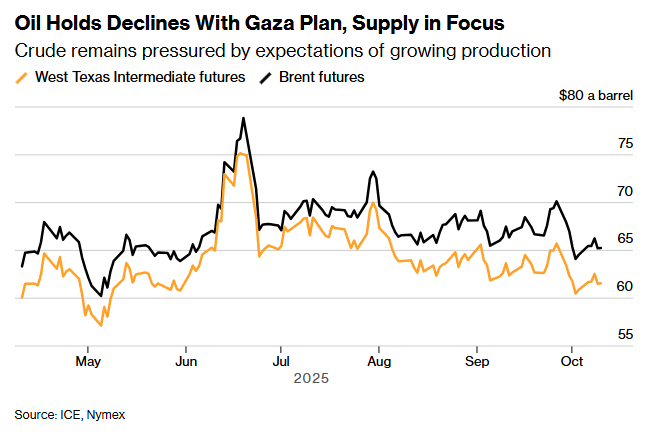
Group 1 - Oil prices have dropped to their lowest level since May, with WTI crude futures falling 5.32% to $58.24 per barrel and Brent crude futures down 4.75% to $62.12 per barrel, reflecting a weekly decline of 4.34% and 3.73% respectively [1][3] - The escalation of trade tensions between the U.S. and China, particularly President Trump's threat of imposing "large-scale tariffs" on Chinese goods, has raised concerns about the impact on oil consumption [1][3] - The market sentiment is further pressured by the easing of tensions in the Middle East, particularly Israel's withdrawal from Gaza, which has reduced the risk premium associated with oil supply from the region [3] Group 2 - Commodity Trading Advisors (CTAs) have significantly reduced their long positions, resulting in WTI crude's short position rising to 91% from 55% on October 9, indicating a bearish outlook [3] - The oil market is facing a "triple whammy" of trade tariff concerns, broader risk asset sell-offs, and systematic strategies that may increase short positions, leading to potential further declines in oil prices [3] - The increase in oil production from OPEC+ and the overall sentiment remaining bearish suggests a significant supply surplus in the oil market [3] Group 3 - The decline in oil prices may also be influenced by the "gamma effects," where a large number of put options at the $60 level could exacerbate volatility and lead to increased selling pressure if prices continue to drop [4]