伽马效应

Search documents
黄金破5000美元后,交易员还在疯狂买入看涨期权?
Jin Shi Shu Ju· 2026-01-27 01:36
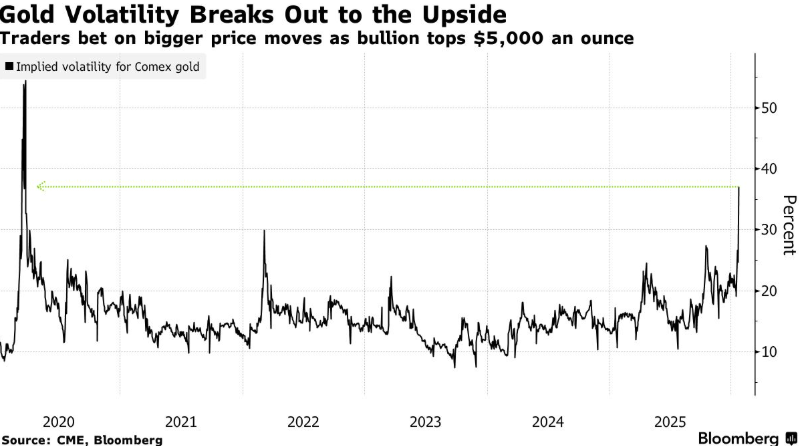
Group 1 - Gold prices have surged above $5,000 per ounce for the first time, prompting strong market reactions and bets from options traders that the upward trend will continue [1] - The increase in gold prices is attributed to a "currency devaluation trade," where investors are shifting from sovereign bonds and currencies to hard assets like gold and silver [1] - The volatility of gold futures on the New York Commodity Exchange (Comex) has reached its highest level since the peak of the pandemic in March 2020, with the SPDR Gold Shares ETF also experiencing significant volatility [1] Group 2 - A large number of bullish spread strategies have emerged in the options market, with significant trades in Comex gold futures, including nearly 5,000 contracts for a $5,500/$5,600 call spread [4] - As gold prices approach key strike levels, traders are rolling their positions upward, which may lead to a "gamma squeeze" driven by market makers needing to buy more futures contracts to balance their risk exposure [4] - Investors are also heavily buying call spread contracts for SPDR Gold Shares, with notable purchases of approximately 70,000 contracts for a $590/$595 call spread and 37,000 contracts for a $510/$515 call spread [7] Group 3 - The volatility and skew of call options in the silver market have also increased significantly, with over 35,000 contracts traded for a $125 call option expiring in May for the iShares Silver Trust [7] - The Comex silver futures market has seen trades of a 200-contract eagle spread for April with strike prices of $110, $120, $130, and $140 [7]

邓正红能源软实力:重构贸易规则投射 伽马效应放大 多因素共振 国际油价走低
Sou Hu Cai Jing· 2025-10-11 04:20
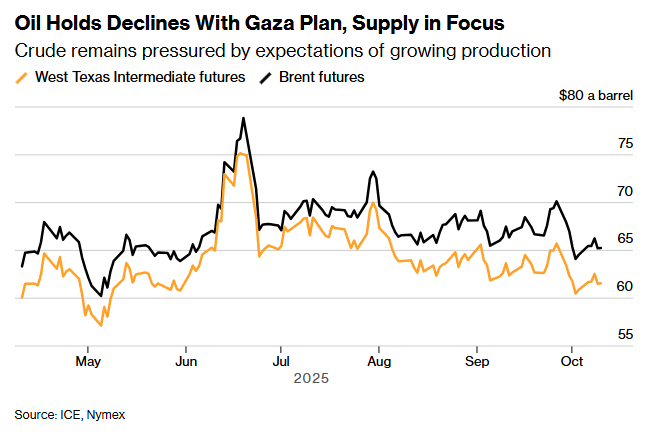
Group 1 - The core viewpoint of the articles revolves around the significant decline in oil prices due to geopolitical tensions, supply increases from OPEC, and market reactions to potential U.S. tariffs on foreign products [1][2][3][4] - Oil prices fell sharply on October 10, with West Texas Intermediate crude settling at $58.90 per barrel, down $2.61 (4.24%), and Brent crude at $62.73 per barrel, down $2.49 (3.82%) [1] - The market sentiment is influenced by President Trump's threats to raise tariffs, which has led to a reduction in risk positions among investors, indicating a potential slowdown in economic growth and demand [1][3] Group 2 - OPEC's continuous increase in supply has contributed to the downward pressure on oil prices, leading to a significant oversupply in the market [2][3] - The ceasefire agreement between Israel and Hamas has reduced geopolitical risks in the Middle East, which accounts for approximately 31.5% of global oil supply, further impacting market sentiment [2][3] - The "gamma effect" is noted, where a concentration of put options around the $60 per barrel mark could lead to increased volatility and further price declines as traders hedge their positions [2][4] Group 3 - The soft power theory framework suggests that the current oil price decline is a result of multiple soft power factors, including tariff threats, geopolitical stability, and OPEC's production adjustments [3][4] - The transition from "material pricing" to "rule pricing" is highlighted, indicating a shift in how oil prices are determined, influenced by geopolitical and economic factors rather than just supply and demand [4]

关税阴云与供应过剩前景双压 油价跌至5月以来新低
智通财经网· 2025-10-11 01:37
Group 1 - Oil prices have dropped to their lowest level since May, with WTI crude futures falling 5.32% to $58.24 per barrel and Brent crude futures down 4.75% to $62.12 per barrel, reflecting a weekly decline of 4.34% and 3.73% respectively [1][3] - The escalation of trade tensions between the U.S. and China, particularly President Trump's threat of imposing "large-scale tariffs" on Chinese goods, has raised concerns about the impact on oil consumption [1][3] - The market sentiment is further pressured by the easing of tensions in the Middle East, particularly Israel's withdrawal from Gaza, which has reduced the risk premium associated with oil supply from the region [3] Group 2 - Commodity Trading Advisors (CTAs) have significantly reduced their long positions, resulting in WTI crude's short position rising to 91% from 55% on October 9, indicating a bearish outlook [3] - The oil market is facing a "triple whammy" of trade tariff concerns, broader risk asset sell-offs, and systematic strategies that may increase short positions, leading to potential further declines in oil prices [3] - The increase in oil production from OPEC+ and the overall sentiment remaining bearish suggests a significant supply surplus in the oil market [3] Group 3 - The decline in oil prices may also be influenced by the "gamma effects," where a large number of put options at the $60 level could exacerbate volatility and lead to increased selling pressure if prices continue to drop [4]