商品周期轮动

Search documents
揭秘商品周期轮动密码:从贵金属-有色-化工-农产品,现在是到哪个阶段了?
对冲研投· 2026-01-27 07:49
Core Viewpoint - The article discusses the cyclical nature of commodity markets, highlighting the sequential rotation of different commodities as indicators of economic phases. It emphasizes that the current market signals suggest the beginning of a new commodity cycle, characterized by differentiation and rotation rather than a broad-based rally [1][13]. Group 1: Commodity Phases - The first phase of a commodity bull market typically features precious metals like gold and silver, which shine during economic uncertainty or stagflation, as seen since March 2024 with gold prices reaching $4000 per ounce [2][3]. - The second phase involves industrial metals, such as copper, which signal economic recovery as demand for raw materials increases when economic stimulus measures take effect. This phase began in November 2025 with rising copper prices [3][4]. - The third phase is marked by a surge in energy and chemical products, driven by overheating economies where demand for oil and related products spikes, often accompanied by inflationary pressures [4][5]. - The final phase sees agricultural products gaining traction, as their demand remains relatively stable regardless of economic conditions, often influenced by production costs and weather conditions [5][6]. Group 2: Current Market Analysis - Current market conditions indicate that gold has reached a historical high, signaling strong global demand for safe-haven assets and concerns about the traditional monetary system, marking a clear first phase signal [10]. - The strong performance of industrial metals suggests that market participants are pricing in expectations of economic recovery, with significant investments flowing into this sector [10][11]. - Energy and chemical products are still in a relatively low position, indicating that the global economy has not yet reached a stage of full operational capacity, suggesting that the third phase is still developing [10][11]. - Agricultural products are influenced more by specific supply and demand factors rather than broad economic trends, indicating that they are not yet in a position to lead the cycle [11][12]. Group 3: Macro Indicators - The dollar's decline since 2025 is noted as a favorable backdrop for commodity price increases, as historically, a weakening dollar correlates with rising commodity prices [12]. - The Baltic Dry Index (BDI) has shown signs of recovery since February 2025, which typically precedes a broader rise in commodity prices by 1-3 months, indicating increased global trade activity [12]. Group 4: Investment Strategy - The article suggests that the current market environment presents structural opportunities, particularly in precious metals and select industrial metals, which have clear investment logic supported by macro indicators [13][14]. - Energy and chemical sectors require patience as their comprehensive market movements depend on confirming signals of economic overheating, while agricultural investments should focus on specific supply narratives rather than broader trends [14].


地缘冲突与极寒天气影响 油气价格震荡上行
Shang Hai Zheng Quan Bao· 2026-01-26 19:16
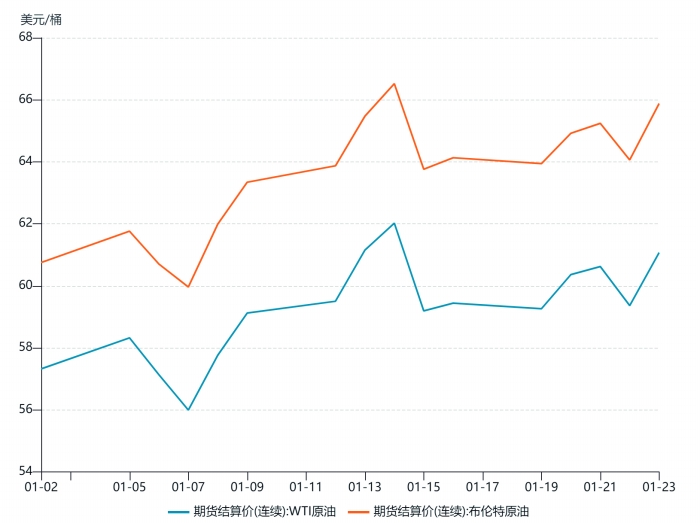
Group 1 - The oil and gas sector has seen a significant increase of 4.32% as of January 26, leading the A-share market, driven by geopolitical tensions and a surge in U.S. natural gas futures prices due to cold weather [2] - As of January 23, the price of light crude oil futures for March delivery on the New York Mercantile Exchange was $61.07 per barrel, while Brent crude oil futures for March delivery were priced at $65.88 per barrel [2] - Analysts indicate that international oil prices are influenced by geopolitical conflicts, supply-demand fundamentals, and expectations of Federal Reserve interest rate cuts, with recent tensions in Iran and Venezuela being key factors for short-term price fluctuations [3] Group 2 - The global oil market is likely to continue experiencing a supply surplus through 2026, with a low probability of a 25 basis point rate cut by the Federal Reserve at only 4.4% as of January [3] - The recent economic cycle suggests that during a Kondratiev winter phase, the oil sector should be closely monitored, as rising geopolitical uncertainties typically lead to price increases in oil following gains in gold and industrial metals [4] - Natural gas futures have rebounded significantly, with a 16.80% increase reported on January 26, reaching $6.156 per million British thermal units, attributed to extreme cold weather in the U.S. [4] Group 3 - The price changes in the energy market have quickly impacted domestic markets, with LNG pipeline gas prices rising to an average of 4200 yuan per ton, an increase of 350 yuan per ton from the previous trading day [5] - The current rebound in natural gas prices is primarily driven by weather anomalies rather than fundamental supply-demand shifts, with expectations of high volatility in U.S. natural gas futures prices in the short term [5]