
国家风险溢价

Search documents
高盛:日本国债收益率曲线不再反映国家风险溢价
Jin Rong Jie· 2026-02-16 06:39
Core Viewpoint - Current Japanese government bond yield curve no longer includes any "sovereign risk premium" according to Goldman Sachs analysts [1] Group 1: Yield Curve Analysis - The 10 to 30-year government bonds have returned to reasonable value, while the 2 to 10-year yield curve is only 10-15 basis points steeper than reasonable levels [1] - The elimination of uncertainty may be sufficient to remove some long-end risk premiums [1] Group 2: Market Sentiment - Recent price movements appear to have exceeded the influence of the single factor of uncertainty, leading the market to believe that the government and the Bank of Japan are capable of addressing "bad" fiscal tail risks [1]

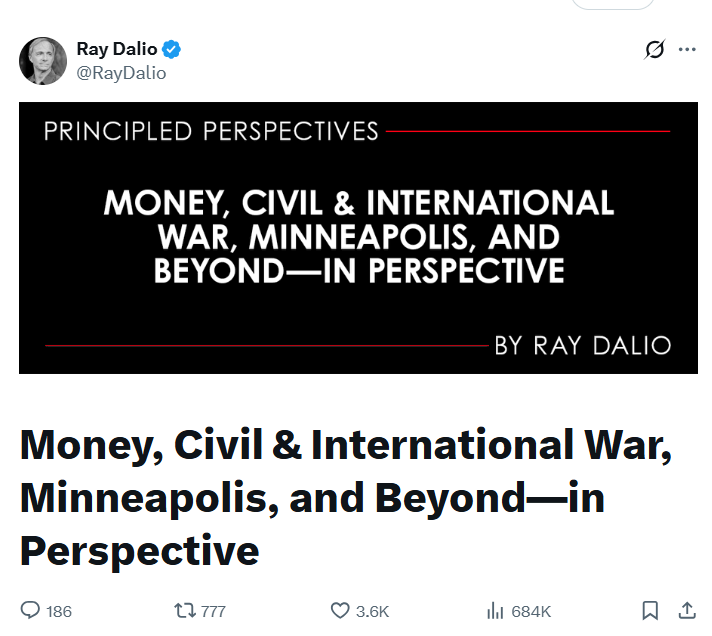
达利欧:美国已成火药桶,滑向“内战边缘”
华尔街见闻· 2026-01-28 10:15
Core Viewpoint - The article presents a dire warning from Ray Dalio, indicating that the United States is on the brink of systemic risk, transitioning from the fifth stage of a "debt cycle" to the sixth stage characterized by potential civil conflict and revolution [2][11]. Group 1: Characteristics of the Fifth Stage - The fifth stage is marked by a toxic combination of factors: uncontrolled fiscal deficits, high government debt, widening wealth gaps, and increasing political polarization [4][5]. - In this environment, class struggles intensify, leading to a breakdown of social order, with rising distrust and a decline in adherence to rules [5][6]. Group 2: Transition to the Sixth Stage - The transition from the fifth to the sixth stage is signaled by violent events, such as the recent killing of a protester in Minneapolis, which Dalio views as indicative of escalating conflict [7][8]. - Historical patterns suggest that significant economic distress and wealth inequality often precede civil unrest, with tax increases and spending cuts acting as leading indicators of potential conflict [9]. Group 3: Current Risks and Recommendations - Dalio describes the current state of the U.S. as a "tinderbox," emphasizing that the risks are structural rather than attributable to any single party or individual [11]. - The influence of moderates is diminishing, and a "winner-takes-all" mentality is becoming prevalent, creating significant uncertainty in the business environment [12]. - Despite the grim outlook, Dalio notes that there are historical precedents for avoiding violent conflict through painful but orderly debt restructuring and reform, although this requires a high degree of political consensus [13]. Group 4: Asset Protection Advice - In light of the impending risks associated with the sixth stage, Dalio advises on asset protection, emphasizing the importance of capital safety and the potential for capital controls as crises deepen [14][15]. - His principle of "When in doubt, get out" suggests that individuals and investors should consider leaving before conditions worsen, as opportunities for safe exit may diminish [15].


“美国已成火药桶!”达利欧:美国债务周期正从“财务恶化”滑向“内战边缘”
Hua Er Jie Jian Wen· 2026-01-28 03:31
Core Viewpoint - The article presents a dire warning from Ray Dalio, indicating that the United States is on the brink of systemic risk, transitioning from the fifth stage of a "debt cycle" to the sixth stage, characterized by civil unrest and revolution [1][4][12]. Group 1: Stages of the Debt Cycle - The fifth stage is marked by a toxic combination of economic dysfunction, including uncontrolled fiscal deficits, high government debt, widening wealth gaps, and increasing political polarization [5][14]. - In this stage, social order begins to collapse, leading to heightened class struggles and a significant rise in distrust among the populace [5][18]. - The transition to the sixth stage is signaled by violent events, such as the recent killing of protesters in Minneapolis, which Dalio views as indicative of escalating internal conflict [6][20]. Group 2: Economic and Social Indicators - Key indicators of the fifth stage include poor financial conditions, significant income and wealth disparities, and severe negative economic shocks [7][14]. - Areas with the highest income and wealth levels, such as San Francisco and New York, are also the most indebted and polarized, making them prime candidates for conflict [17]. - Historical patterns suggest that government financial bankruptcy and extreme wealth inequality are reliable predictors of civil unrest or revolution [16][22]. Group 3: Political Dynamics - The rise of populism and extreme political factions is a hallmark of the fifth stage, as moderate voices become marginalized [8][21]. - The article emphasizes that the current political climate is characterized by a lack of consensus and increasing polarization, which complicates the potential for peaceful resolution [19][21]. - Dalio warns that as the system becomes more dysfunctional, the likelihood of violent conflict increases, with leaders emerging who may exploit the chaos for their own agendas [20][23]. Group 4: Recommendations for Investors - In light of the impending transition to the sixth stage, Dalio advises investors to prioritize capital safety and consider exiting markets that may be affected by civil unrest [9][10]. - He highlights the risk of capital controls being implemented as governments attempt to manage the financial fallout from escalating conflicts [10][24]. - The overarching message is to remain vigilant and prepared for significant changes in the economic and political landscape, as historical precedents suggest that such transitions can lead to profound instability [22][24].
阿根廷达成30亿美元回购协议 力保主权债务不违约
Xin Lang Cai Jing· 2026-01-07 13:07
Core Viewpoint - Argentina has reached a $3 billion repurchase agreement with a group of banks to assist in paying off $4.3 billion in sovereign debt due on January 9 [1] Group 1: Financial Agreement - The agreement is for a one-year term with an interest rate of 7.4% [1] - The deal involves unnamed lending institutions [1] Group 2: Government Strategy - The Milei government is seeking to raise sufficient US dollars to meet its debt obligations while temporarily deciding not to return to the international bond market [1] - As part of the preparations, the Ministry of Economy conducted a debt swap with the central bank last week [1] Group 3: Market Implications - The debt swap helps accumulate dollar-denominated sovereign bonds as collateral, allowing for pledging in the repurchase structure [1] - Market focus will soon shift to the possibility of Argentina returning to the international market [1] - Officials have indicated that resolving the January debt maturity is a key step in further reducing the country's risk premium, which is currently at a multi-year low, and will pave the way for cheaper financing in the future [1]