地缘政治风险定价

Search documents
黄金暴跌30%后是抄底良机还是死亡陷阱?
Sou Hu Cai Jing· 2026-02-06 05:16
Core Viewpoint - The recent sharp decline in gold prices, exceeding 5% in a single day, has sparked significant concern and speculation within the investment community regarding whether this represents a buying opportunity or a deeper financial crisis [1]. Historical Context - Over the past two decades, the gold market has experienced three notable crashes, each followed by significant recoveries: - In 2008, gold prices fell from $1,032 to $680, a 34% drop, before reaching a historic high of $1,920 three years later [3]. - In April 2013, a single-day drop of 9.1% occurred during the "Chinese aunties vs. Wall Street" event, leading to a seven-year period of losses for buyers [3]. - In March 2020, gold prices fell alongside equities due to the pandemic but rebounded sharply due to the Federal Reserve's quantitative easing policies [3]. Common Patterns in Price Drops - Each of the three significant declines in gold prices was associated with a shift in U.S. Federal Reserve monetary policy, particularly when declines exceeded 30%: - The 1980s saw Paul Volcker's aggressive rate hikes end a gold bull market [5]. - In 2008, Ben Bernanke's quantitative easing helped stabilize the market [5]. - In 2020, Jerome Powell's liquidity measures reversed the downward trend [5]. Current Market Dynamics - The current gold market is characterized by conflicting pressures from the Federal Reserve, which is trying to balance high interest rates to combat inflation while managing risks in commercial real estate and employment data during an election year [6]. - Global inflation trends are also mixed, with fluctuating U.S. CPI data, Europe's energy crisis, and Japan's currency challenges affecting gold's traditional role as an inflation hedge [8]. - Geopolitical risks, such as the ongoing Russia-Ukraine conflict and Middle Eastern tensions, have not significantly influenced gold prices, indicating a shift in market sensitivity [8]. Investment Strategies - For investors with substantial capital, a recommended strategy is to create a "gold volatility arbitrage portfolio" by buying both call and put options to capitalize on high implied volatility [9]. - It is advised to limit physical gold holdings to 5%-8% of total assets and to pair these with dollar-denominated money market funds for liquidity [9]. - Caution is advised for retail investors, particularly regarding the purchase of gold bars, emphasizing the importance of verifying authenticity and avoiding excessive processing fees [9].

邓正红能源软实力:供应中断恐慌与增产博弈形成溢价 风险偏好改善油价走高
Sou Hu Cai Jing· 2025-08-26 03:00
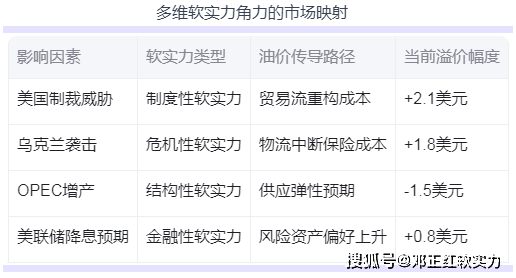
Core Insights - International oil prices have surged due to geopolitical risks, with a premium of $3.20 per barrel attributed to fears of Russian supply disruptions and OPEC's production increase dynamics [1][3] - The market is shifting towards a new paradigm of pricing based on geopolitical risks, influenced by sanctions and military actions affecting oil supply [1][5] Geopolitical Factors - The U.S. has threatened sanctions against Russia if no progress is made towards peace in Ukraine, and may impose tariffs on India for purchasing Russian oil [2] - Ukraine's drone attacks on Russian energy infrastructure have raised concerns about supply chain disruptions, leading to a reassessment of Russia's daily export risk of 5 million barrels [3][4] OPEC's Role - OPEC's reversal of production cuts is expected to alleviate concerns over Russian supply interruptions, potentially adding millions of barrels to the market [2][3] - Historical data suggests that similar geopolitical tensions have previously led to significant price fluctuations, such as a $7 swing during the Crimea crisis [3] Soft Power Model Insights - The "Deng Zhenghong Soft Power Model" quantifies the impact of geopolitical risks on oil prices, indicating that current premiums reflect expectations of supply disruptions lasting 8-12 weeks [3][4] - The model identifies various soft power influences on oil prices, including U.S. sanctions (+$2.1), Ukrainian attacks (+$1.8), OPEC's production increase (-$1.5), and expectations of U.S. interest rate cuts (+$0.8) [4] Future Scenarios - Three potential scenarios for oil prices have been outlined: 1. Base scenario (45% probability): Sanctions limited to secondary financial institutions, maintaining 80% of Russian exports, with a soft power premium of $2-3 per barrel until late October [4] 2. Escalation scenario (30% probability): Tariffs on India lead to a price surge of $5-7 per barrel, with WTI potentially exceeding $90 [4] 3. Easing scenario (25% probability): Diplomatic breakthroughs reduce premiums to below $1, though demand-side recession risks remain [4] Market Paradigm Shift - The market is transitioning from a traditional supply-demand framework to one dominated by geopolitical risk pricing, with soft power factors accounting for 37% of oil price influences by 2025, up from 22% in 2021 [5]