场外交易

Search documents
黄金税收新规落地,有银行实物金条卖断货,金店店员称暂未受影响
Sou Hu Cai Jing· 2025-11-03 23:19
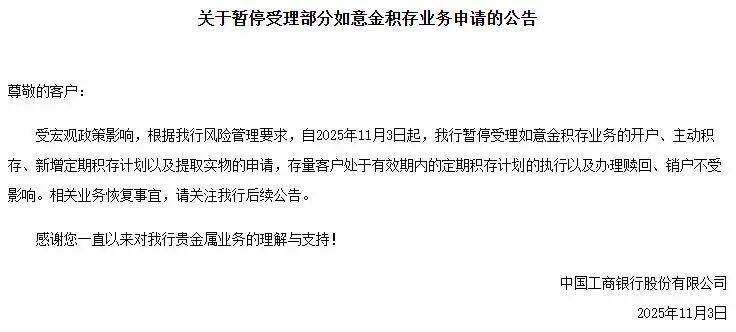
Core Viewpoint - The new tax policy on gold, announced by the Ministry of Finance and the State Taxation Administration, aims to refine the existing gold market regulations, particularly regarding the distinction between gold as a commodity and as a financial asset. The policy will exempt value-added tax (VAT) for transactions conducted through designated exchanges, effective from November 1, 2025, to December 31, 2027 [2][10]. Group 1: Tax Policy Changes - The new regulation states that transactions of standard gold through the Shanghai Gold Exchange and Shanghai Futures Exchange will be exempt from VAT for sellers, while non-exchange sales will still incur VAT as per existing regulations [2][10]. - The policy is designed to encourage on-exchange trading and reduce off-exchange transactions, which are subject to higher tax burdens [8][10]. Group 2: Impact on Financial Institutions - Industrial and Commercial Bank of China (ICBC) announced a suspension of certain gold accumulation services starting November 3, 2025, due to macroeconomic policy impacts, although existing plans for current customers remain unaffected [4][5]. - Similarly, China Construction Bank (CCB) will halt various gold-related services, including real-time purchases and physical gold exchanges, while existing investment plans will continue [6]. Group 3: Market Reactions - Following the announcement, there was a surge in demand for physical gold bars, leading to rapid sellouts at various banks [4][6]. - Despite the heightened activity in the physical gold market, the A-share gold sector has experienced a downturn, with significant declines in stock prices for several gold-related companies [6]. Group 4: Expert Insights - Experts suggest that the new tax regulations may lead to a price increase for gold jewelry, while the impact on investment gold remains uncertain [7][10]. - The policy aims to streamline the gold sales chain and reduce the accumulation of physical gold, potentially shifting investor interest towards paper gold and futures trading [10].

深圳水贝料商“再出事”:黄金场外交易的冰山一角?
Jing Ji Guan Cha Wang· 2025-09-16 12:20
Core Viewpoint - The recent closure of several gold trading companies in Shenzhen's Shui Bei area, including Junhao and Yuebaoxin, has sparked discussions about a potential crisis in the gold trading sector, particularly related to a risky trading model known as "private betting" on gold prices [1][2][3] Company Operations - Junhao and Yuebaoxin are identified as companies involved in gold trading, but their operations have been characterized by a lack of transparency and regulatory oversight, particularly in the area of gold recycling [4][18] - The companies have been accused of engaging in a trading model that deviates from traditional practices, focusing instead on speculative price betting rather than legitimate gold trading [2][9] Trading Model - The "private betting" model allows traders to lock in prices for gold without immediate delivery, creating a time gap that can lead to significant financial risks [6][10] - Instead of hedging against price fluctuations, these traders have been betting on price declines, which has backfired as gold prices have risen sharply [9][10] Market Impact - The failure of these companies has resulted in substantial financial losses for both the companies themselves and their clients, with reports of victims losing millions [11][12] - The incident has raised concerns about the stability of the gold trading ecosystem in Shui Bei, with many industry participants expressing a sense of inevitability regarding such crises [14][19] Regulatory Environment - The lack of clear regulatory oversight in the gold trading sector has allowed for the proliferation of risky trading practices, contributing to the current crisis [18][20] - Previous warnings from regulatory bodies have not effectively mitigated the risks associated with the trading practices in Shui Bei, indicating a need for more stringent enforcement [20]
稳定币,如何从灰色走到台前?
Hu Xiu· 2025-06-19 14:18
Group 1 - The core point of the article is the growing interest in stablecoins due to the upcoming implementation of the Hong Kong Stablecoin Regulation and the recent IPO of a stablecoin company in the US, which has seen its stock price rise significantly [1][2][90]. - Stablecoins are a type of cryptocurrency that is pegged to a fiat currency, providing stability in value, which has led to their increased adoption in the cryptocurrency market [49][55][66]. - The emergence of stablecoins was driven by the need for a reliable medium of exchange in the cryptocurrency space, especially after regulatory crackdowns on direct fiat-to-crypto transactions [66][94]. Group 2 - The article discusses the historical context of stablecoins, noting that they gained popularity after 2017 when traditional fiat channels for purchasing cryptocurrencies were restricted [66][94]. - The lack of regulatory oversight initially allowed for rapid expansion of stablecoin issuance, leading to concerns about the adequacy of reserves backing these coins [71][73]. - Recent enforcement actions against stablecoin issuers highlight the need for clearer regulations to ensure compliance and protect investors [82][86]. Group 3 - The article mentions that large institutions are now investing in cryptocurrencies and require stablecoins for transactions, emphasizing the importance of regulatory clarity for their participation [88][90]. - The Hong Kong Stablecoin Regulation is seen as a significant step towards legitimizing stablecoins as a financial service, encouraging more companies to engage in the market [94][97]. - There is speculation that stablecoins could play a role in alleviating the US debt crisis by indirectly supporting the purchase of US Treasury bonds through their backing [99][102].