
城市发展逻辑转变

Search documents
数量做减法质量做加法,打开首都发展新逻辑
Xin Lang Cai Jing· 2026-01-26 20:02
Core Viewpoint - Beijing is shifting its development strategy from quantity-focused growth to quality-driven development, emphasizing efficiency, quality, and sustainability in urban planning and economic growth [4]. Group 1: Achievements and Goals - During the "14th Five-Year Plan" period, Beijing reduced non-capital functions, decreasing urban construction land by approximately 50 square kilometers, while achieving an average GDP growth of 5.2% and surpassing economic milestones of 4 trillion and 5 trillion yuan [1]. - The "15th Five-Year Plan" outlines seven development goals and 13 specific tasks aimed at enhancing urban quality and promoting high-quality development [1][3]. Group 2: Industrial Transformation - Beijing has shifted from traditional scale expansion to a model driven by technology, knowledge, and high-value-added industries, successfully relocating over 594 general manufacturing enterprises and removing 1.2 million square meters of illegal constructions [2]. - The city has increased its industrial clusters from two to three in sectors such as information technology, artificial intelligence, and biomedicine, indicating a focus on high-tech industries [2]. Group 3: Urban Renewal and Infrastructure - Over the past five years, Beijing has implemented comprehensive renovations in over 2,600 old residential communities, added 41,000 public service spots, and increased the number of parks to 1,136, showcasing a commitment to urban renewal rather than expansion [2]. - The "15th Five-Year Plan" emphasizes urban renewal projects, including the renovation of over 300 old residential communities and the addition of 35,000 parking spaces, reflecting a focus on improving urban living conditions [3].
社论 | 公交免费,让群众更多分享发展红利
Xin Lang Cai Jing· 2026-01-05 16:39
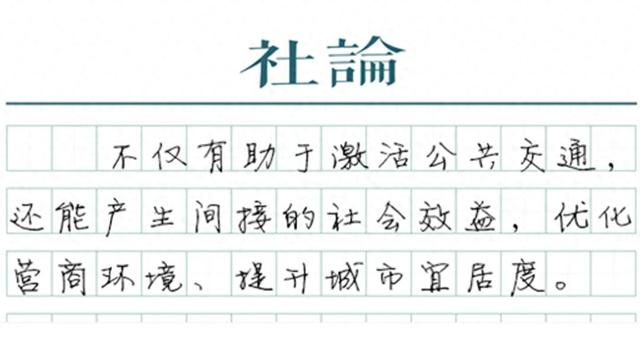
Core Viewpoint - The implementation of free public transportation in cities like Wuxue and Inner Mongolia's Zhungeerqi aims to reduce the financial burden on citizens while promoting public transport as a public good and enhancing low-carbon travel initiatives [3][4]. Group 1: Free Public Transport Implementation - Wuxue City has initiated free public transport for urban areas and three major industrial parks, effectively eliminating commuting costs for residents [3]. - Inner Mongolia's Zhungeerqi has also launched a free bus service for all residents, allowing access with valid identification or transport cards [3]. - The free transport policy is expected to save families significant amounts on monthly transportation costs, potentially leading to a greater sense of financial relief over time [3]. Group 2: Benefits and Strategic Importance - The free bus service is seen as a direct and effective way to encourage the public to prioritize public transport, aligning with national strategies to develop a public transport-centric urban traffic system [4]. - The policy addresses the declining attractiveness of public transport amidst the rise of private vehicles and ride-hailing services, aiming to reverse the cycle of reduced ridership and service frequency [4]. - In smaller cities, the marginal benefits of free public transport are higher due to concentrated populations and limited urban areas, making the policy more feasible [4]. Group 3: Financial and Social Implications - The financial commitment from local governments is significant, with Wuxue expected to spend over 38 million yuan annually on this initiative [4]. - The free transport policy not only revitalizes public transport but also has indirect social benefits, such as improving the business environment and enhancing urban livability [5]. - The shift in urban development logic reflects a growing focus on citizen experiences in public services rather than solely on GDP growth [5]. Group 4: Operational Considerations - While free transport is a positive step, optimizing route layouts and scheduling is crucial for effective governance and service delivery [6]. - Ensuring the sustainability of financial support for the free transport initiative requires careful budgeting and operational efficiency [6]. - The initiative represents a commitment to public welfare and a vision for a greener, more convenient urban lifestyle [6].

从“苏超力量”看城市发展逻辑转变
Xin Hua Ri Bao· 2025-08-26 07:25
Core Perspective - The emergence of "Su Super" reflects a shift in urban development logic from a material-oriented approach to a people-oriented approach, emphasizing emotional resonance and multi-dimensional collaboration [1][2][4][5][7][8] Group 1: Transition in Urban Development Logic - The transition from "material-oriented" to "people-oriented" development highlights the awakening of public participation, where citizens evolve from passive spectators to active participants in urban growth [2] - The shift from "homogeneous cities" to "unique cities" emphasizes the importance of cultural identity, where local characteristics become core competitive advantages [3] - The change from "function satisfaction" to "emotional resonance" indicates a focus on fulfilling emotional needs rather than just material requirements [4] Group 2: Economic and Structural Implications - The movement from "resource dependence" to "demand-driven" growth reflects a transformation in consumption preferences, prioritizing emotional experiences over mere material satisfaction [5][6] - The evolution from "single entity" to "multi-party collaboration" in urban governance promotes shared responsibilities and cooperative strategies among various stakeholders [7] - The transition from "local circulation" to "global outreach" signifies the need for cities to expand their influence beyond local boundaries, enhancing their attractiveness and competitive edge [8]
