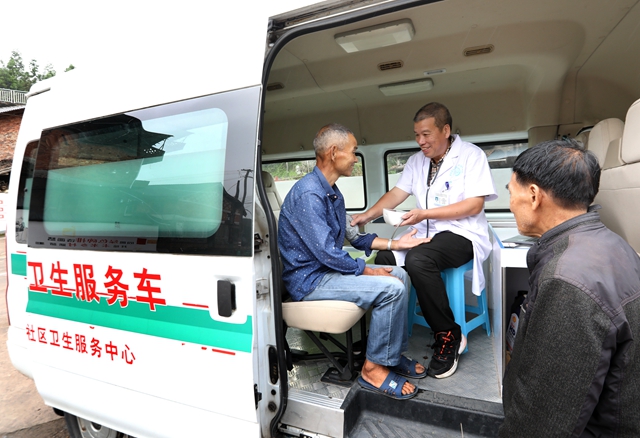
基层医疗服务提升

Search documents
国家卫生健康委:今年将开展基层儿科诊疗和县域心理门诊扩容等为民服务实事项目
Yang Guang Wang· 2026-02-13 01:29
Core Viewpoint - The National Health Commission and other departments are focusing on enhancing pediatric services and mental health care in grassroots medical institutions, with specific initiatives including the expansion of pediatric diagnosis and treatment, the introduction of free HPV vaccinations, and the mutual recognition of medical examination results across hospitals [1] Group 1: Pediatric Services - The enhancement of pediatric service capabilities is prioritized, with plans to add 1,000 township health centers and community health service centers to provide diagnosis and treatment for common pediatric diseases [1] - Grassroots medical institutions are encouraged to establish dedicated pediatric departments and to offer weekend outpatient services [1] Group 2: Mental Health Services - The goal is to add 110 counties providing mental health outpatient services, improving the capacity for mental health and psychiatric care at the grassroots level [1] - By the end of November this year, at least one county-level public hospital in populous counties with high demand is expected to offer mental health outpatient services [1] Group 3: HPV Vaccination - The HPV vaccine will be included in the national immunization program by 2025, providing free vaccinations for girls who turn 13 years old after November 10, 2011, with two doses of the bivalent HPV vaccine [1] - HPV vaccination efforts are set to begin in late February, with a focus on ensuring sufficient vaccine supply through dynamic coordination [1] Group 4: Medical Examination Mutual Recognition - The National Health Commission aims to promote mutual recognition of at least 300 medical examination items among secondary and higher-level medical institutions, using cities as the basic unit for implementation [1]
国家卫健委:今年将新增普惠托位15万个 加大资金投入保障
Zhong Guo Jing Ying Bao· 2026-02-12 14:29
Core Viewpoint - The National Health Commission plans to increase the number of inclusive childcare spaces significantly by 2026, aiming to enhance family welfare and support population development [1][2]. Group 1: Inclusive Childcare Expansion - By 2025, an additional 890,000 inclusive childcare spaces will be created, followed by another 150,000 in 2026, supported by increased central budget investments [1]. - The focus on "inclusive" childcare is intended to meet public demand and improve service accessibility, allowing more families to benefit from affordable and standardized childcare services [1][2]. Group 2: Service Quality Improvement - The National Health Commission will implement actions to enhance the quality of childcare services, including strengthening the workforce and establishing fixed connections between healthcare institutions and childcare providers [2]. - A comprehensive regulatory mechanism will be developed to ensure the health and safety of infants and toddlers, thereby increasing parental confidence in childcare services [2]. Group 3: Broader Health Initiatives - The 2026 health service initiatives include the addition of 1,000 town health centers and community health service centers to provide pediatric care, as well as 350 centers offering dialysis services [3]. - Mental health services will be expanded to 110 counties, aiming for full coverage in densely populated areas by the end of 2026 [3]. - The government will also provide free HPV vaccinations for girls aged 13, with a focus on preventing cervical cancer [3][4]. Group 4: Maternal and Child Health Services - In 2026, early pregnancy care clinics will be promoted in 10,000 medical institutions, offering comprehensive support including nutrition and psychological counseling [5]. - The initiative will also include training for 3,200 healthcare professionals to enhance collaboration between Western and traditional Chinese medicine [5].
织密基层医疗“健康网”
Xin Lang Cai Jing· 2026-01-20 18:52
Group 1 - The core focus for 2025 is to enhance the accessibility of quality healthcare services for employees and the public by improving the grassroots medical service capacity [1] - There is a strong emphasis on expanding and balancing the distribution of quality medical resources to meet the healthcare needs of the community [1] - The initiative aims to strengthen the grassroots health talent team to ensure effective healthcare delivery [1]
【宝鸡】让群众在“家门口”好就医
Shan Xi Ri Bao· 2026-01-14 00:04
Core Viewpoint - Baoji City is enhancing its grassroots healthcare services by establishing a comprehensive network of traditional Chinese medicine clinics and optimizing medical resources to improve accessibility and treatment effectiveness for residents [2][3][4]. Group 1: Healthcare Infrastructure Development - Baoji City has achieved full coverage of community health service centers and traditional Chinese medicine clinics, with 140 standardized TCM facilities established in community health service stations and village clinics [2][4]. - The city has built 149 standardized town health centers and 1,637 village clinics, creating a grassroots medical service network that allows urban residents to access services within 15 minutes and rural residents within 30 minutes [4]. Group 2: Service Model Innovation - The implementation of family doctor services has been pivotal in enhancing grassroots healthcare capabilities, with 1,185 family doctor teams established and an 87% coverage rate for key populations [7]. - Family doctors provide personalized services for vulnerable groups, including home visits and chronic disease management, addressing the challenges of accessibility for elderly and immobile residents [7]. Group 3: Talent Development and Training - Baoji City has launched a special program to recruit university graduates as village doctors, aiming to strengthen the healthcare workforce in rural areas [8]. - A systematic training and support mechanism has been established, involving collaboration between higher-level hospitals and county-level hospitals to improve the capabilities of local healthcare providers [8].
省政府召开座谈会征求对政府工作报告和“十五五”规划纲要草案的意见建议
Da Zhong Ri Bao· 2026-01-13 01:12
Group 1 - The meeting was convened to gather opinions on the "Government Work Report (Draft for Comments)" and the "14th Five-Year Plan Outline Draft" from grassroots representatives and experts [1] - Key discussion topics included expanding domestic demand, developing new productive forces, promoting "Artificial Intelligence +", supporting the private economy, high-level opening up, rural revitalization, cultural prosperity, community governance innovation, quality education resource supply, enhancing grassroots medical services, and new employment form protections [1] - The Vice Governor Zhang Haibo acknowledged the suggestions made by participants and expressed commitment to incorporate these insights into the revisions of the two documents and future work planning [1]
浙江聚焦基层医疗领域突出问题抓实整改提升群众就医便捷度满意度
Zhong Yang Ji Wei Guo Jia Jian Wei Wang Zhan· 2025-06-16 03:16
Group 1 - The core viewpoint emphasizes the need for improved medical services in rural areas of Zhejiang Province, focusing on enhancing patient experience and reducing medical burdens through initiatives like "mutual recognition of inspection results" and "more convenient chronic disease medication" [2][3][4] - Zhejiang Province has achieved mutual recognition of inspection results across all secondary and above public medical institutions and community health service centers, with over 1.7075 million long prescriptions issued for chronic diseases [4][10] - The implementation of the "mutual recognition" system aims to address issues of repeated and multiple inspections, enhancing efficiency and reducing costs for patients [5][6][7] Group 2 - The Zhejiang Provincial Commission for Discipline Inspection and Supervision has organized efforts to improve the mutual recognition of inspection results, establishing a unified coding system for inspection items and creating a data pool for better information sharing [6][7] - The "chronic disease long prescription" initiative allows patients to receive prescriptions for 4 to 12 weeks, significantly improving access to necessary medications for chronic conditions [10][13] - Various local health departments are implementing measures to ensure the availability of essential medications and streamline the prescription process, enhancing patient satisfaction and access to care [11][12][14] Group 3 - The introduction of mobile medical services, such as the use of medical vans, aims to reach underserved populations in remote areas, ensuring that healthcare services are accessible [14][15] - The Zhejiang Province has over 500 mobile medical units operating, providing coverage to rural and mountainous regions, thereby addressing healthcare disparities [15] - Continuous monitoring and evaluation of healthcare services are being conducted to ensure quality and efficiency, with local health authorities actively involved in oversight [16][17]