
增值税加计抵减政策

Search documents
我的收入到底算劳务报酬还是经营所得?
蓝色柳林财税室· 2026-01-25 02:02
Group 1 - The article discusses the distinction between business income and labor remuneration, emphasizing that business income is derived from stable institutional operations and continuous business activities, while labor remuneration is obtained from independent labor activities [2][5]. - Specific categories of business income include sales of goods, transportation services, and construction services, whereas labor remuneration includes various forms of service income [2][4]. - The article highlights the importance of correctly identifying the type of income to avoid tax risks, advising individuals to consult tax authorities if uncertain [5]. Group 2 - The article outlines the VAT preferential policy for advanced manufacturing enterprises, which allows eligible companies to deduct an additional 5% of the current deductible input tax from their payable VAT from January 1, 2023, to December 31, 2027 [13]. - Advanced manufacturing enterprises are defined as high-tech enterprises recognized according to specific regulations, and the list of eligible companies is determined by local industrial and information departments in conjunction with tax authorities [11][12]. - The application timeline for companies to enjoy the VAT deduction policy is specified, with existing high-tech enterprises required to submit applications from June 1 to June 10, 2025, and new applicants from September 1 to September 10, 2025 [17].


先进制造业企业,增值税加计抵减政策详解!
蓝色柳林财税室· 2026-01-05 09:55
Policy Overview - From January 1, 2023, to December 31, 2027, advanced manufacturing enterprises are allowed to deduct 5% of the current deductible input tax from their payable value-added tax (VAT) [2] - The policy is based on the announcement by the Ministry of Finance and the State Administration of Taxation regarding the VAT deduction policy for advanced manufacturing enterprises [2] Eligible Entities - Advanced manufacturing enterprises refer to general VAT taxpayers that are high-tech enterprises, including their non-legal branches [2] - High-tech enterprises are defined according to the regulations set forth by the Ministry of Science and Technology, Ministry of Finance, and State Administration of Taxation [2] Deduction Scenarios - Advanced manufacturing enterprises calculate their payable VAT before deduction and distinguish the following scenarios for the additional deduction: 1. If the payable VAT before deduction is zero, the entire current deductible additional deduction amount can be carried forward to the next period [3] 2. If the payable VAT before deduction is greater than zero and exceeds the current deductible additional deduction amount, the entire current deductible additional deduction amount is deducted from the payable VAT [3] 3. If the payable VAT before deduction is greater than zero but less than or equal to the current deductible additional deduction amount, the payable VAT is reduced to zero using the current deductible additional deduction amount; any remaining amount can be carried forward to the next period [3] Additional Notes - Advanced manufacturing enterprises can claim additional deductions that were eligible but not claimed in the current period [5] - Enterprises must separately account for the changes in the additional deduction amount, including claims, deductions, adjustments, and balances [7] - Enterprises that meet multiple VAT deduction policies can choose one to apply but cannot combine them in the same period [7]
【关注】关于开展2025年度享受增值税加计抵减政策的集成电路企业清单制定工作的通知工信部联电子函〔2025〕234号
蓝色柳林财税室· 2025-09-24 09:22
Core Viewpoint - The Ministry of Industry and Information Technology, along with other governmental bodies, has issued a notice regarding the establishment of a list of integrated circuit companies eligible for the VAT deduction policy for the year 2025, emphasizing the importance of compliance and timely application submission [2][3][4]. Group 1: Application Process - Companies wishing to be included in the list must submit their applications between September 25-30 and October 9-14, 2025, through the information reporting system, along with necessary supporting documents [4][5]. - Companies already listed in 2024 must reapply by submitting relevant materials as specified in the detailed submission list [4][5]. Group 2: Review and Confirmation - Local departments will conduct an initial review of the applications and submit the approved list to the Ministry of Industry and Information Technology and the National Development and Reform Commission by October 31 [4][5]. - A third-party organization will conduct a review based on the submitted information, leading to a final confirmation of the list by the relevant ministries [4][5]. Group 3: Policy Benefits and Compliance - Companies listed for 2025 will enjoy the VAT deduction policy starting January 1, 2025, while those not included will cease to enjoy the benefits from November 30, 2025 [5]. - Any significant changes in a company's status, such as name changes or mergers, must be reported within specified timeframes to maintain eligibility for the policy [6]. Group 4: Regulatory Oversight - Local departments will enhance daily supervision of the listed companies, and any fraudulent claims will be investigated and reported for further action [6][7]. - Companies are responsible for the authenticity of their submitted materials and must sign a commitment letter regarding the truthfulness of their applications [6].

【关注】关于开展2025年度享受增值税加计抵减政策的集成电路企业清单制定工作的通知工信部联电子函〔2025〕234号
蓝色柳林财税室· 2025-09-24 06:50
Core Viewpoint - The Ministry of Industry and Information Technology, along with other governmental bodies, has issued a notice regarding the establishment of a list of integrated circuit companies eligible for the VAT deduction policy for the year 2025 [2][3]. Group 1: Application Process - Companies wishing to be included in the list must submit their applications between September 25-30 and October 9-14, 2025, through the information reporting system, along with necessary supporting documents [4]. - Companies already listed in 2024 must re-submit relevant materials to apply for the 2025 list [4]. - Local departments will conduct preliminary reviews and submit approved lists to the Ministry of Industry and Information Technology by October 31 [4]. Group 2: Review and Confirmation - The Ministry of Industry and Information Technology will collaborate with other departments to conduct a review based on the submitted information, leading to a final confirmation of the list [4][5]. - Companies can check their inclusion status in the list after November 30, 2025, and those listed will enjoy the policy benefits starting January 1, 2025 [5]. Group 3: Changes and Compliance - Companies must report any significant changes such as name changes, mergers, or major business shifts within 45 days of registration [5]. - Local departments will not accept late submissions, and companies failing to report changes will lose eligibility for the policy [5][6]. - Regular supervision will be conducted by local departments to ensure compliance, and any fraudulent claims will be investigated [6].
【涨知识】6小问带您了解先进制造业企业增值税加计抵减政策
蓝色柳林财税室· 2025-09-01 01:34
Core Viewpoint - The article discusses the implementation of a VAT deduction policy for advanced manufacturing enterprises in China, allowing them to deduct 5% of their deductible input VAT from their payable VAT from January 1, 2023, to December 31, 2027 [3]. Group 1: VAT Deduction Policy - Advanced manufacturing enterprises can deduct 5% of their deductible input VAT from their payable VAT during the specified period [3]. - To apply for this policy, enterprises must submit application materials through the High-tech Enterprise Recognition Management System and will enjoy the policy after approval [3]. - Any deductible amount that has not been claimed can be accounted for in the period when the policy is applicable [3]. Group 2: Corporate Income Tax Implications - The portion of VAT deducted under this policy is subject to corporate income tax, as it does not meet the criteria for non-taxable income [3]. - According to the relevant regulations, any financial funds received from government departments that meet specific criteria can be excluded from taxable income when calculating the taxable income [3].

涉税名词一起学|增值税加计抵减系列问题(1)增值税“加计抵减”是个啥政策?
蓝色柳林财税室· 2025-08-27 08:41
Core Viewpoint - The article discusses the VAT incremental deduction policy, which allows specific taxpayers to calculate a deduction amount based on a certain percentage of the current deductible input tax, thereby reducing their VAT burden [3][4]. Group 1: Policy Explanation - The VAT incremental deduction policy is a tax incentive that enables eligible taxpayers to deduct an additional percentage of their deductible input tax from their VAT payable [3]. - For example, if a company purchases raw materials worth 10,000 yuan and can deduct 1,300 yuan in input tax, under this policy, it can calculate an additional 5% (65 yuan) to further reduce its VAT liability [4]. Group 2: Applicable Industries - The advanced manufacturing industry is included in the sectors eligible for this policy, allowing these enterprises to benefit from the VAT incremental deduction [4]. Group 3: Policy Duration - The policy is effective from January 1, 2023, to December 31, 2027, as per the announcement by the Ministry of Finance and the State Taxation Administration [4].

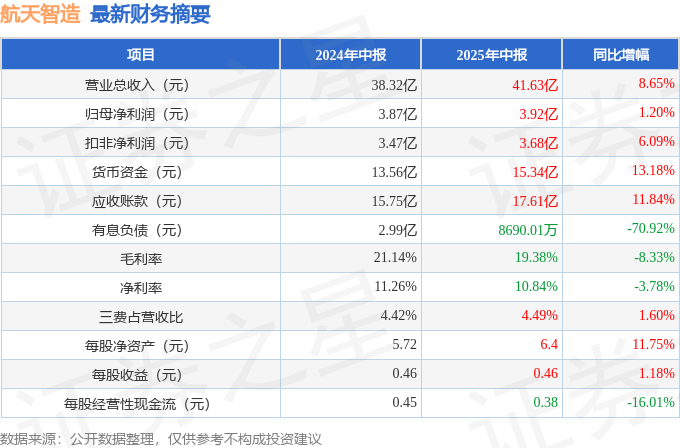
航天智造2025年中报简析:营收净利润同比双双增长,公司应收账款体量较大
Zheng Quan Zhi Xing· 2025-08-26 23:09
Core Viewpoint - Aerospace Intelligence (航天智造) reported a moderate increase in revenue and net profit for the first half of 2025, with concerns regarding accounts receivable and declining profit margins [1][2]. Financial Performance - Total revenue for the first half of 2025 reached 4.163 billion yuan, an increase of 8.65% year-on-year [1]. - Net profit attributable to shareholders was 392 million yuan, up 1.2% year-on-year [1]. - In Q2 2025, total revenue was 2.008 billion yuan, a year-on-year increase of 3.73%, while net profit decreased by 6.48% to 206 million yuan [1]. - The gross margin was 19.38%, down 8.33% year-on-year, and the net margin was 10.84%, down 3.78% year-on-year [1]. - The company’s accounts receivable accounted for 222.43% of the latest annual net profit, indicating a significant concern regarding cash flow [1][3]. Key Financial Metrics - The company’s operating cash flow per share was 0.38 yuan, a decrease of 16.01% year-on-year [1]. - Earnings per share remained stable at 0.46 yuan, reflecting a slight increase of 1.18% year-on-year [1]. - The total liabilities decreased significantly by 70.92% to 86.9 million yuan [1]. - The company’s net assets per share increased by 11.75% to 6.4 yuan [1]. Business Segments - The automotive parts business saw a revenue increase of approximately 10%, benefiting from a 13% year-on-year growth in passenger car sales [4]. - The oil and gas equipment segment maintained performance compared to the previous year, while the high-performance functional materials segment experienced a decline due to market changes [4].

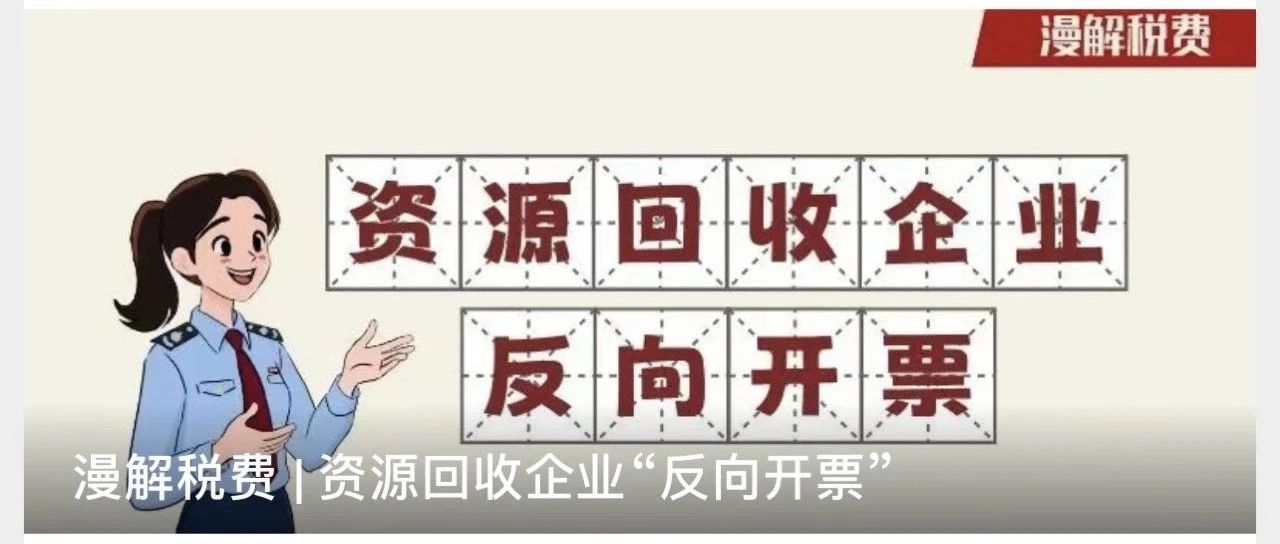
漫资源回收企业“反向开票”
蓝色柳林财税室· 2025-08-26 00:44
Group 1 - The implementation of "reverse invoicing" for resource recovery enterprises aims to enhance the convenience of obtaining invoices when purchasing scrapped products from individuals [3] - "Scrapped products" are defined as products that have lost all or part of their original utility value due to social production and consumption [3] - "Sellers" refer to individuals selling their used scrapped products or those purchased for resale, with cumulative sales not exceeding 5 million yuan (excluding VAT) within a continuous period of 12 months [3] Group 2 - Resource recovery enterprises must meet specific conditions, such as obtaining the hazardous waste operation license for hazardous waste collection [3] - For scrapped vehicle recovery, enterprises must comply with national regulations and obtain the qualification certificate for scrapped vehicle recovery and dismantling [3] - Other resource recovery enterprises must register as business entities and complete the filing with the Ministry of Commerce according to national regulations [3] Group 3 - Resource recovery enterprises can be either units or individual businesses when implementing "reverse invoicing" [3] - When resource recovery enterprises issue "reverse invoices" to sellers, they are also required to handle VAT and additional tax fees on behalf of the sellers [3]
为啥租起重机带不带司机,税率差4个点?
蓝色柳林财税室· 2025-08-26 00:44
Tax Policy Insights - The article discusses the tax rate differences for crane rental services, highlighting a 13% tax rate versus a 9% tax rate based on whether the rental includes operators and maintenance [5][11]. - It emphasizes that taxpayers renting construction equipment must provide operators and maintenance services, which can influence the choice of rental service based on tax implications [5]. Advanced Manufacturing Tax Policies - Advanced manufacturing enterprises cannot simultaneously enjoy multiple VAT deduction policies; they must choose the most favorable one without overlapping in the same period [14]. - Exported goods and services by advanced manufacturing enterprises do not qualify for VAT deduction policies, and the corresponding input tax cannot be claimed for deductions [15]. - Unclaimed VAT deductions can be accounted for in the current period if the advanced manufacturing enterprise decides to apply the deduction policy [16].

GHW INTL发盈喜,预计中期纯利增加至约800万元
Zhi Tong Cai Jing· 2025-08-20 12:48
Core Viewpoint - GHW International (09933) expects a net profit of approximately RMB 8 million for the six months ending June 30, 2025, compared to a net profit of approximately RMB 4.4 million for the six months ending June 30, 2024, indicating a significant increase in profitability driven by foreign exchange gains and other income [1] Financial Performance - The anticipated net profit for the upcoming period represents an increase of approximately 81.82% compared to the previous period's net profit [1] - The increase in net profit is primarily attributed to a rise in other income due to foreign exchange gains from the appreciation of currencies such as the Russian Ruble and Mexican Peso against the RMB [1] - Additional income of approximately RMB 7.5 million was generated from the VAT rebate policy, which contributed positively to the overall financial performance [1] Market Conditions - The increase in net profit was partially offset by a decrease in gross profit due to intensified market competition resulting from the expansion of market supply for certain self-produced and traded products [1]