
外汇便利化改革

Search documents
国家外汇管理局山西省分局四方面发力落实落细外汇便利化改革政策
Sou Hu Cai Jing· 2026-02-26 02:48
Core Viewpoint - The State Administration of Foreign Exchange (SAFE) in Shanxi Province aims to enhance foreign exchange services and facilitate the development of the local economy by implementing targeted reforms and policies by 2026 [1] Group 1: Trade Facilitation Reforms - The focus will be on optimizing and expanding policies to support new trade formats such as cross-border e-commerce and intermediate goods trade [1] - Support will be provided for enterprises involved in the Belt and Road Initiative to conduct flexible trade settlements [1] - A pilot program for categorizing service trade entities will be implemented across the province [1] Group 2: Cross-Border Financing - The policies for cross-border financing will be enhanced, particularly for high-tech, "specialized and innovative," and technology-based small and medium-sized enterprises [1] - The implementation of a unified currency pool policy for multinational companies will be promoted throughout the province [1] Group 3: Direct Investment Management - The management of foreign direct investment will be optimized to facilitate the payment and use of foreign investment funds [1] - A unified management approach for domestic enterprises lending abroad will be implemented [1] Group 4: Banking Reform - There will be an emphasis on policy promotion to guide banks in orderly participation and expansion of services [1] - The coverage of first-class enterprises will be enhanced to create a more trustworthy and convenient foreign exchange environment [1]
国家外汇管理局上海市分局:加大力度支持贸易新业态发展,提高个人用汇便利化水平
Xin Lang Cai Jing· 2026-01-26 15:53
Group 1 - The core viewpoint of the article is the strategic focus of the Shanghai Foreign Exchange Management Bureau for 2026, emphasizing the importance of enhancing foreign exchange management and services in the region [1] Group 2 - The first key point highlights the continuous deepening of foreign exchange facilitation reforms, optimizing trade foreign exchange business management, and increasing support for new trade formats, while improving personal foreign exchange convenience [1] - The second key point discusses the steady advancement of high-level openness in the foreign exchange sector, promoting banking foreign exchange business reforms in a prudent manner, and exploring integrated reform innovations in the Shanghai Free Trade Zone [1] - The third key point addresses the need for risk prevention following business reforms, optimizing business models, enhancing risk assessment of facilitation policies, and strengthening monitoring of large and unusual capital flows [1] - The fourth key point emphasizes the use of technology to enhance capabilities, continuing to develop cross-border financial service platforms, and exploring the construction of a "smart foreign exchange management" system [1]
国家外汇局:将出台境外放款、国内外汇贷款资金管理等政策
Sou Hu Cai Jing· 2026-01-15 08:38
Core Viewpoint - The press conference held by the State Council Information Office on January 15 highlighted the effectiveness of monetary and financial policies in supporting the high-quality development of the real economy, with a focus on enhancing foreign exchange management systems for better convenience, openness, security, and intelligence [1]. Group 1: Financial Services to the Real Economy - The fundamental purpose is to enhance financial services for the real economy by deepening foreign exchange facilitation reforms and boosting high-quality development vitality [1]. - There will be an optimization of trade foreign exchange business management and an orderly expansion of high-level opening-up pilot projects for cross-border trade and investment [1]. - Support will be provided for new trade formats such as cross-border e-commerce and market procurement trade, along with facilitating electronic transaction information for payment institutions and banks [1]. Group 2: High-Level Opening-Up - The focus will be on promoting high-level opening-up in the foreign exchange sector, aiding win-win cooperation through the internationalization of the Renminbi and high-quality opening of capital projects [2]. - New policies will be introduced for overseas loans and domestic foreign exchange loan fund management to better support enterprises in going global and developing foreign trade [2]. - The implementation of cross-border capital centralized operation management for multinational companies will enhance fund turnover efficiency and reduce financial costs for enterprises [2]. Group 3: Foreign Exchange Market Development - The strategy includes promoting a robust foreign exchange market while enhancing regulatory capabilities to maintain stable market operations [3]. - There will be improvements in exchange rate risk management, with financial institutions encouraged to develop user-friendly hedging products to lower costs for small and medium-sized enterprises [3]. - The focus will also be on strengthening non-site regulatory capabilities and combating illegal cross-border financial activities [3]. Group 4: Capacity Enhancement - The emphasis will be on improving the effectiveness of foreign exchange policy implementation and ensuring that policies reach enterprises and residents effectively [3]. - There will be a steady exploration of building a "smart foreign exchange management" system to enhance the digitalization of foreign exchange management and service [3].
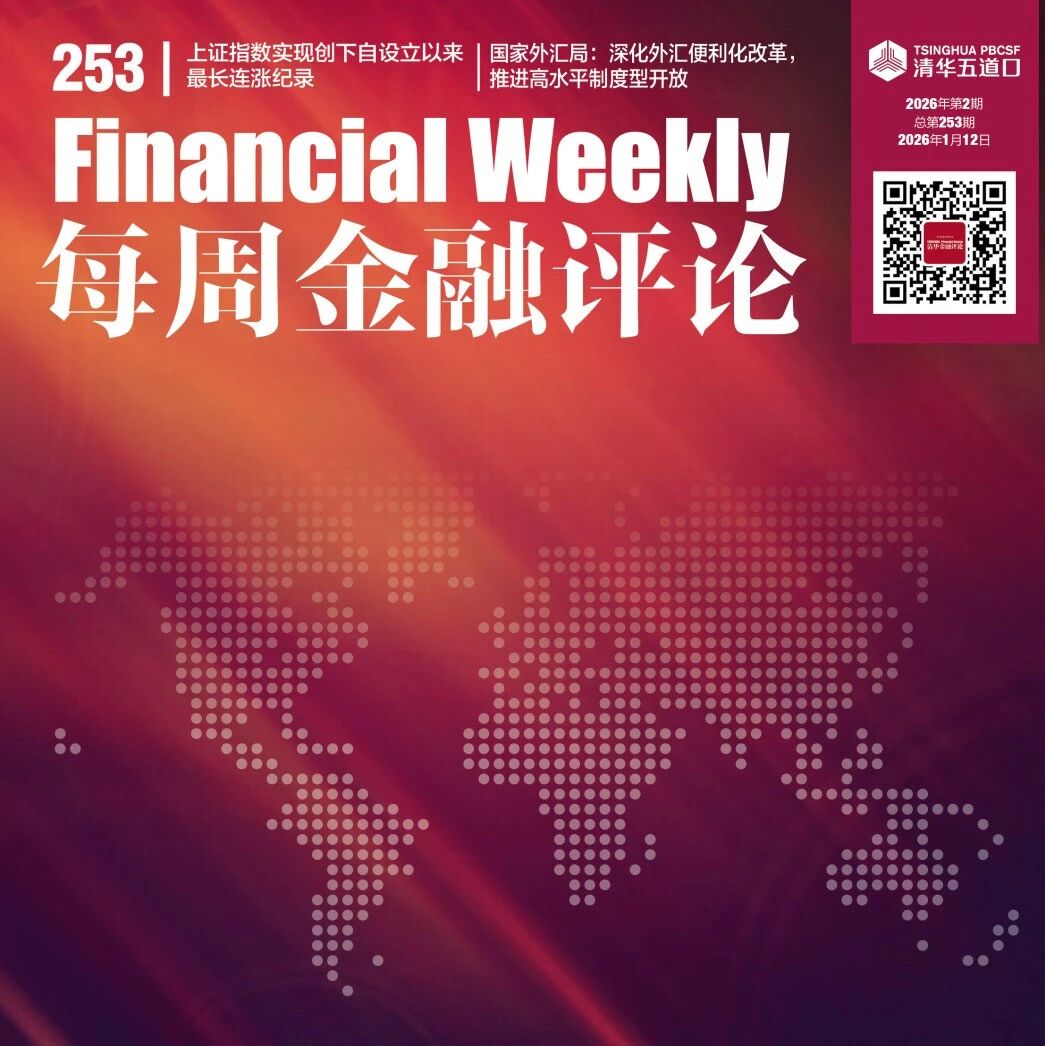
上证指数创下自设立以来最长连涨纪录;国家外汇局:深化外汇便利化改革,推进高水平制度型开放|每周金融评论(2026.1.5-2026.1.11)
清华金融评论· 2026-01-12 10:16
Key Points - The Shanghai Composite Index achieved a 17-day consecutive rise, marking the longest streak since its establishment, closing at 4165.29 points on January 12, 2026, with a trading volume exceeding 3 trillion yuan [8][9]. - The National Foreign Exchange Administration is deepening foreign exchange facilitation reforms and promoting high-level institutional opening [9][10]. - The China Securities Regulatory Commission has significantly increased the rewards for whistleblowers reporting securities and futures violations, with the maximum reward rising from 100,000 yuan to 1 million yuan for serious cases [12][13]. - The insurance industry reported a premium income of 5.76 trillion yuan for the first 11 months of 2025, reflecting a year-on-year growth of 7.6%, driven by strong performance in life insurance [14]. - The People's Bank of China has increased its gold reserves for 14 consecutive months, indicating a strategic response to global financial changes and a shift in reserve asset structure [15]. - The Consumer Price Index (CPI) rose by 0.8% year-on-year in December 2025, the highest level since March 2023, driven by increased consumer demand and rising food prices [16][17].

深化外汇便利化改革 着力增强高质量发展活力动力
Xin Lang Cai Jing· 2026-01-06 23:12
Core Viewpoint - The 2026 National Foreign Exchange Management Work Conference was held to summarize the 2025 work and outline key tasks for 2026, emphasizing the integration of domestic and international strategies and the importance of high-quality development in foreign exchange management [1][2]. Group 1: Key Achievements in 2025 - The foreign exchange management department effectively implemented the decisions of the central government, achieving new results in various areas, including enhancing the quality of foreign exchange services for the real economy and deepening reforms in the foreign exchange sector [1][2]. - The foreign exchange reserve scale remained basically stable, indicating effective management practices [1]. Group 2: 2026 Work Focus - The work in 2026 will be guided by Xi Jinping's thoughts and will focus on creating a more convenient, open, safe, and intelligent foreign exchange management system [2][3]. - Key tasks include strengthening the Party's leadership in financial work, promoting strict governance, and enhancing the quality of party-building efforts [3][9]. Group 3: Reform and Development Initiatives - The conference highlighted the need for deepening foreign exchange facilitation reforms to enhance high-quality development, including optimizing trade foreign exchange management and supporting new trade formats like cross-border e-commerce [3][9]. - There will be a steady push for high-level institutional opening in the foreign exchange sector, including reforms in bank foreign exchange operations and policies for cross-border capital management [3][9]. Group 4: Regulatory Enhancements - The conference emphasized the importance of maintaining a robust regulatory framework to ensure the stability of the foreign exchange market, including macro-prudential management and the analysis of market conditions [4][10]. - Strengthening foreign exchange supervision and enhancing regulatory capabilities were also key points, with a focus on combating illegal cross-border financial activities [4][10]. Group 5: Future Directions - The management of foreign exchange reserves will prioritize asset safety, liquidity, and value preservation [5][11]. - The revision of the Foreign Exchange Management Regulations and the development of a higher standard international balance of payments statistical system are planned to improve the digitalization of foreign exchange management [5][11].
外汇管理工作会议定调2026:营造既“放得活”又“管得好”的外汇政策环境
Shang Hai Zheng Quan Bao· 2026-01-06 17:56
Core Viewpoint - The 2026 National Foreign Exchange Management Work Conference emphasized the need for a more convenient, open, secure, and intelligent foreign exchange management system, aiming to enhance the quality and efficiency of foreign exchange management while balancing development and security [1]. Group 1: Key Work Areas for 2026 - The conference outlined seven key areas for foreign exchange management in 2026, including strict governance, deepening foreign exchange facilitation reforms, and advancing high-level institutional openness in the foreign exchange sector [1]. - It highlighted the importance of strengthening foreign exchange market defenses and enhancing regulatory capabilities to ensure a stable foreign exchange policy environment [1]. Group 2: Foreign Exchange Facilitation Reforms - The meeting called for optimizing trade foreign exchange business management and expanding cross-border trade pilot programs, particularly supporting the development of new trade formats like cross-border e-commerce [2]. - It emphasized the need for financial institutions to develop user-friendly foreign exchange hedging products to lower costs for small and medium-sized enterprises [2]. Group 3: Strengthening Foreign Exchange Regulation - The conference stressed the importance of strict and fair law enforcement in foreign exchange regulation, enhancing non-site supervision capabilities, and monitoring trading behaviors in the foreign exchange market [3]. - It also highlighted the ongoing efforts to combat illegal cross-border financial activities [3].
支持海南自贸港建设
Xin Lang Cai Jing· 2026-01-06 17:29
Core Insights - The 2026 National Foreign Exchange Management Work Conference has outlined key priorities for foreign exchange management, focusing on deepening reform and expanding high-level institutional openness in the foreign exchange sector [1][2] Group 1: Foreign Exchange Reform Initiatives - The foreign exchange management department will continue to optimize trade foreign exchange business management and expand cross-border trade pilot programs [1] - There will be increased support for the development of new trade formats such as cross-border e-commerce and improvements in corporate trade credit reporting management [1] - The financial sector will focus on enhancing cross-border financial service platforms and developing simple and effective foreign exchange risk hedging products for small and medium-sized enterprises [1] Group 2: Banking Sector Reforms - A key reform initiative launched in December 2024 aims to streamline bank foreign exchange business processes, allowing enterprises to benefit from cross-border trade and investment facilitation policies [1] - By the end of 2025, 30 banks will participate in this reform, with a total foreign exchange business volume of $440 billion processed based on customer instructions [1] Group 3: Policy Implementation and Support - In 2026, the foreign exchange management department will guide reformed banks to expand their services nationwide and promote the integration of business reforms with facilitation policies [2] - New policies regarding overseas lending and domestic foreign exchange loan fund management will be introduced, along with cross-border capital management for multinational companies [2] - The conference emphasized the importance of maintaining a robust regulatory framework to safeguard foreign exchange reserves and enhance regulatory capabilities [2]
外汇局工作会议:深化外汇便利化改革,推进高水平制度型开放
2 1 Shi Ji Jing Ji Bao Dao· 2026-01-06 13:03
Core Viewpoint - The 2026 National Foreign Exchange Management Work Conference outlined seven key priorities for foreign exchange management, emphasizing the need for a more convenient, open, secure, and intelligent foreign exchange management system to support economic development and risk prevention [1]. Group 1: Deepening Foreign Exchange Facilitation Reform - The conference highlighted the need to deepen foreign exchange facilitation reform to enhance the vitality of high-quality development, including optimizing trade foreign exchange business management and expanding cross-border trade pilot programs [3]. - Support for cross-border e-commerce and new trade formats was emphasized, with over 10 billion online foreign exchange transactions processed, benefiting over 1.8 million small and micro businesses [4]. - The goal is to build a diverse and competitive foreign exchange market, reducing hedging costs for small and micro enterprises and improving service levels in foreign exchange market infrastructure [3]. Group 2: High-Level Institutional Opening in Foreign Exchange - The conference aims to steadily advance high-level institutional opening in the foreign exchange sector, facilitating multi-field cooperation [5]. - The reform of bank foreign exchange operations will be guided to expand coverage nationwide, with 30 banks participating and handling foreign exchange business worth $440 billion [5]. - Policies for cross-border capital management for multinational companies will be implemented, benefiting nearly 5,000 member enterprises [5]. Group 3: Strengthening Foreign Exchange Regulation - Strengthening foreign exchange regulation and maintaining a stable foreign exchange market are key focuses for 2026, with an emphasis on macro-prudential management and expectation management [8]. - The conference noted the importance of enhancing regulatory capabilities and maintaining strict enforcement, with over 1,100 illegal activities addressed in 2025 [8]. - As of November 2025, China's foreign exchange reserves stood at $33,464 billion, remaining stable, with plans to revise the Foreign Exchange Management Regulations [8].

国家外汇管理局将有序扩大跨境贸易高水平开放试点
Xin Hua Wang· 2026-01-06 12:47
Core Insights - The 2026 National Foreign Exchange Management Work Conference has outlined key priorities for foreign exchange management, focusing on deepening reform and expanding high-level institutional openness in the foreign exchange sector [1][2] Group 1: Foreign Exchange Reform Initiatives - The foreign exchange management department will continue to optimize trade foreign exchange business management and expand cross-border trade pilot programs [1] - There will be increased support for the development of new trade formats such as cross-border e-commerce and improvements in enterprise trade credit reporting management [1] - The financial sector will focus on enhancing cross-border financial service platforms and developing user-friendly foreign exchange risk hedging products for small and medium-sized enterprises [1] Group 2: Banking Sector Reforms - The banking foreign exchange business reform, initiated in December 2024, aims to streamline processes and allow enterprises to benefit from policy reforms in cross-border trade and investment [1] - By the end of 2025, 30 banks will have participated in this reform, processing foreign exchange transactions worth $440 billion [1] Group 3: Policy Implementation and Support - In 2026, the foreign exchange management department will guide reformed banks to expand their services nationwide and promote the integration of business reforms with facilitation policies [2] - New policies regarding overseas lending and domestic foreign exchange loan fund management will be introduced, along with cross-border fund management for multinational companies [2] - The conference emphasized the importance of maintaining a robust regulatory framework to safeguard foreign exchange reserves and enhance regulatory capabilities [2]
国家外汇局:支持金融机构开发简单好用的汇率避险产品
Bei Jing Shang Bao· 2026-01-06 11:21
Core Viewpoint - The 2026 National Foreign Exchange Management Work Conference emphasizes the need to deepen foreign exchange facilitation reforms to enhance high-quality development vitality [1] Group 1: Key Focus Areas for 2026 - The conference aims to optimize trade foreign exchange business management and orderly expand high-level opening pilot projects for cross-border trade [1] - There will be increased support for the development of new trade formats such as cross-border e-commerce and improvements in enterprise trade credit reporting management [1] - The goal is to build an open, diverse, well-functioning, and competitively orderly foreign exchange market [1] Group 2: Support for Financial Institutions and SMEs - Financial institutions are encouraged to develop simple and user-friendly foreign exchange risk hedging products to reduce hedging costs for small and micro enterprises [1] - There will be an enhancement of the service level of foreign exchange market infrastructure [1] Group 3: Policy Implementation and Evaluation - The conference will continue to focus on the "five major articles" of finance and expand the application scenarios of cross-border financial service platforms [1] - There is a need to strengthen the transmission and evaluation of foreign exchange policies to improve the effectiveness of policy implementation [1]