
吹哨人制度

Search documents
市场监管总局答新京报:保护消费者权益,平台须设投诉“直通车”
Xin Jing Bao· 2026-02-26 12:41
Core Viewpoint - The newly introduced regulations aim to enhance consumer rights protection in food safety, ensuring that consumers can "understand, trust, and feel comfortable" while making purchases [1] Group 1: Regulations Overview - The two new regulations are the "Regulations on the Supervision and Management of Food Safety Responsibilities of Online Catering Service Operators" and the "Regulations on the Supervision and Management of Food Safety Responsibilities of Online Food Sales Operators" [1] - These regulations require online food service providers and sellers to prominently display their operating qualifications and ensure the accuracy of this information, thereby safeguarding consumers' right to know and choose [1] Group 2: Safety Mechanisms - Both regulations mandate platform providers to establish mechanisms for "intelligent monitoring, investigation, scheduling, and rapid response" to better manage food safety risks in online operations [2] - The regulations specify prohibited actions for food service operators, such as using spoiled or contaminated food, processing food outside designated areas, and outsourcing food preparation [2] Group 3: Consumer Complaint Handling - The regulations require platform providers to set up complaint and reporting links on the main pages of online food sellers, ensuring that consumer complaints are addressed promptly [3] - The introduction of a "whistleblower" system encourages delivery personnel to report food safety violations, enhancing community oversight of food safety practices [3]
保护“吹哨人”就是保护民营经济
经济观察报· 2026-02-05 10:54
Group 1 - The healthy development of the private economy relies on a fair competitive market environment under the rule of law, with internal corruption being a significant threat to this environment [1][27] - Protecting whistleblowers and encouraging insiders to bravely expose illegal activities is crucial for breaking the corruption black box and achieving a combination of corporate self-purification and social supervision [1][27] - The new regulations by the China Securities Regulatory Commission (CSRC) significantly increase the maximum reward for whistleblowers to one million yuan, marking a notable shift in the capital market's focus [2][4] Group 2 - The increase in reward limits and proportions aims to address the previous inadequacies in incentivizing whistleblowers, as evidenced by only eight publicly rewarded cases in the past twelve years [4][9] - The U.S. whistleblower protection framework, established post-Enron and the 2008 financial crisis, offers a contrasting model with a profit-sharing approach and open reward limits, highlighting a difference in institutional philosophy [5][6] Group 3 - The new regulations show progress in protecting whistleblowers, including anonymous management of identities and prohibiting retaliation against whistleblowers, but the effectiveness of these principles in practice remains to be seen [5][12] - The challenges of ensuring confidentiality and preventing soft retaliation against whistleblowers are significant, particularly in tightly-knit organizational cultures [11][12] Group 4 - The practical implementation of the new regulations faces obstacles, such as the high evidence threshold for whistleblowers and the lack of feedback on the status of their reports, which may discourage future cooperation [13][10] - Future improvements could include higher-level legislative protections, the establishment of an independent whistleblower reward fund, and detailed operational guidelines for handling whistleblower reports [14][19] Group 5 - The conflict between whistleblowing and the protection of trade secrets poses a dilemma for potential whistleblowers, as revealing internal documents may lead to legal repercussions [16][18] - Establishing a clear legal framework for whistleblower immunity regarding trade secrets is essential for encouraging reporting of illegal activities without fear of retaliation [19][20] Group 6 - The fight against internal corruption in private enterprises has evolved into a comprehensive effort to build a sustainable governance system, emphasizing proactive prevention rather than reactive punishment [22][25] - Companies like Tencent demonstrate effective anti-corruption practices through clear guidelines, protected reporting channels, and technology-driven risk monitoring, creating a supportive environment for whistleblowers [22][23][24] Group 7 - The future of the whistleblower system in China requires collaboration among legislative, regulatory, and corporate entities to enhance legal frameworks, ensure the fulfillment of protection promises, and integrate whistleblower protection into corporate culture [29][28]


黑镜律师观察 | 保护“吹哨人”就是保护民营经济
Jing Ji Guan Cha Wang· 2026-01-30 09:23
Core Viewpoint - The new whistleblower reward regulation by the China Securities Regulatory Commission (CSRC) and the Ministry of Finance, which raises the maximum reward to one million yuan, aims to encourage internal reporting of securities violations, but questions remain about whether financial incentives are sufficient to overcome the risks faced by whistleblowers [2][3][6]. Group 1: Regulatory Changes - The new regulation increases the reward percentage from 1% to 3% of the fines collected, with the maximum reward raised from 300,000 or 600,000 yuan to one million yuan, addressing previous inadequacies in incentives [3][4]. - Since the establishment of the whistleblower reward system in 2014, only eight cases have been publicly rewarded, indicating a historical lack of effective incentives for whistleblowers [3][6]. Group 2: International Comparisons - The U.S. whistleblower system, established through laws like the Sarbanes-Oxley Act and the Dodd-Frank Act, allows whistleblowers to receive 10% to 30% of the fines collected, highlighting a more market-oriented approach compared to China's administrative perspective [4][5]. - The U.S. system provides stronger legal protections against retaliation, allowing whistleblowers to sue for damages if they face discrimination for reporting violations [5][6]. Group 3: Implementation Challenges - The effectiveness of the new regulations depends on translating principles into actionable guidelines, as informal pressures and retaliation risks within organizations remain significant [5][6]. - The requirement for whistleblowers to provide verifiable evidence may deter potential reporters, as many may only have partial information rather than complete evidence [10][11]. Group 4: Protection Mechanisms - The new regulation includes provisions for anonymous reporting and limits on the collection of personal information, addressing concerns about identity disclosure and workplace retaliation [4][8]. - However, the practical challenges of maintaining confidentiality and preventing subtle forms of retaliation, such as marginalization or reassignment, remain significant [8][9]. Group 5: Future Directions - Future legislative efforts should focus on establishing clearer protections for whistleblowers, potentially through dedicated whistleblower protection funds and more robust legal frameworks [11][12]. - The integration of a "safe harbor" rule for whistleblowers who disclose business secrets in good faith is essential to encourage reporting without fear of legal repercussions [16][17]. Group 6: Corporate Governance - Companies are encouraged to develop comprehensive anti-fraud systems that include clear guidelines, accessible reporting channels, and a culture that supports whistleblowing as a positive action [18][19]. - The case of Tencent illustrates the effectiveness of a structured anti-fraud approach, which combines clear ethical standards, protected reporting mechanisms, and technology-driven risk detection [20][21]. Group 7: Conclusion - Protecting whistleblowers is crucial for fostering a fair market environment and combating internal corruption, which is essential for the sustainable development of the private economy [22][23][24].


大幅跃升!100万!重奖→
Jing Ji Ri Bao· 2026-01-22 06:14
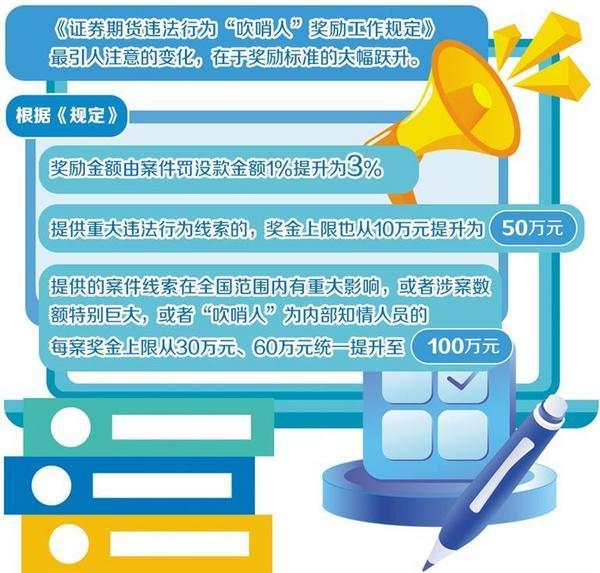
Core Viewpoint - The China Securities Regulatory Commission (CSRC) and the Ministry of Finance have revised the "Whistleblower Reward Work Regulations" to enhance the whistleblower system, aiming to promote a culture of accountability and better adapt to the requirements of high-quality capital market development and regulatory enforcement [1] Group 1: Whistleblower System Overview - A "whistleblower" is defined as an individual or entity that provides information about violations in the securities and futures markets to protect investors' rights [1] - The whistleblower system is a crucial mechanism for combating illegal activities in mature capital markets, with the initial regulations established in June 2014 [1] Group 2: Changes in Reward Standards - The new regulations significantly increase the reward standards, raising the reward from 1% to 3% of the penalties collected from violations [1] - The maximum reward for providing major violation leads has been increased from 100,000 yuan to 500,000 yuan, with cases of national significance or involving substantial amounts eligible for rewards up to 1 million yuan [2] Group 3: Conditions for Rewards - The criteria for rewarding whistleblowers have been expanded to include cases that severely disrupt market order or harm financial security, with the minimum penalty amount for rewards raised from 100,000 yuan to 1 million yuan [2] - Anonymous whistleblowers who provide necessary supplementary materials and those with minor or assisting roles in violations are also eligible for rewards [2] Group 4: Protection Mechanisms for Whistleblowers - The regulations enhance protection mechanisms for whistleblowers, ensuring anonymity and prohibiting retaliation through various means [3] - The dual mechanism of "incentives and protection" is expected to improve the efficiency of regulatory enforcement and encourage compliance among companies and intermediaries [3] Group 5: Future Recommendations - Suggestions for further improvement include establishing a unified, efficient, and confidential reporting platform, enhancing the protection of whistleblower rights, and clarifying legal standards for malicious reporting [4]
最高100万元 证券期货“吹哨人”奖励大幅提高
Jing Ji Ri Bao· 2026-01-21 23:55
Core Viewpoint - The revised "Whistleblower" reward regulations by the CSRC and Ministry of Finance aim to enhance the reporting system, promote a culture of accountability, and adapt to the requirements of high-quality capital market development and regulatory enforcement [2] Group 1: Changes in Reward Structure - The reward standard has significantly increased, with the reward amount rising from 1% to 3% of the penalties collected from cases [2] - The maximum reward for providing major illegal activity leads has been raised from 100,000 yuan to 500,000 yuan [2] - For cases with significant national impact or involving particularly large amounts, the maximum reward has been unified and increased to 1 million yuan [2][3] Group 2: Inclusion of Serious Cases - The new regulations include serious cases that severely disrupt the securities and futures market order, endanger financial security, or infringe on investors' legal rights [3] - The threshold for rewarding cases has been raised from penalties of 100,000 yuan to 1 million yuan [3] Group 3: Protection Mechanisms for Whistleblowers - The regulations enhance protection mechanisms for whistleblowers, ensuring anonymity and strict management of personal information [4] - Any form of retaliation against whistleblowers, including violence, coercion, or breach of privacy, is prohibited [4] Group 4: Expected Positive Impacts - The dual mechanism of "incentives and protection" is expected to significantly improve the efficiency of regulatory enforcement by enabling whistleblowers to provide high-value information [5] - The regulations signal a strong commitment from regulators to combat illegal activities and protect the rights of small and medium investors, fostering a fair market order [5] Group 5: Future Recommendations - Suggestions for further improvement include establishing a unified, efficient, and confidential reporting platform, enhancing the protection of whistleblower rights, and clarifying standards for malicious reporting [6]
最高100万元,证券期货“吹哨人”奖励大幅提高——解除“吹哨人”后顾之忧
Xin Hua Wang· 2026-01-21 23:18
Core Viewpoint - The China Securities Regulatory Commission (CSRC) and the Ministry of Finance have revised the "Whistleblower Reward Work Regulations" to enhance the whistleblower system, aiming to promote a culture of accountability and better align with the requirements of high-quality capital market development and regulatory enforcement [1]. Group 1: Whistleblower System Overview - A "whistleblower" is defined as an individual or entity that provides information about violations in the securities and futures market to the CSRC, aiming to protect investors' rights [1]. - The whistleblower system is a crucial mechanism for combating illegal activities in mature capital markets, with the initial regulations established in June 2014 [1]. Group 2: Changes in Reward Standards - The new regulations significantly increase the reward standards, raising the reward from 1% to 3% of the penalties collected from violations [1]. - The maximum reward for providing major violation information has increased from 100,000 yuan to 500,000 yuan, with cases of national significance or involving substantial amounts eligible for rewards up to 1 million yuan [1][2]. Group 3: Enhanced Protection Mechanisms - The regulations include improved protection for whistleblowers, ensuring anonymity and preventing retaliation through various means [3]. - Any entity or individual is prohibited from using violence, coercion, defamation, or other illegal methods to retaliate against whistleblowers [3]. Group 4: Expected Impact and Future Recommendations - The dual mechanism of incentives and protections is expected to enhance the efficiency of regulatory enforcement and encourage compliance among companies and intermediaries [3]. - Future recommendations include establishing a unified, efficient, and confidential reporting platform, clarifying personal safety measures for whistleblowers, and defining legal standards for malicious reporting [4].
解除“吹哨人”后顾之忧
Xin Lang Cai Jing· 2026-01-21 22:38
Core Viewpoint - The China Securities Regulatory Commission (CSRC) and the Ministry of Finance have revised the "Whistleblower Reward Work Regulations" to enhance the whistleblower system, address market concerns, and promote a culture of accountability in the capital market [2] Group 1: Whistleblower System Overview - A "whistleblower" is defined as an individual or entity that provides information about violations in the securities and futures market to protect investors' rights [2] - The whistleblower system is a crucial mechanism for combating illegal activities in mature capital markets, with the initial regulations established in June 2014 [2] Group 2: Changes in Reward Standards - The new regulations significantly increase the reward standards, raising the reward from 1% to 3% of the penalties collected from violations [2] - The maximum reward for providing major violation leads has increased from 100,000 yuan to 500,000 yuan, with cases of national significance or involving large sums eligible for rewards up to 1 million yuan [2][3] Group 3: Conditions for Rewards - The criteria for rewarding whistleblowers have been expanded to include serious cases that severely disrupt market order or harm financial security, with the minimum penalty amount for rewards raised from 100,000 yuan to 1 million yuan [3] Group 4: Protection Mechanisms for Whistleblowers - The regulations include measures to protect the identity of whistleblowers, ensuring anonymity and preventing retaliation from employers or other parties [4] - Any form of violence, coercion, or defamation against whistleblowers is strictly prohibited, and their personal information must be handled with care [4] Group 5: Expected Impact of the Regulations - The dual mechanism of incentives and protections is expected to enhance the quality of information provided by whistleblowers, improving the efficiency of regulatory enforcement [5] - The regulations signal a strong commitment from regulators to combat illegal activities and protect the rights of small investors, fostering a fair market environment [5] Group 6: Future Recommendations - Suggestions for further improvement include establishing a unified and confidential reporting platform, enhancing the protection of whistleblower rights, and clarifying the legal standards for malicious reporting [6]
证监会开出百万“悬赏令”
Jing Ji Wang· 2026-01-19 07:29
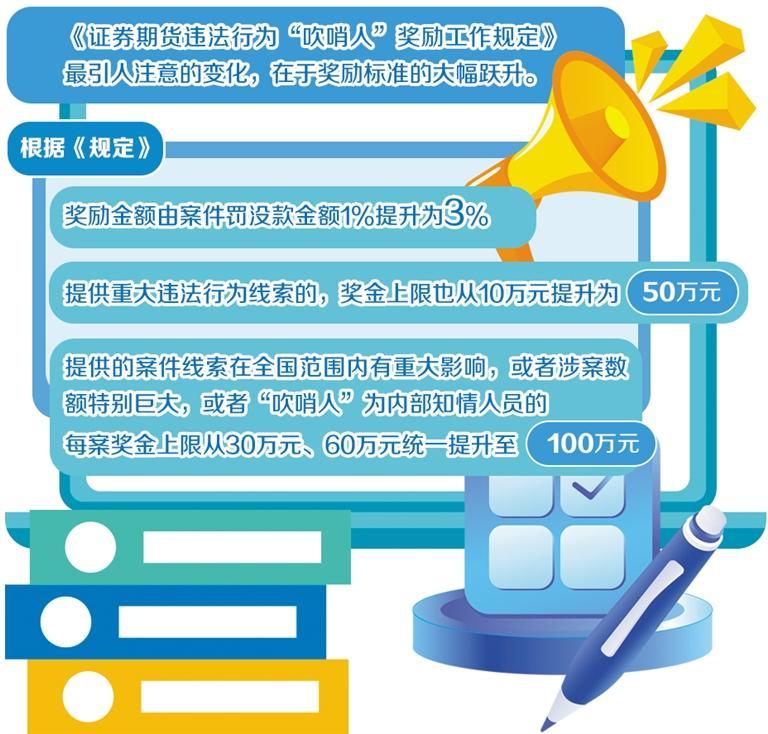
Core Viewpoint - The Chinese capital market is experiencing a significant regulatory shift aimed at addressing financial fraud and enhancing market integrity through increased whistleblower incentives and protections [1][4]. Regulatory Changes - A record trading volume of over 3.6 trillion yuan was reported on January 12, with more than 4,100 stocks gaining [1]. - The regulatory framework has been strengthened with a joint initiative from 12 departments to combat financial fraud, alongside new whistleblower reward regulations issued by the CSRC and the Ministry of Finance [1]. Whistleblower Incentives - The new regulations have increased the reward for whistleblowers from 1% to 3% of the fines collected from cases, with a maximum reward for significant violations raised from 100,000 yuan to 500,000 yuan [3]. - For cases with substantial impact or large sums involved, the maximum reward has been standardized to 1 million yuan, up from previous limits of 300,000 or 600,000 yuan [3]. Addressing Information Asymmetry - The core objective of these changes is to tackle the issue of information asymmetry in the capital market, as financial fraud and insider trading often occur internally within companies [4][5]. - Whistleblowers, particularly those with insider knowledge, are seen as crucial to uncovering such cases, which is why the new regulations favor internal informants [6]. Reporting Thresholds and Protections - The new rules set a high threshold for obtaining rewards, requiring that the reported violations must be severe and previously undisclosed [9]. - Measures have been implemented to prevent malicious reporting, including the cancellation of rewards for whistleblowers who withdraw their reports or obstruct investigations [10]. Anonymity and Protection for Whistleblowers - The regulations allow for anonymous reporting, ensuring that whistleblowers can come forward without fear of retaliation [12]. - Strict measures are in place to protect whistleblowers from violence or privacy breaches, with companies facing penalties for retaliatory actions [12]. Accountability in Handling Reports - Individuals responsible for processing whistleblower reports are also held to high standards, facing legal consequences for negligence or corruption [13]. Market Impact - The essence of the new regulations represents a shift from isolated regulatory actions to a model of social governance, encouraging insiders to provide critical information [14]. - The increased costs of illegal activities in the market are expected, as potential wrongdoers must now consider the risk of being reported by insiders, effectively creating an "internal monitoring" system within companies [14].
从“单一监管”向“社会共治”转型
Qi Huo Ri Bao Wang· 2026-01-16 01:57
Core Viewpoint - The introduction of the "whistleblower" system upgrade by the China Securities Regulatory Commission (CSRC) and the Ministry of Finance aims to enhance the detection and reporting of illegal activities in the capital market, addressing the increasing complexity and concealment of such violations [1][2]. Group 1: Regulatory Framework - The new regulations significantly improve the reward mechanism for whistleblowers, increasing both the reward ratios and caps, while also refining the distribution and initiation procedures [2]. - A robust protection system for whistleblowers has been established, ensuring stricter identity protection and harsher penalties for retaliation against whistleblowers [2]. - The definition of a whistleblower has been clarified, along with the three core criteria for valid leads, delineating the rights and responsibilities of all parties involved [2]. Group 2: Impact on Market Participants - The implementation of the regulations will create a strong compliance deterrent for listed companies, increasing the likelihood of exposing hidden illegal activities such as financial fraud and unfair related-party transactions [3]. - Securities and futures institutions, as key intermediaries in the capital market, will face dual constraints, enhancing the incentive for employees to report violations and compelling institutions to strengthen their risk control measures [3]. Group 3: Investor Protection - The regulations serve as a vital tool for protecting investors' rights, significantly improving the detection efficiency of major illegal activities, thereby reducing risks associated with financial fraud and regulatory violations [4]. - The whistleblower system will provide critical evidence for investors' civil claims, facilitating quicker and less costly pathways for investors to seek redress [4]. - The reward mechanism is designed to motivate ordinary investors to participate in supervision, fostering a collaborative environment for investor protection, particularly benefiting small and medium-sized investors [4]. Group 4: Challenges and Considerations - Despite the comprehensive design of the regulations, challenges remain, such as the potential for hidden risks faced by whistleblowers and the need for industry self-discipline and professional protection mechanisms [5]. - Ordinary investors may lack the necessary skills to provide sufficient evidence for their claims, necessitating training and awareness programs to enhance their supervisory capabilities [5]. - The compliance cost pressures on listed companies and institutions need to be managed carefully to avoid undue operational burdens, particularly for small and medium enterprises [5].
证监会大幅提高证券期货“吹哨人”奖励
Qi Huo Ri Bao Wang· 2026-01-12 14:59
Core Viewpoint - The new regulations by the China Securities Regulatory Commission (CSRC) and the Ministry of Finance aim to enhance the whistleblower reward system for reporting securities and futures violations, significantly increasing the potential rewards and protections for whistleblowers [1][2][4] Summary by Sections Whistleblower Definition and Purpose - A "whistleblower" is defined as an individual or entity that possesses knowledge of securities and futures violations and is willing to provide evidence to protect investors' rights [1] - The implementation of these regulations marks a significant upgrade in the whistleblower incentive system in China's capital market, impacting market ecology, regulatory efficiency, and investor confidence [1] Reward Structure - The reward amount for whistleblowers has been increased from 1% to 3% of the penalty amount, with specific caps: up to 500,000 yuan for significant leads and up to 1,000,000 yuan for cases with national impact or involving insider knowledge [2] - The CSRC will initiate the reward process based on the number of cases and available budget, with a structured announcement of eligible cases and reward procedures [2] Protection Mechanisms - The regulations include measures to protect whistleblower identities, ensuring anonymity and preventing retaliation through legal consequences for those who attempt to harm or intimidate whistleblowers [3] - Whistleblowers who voluntarily disclose their involvement in violations may receive leniency in administrative penalties, promoting a culture of accountability [3] Impact on Market Regulation - The regulations are expected to enhance regulatory effectiveness, encouraging internal personnel to report serious violations such as financial fraud and insider trading, thereby purifying the market environment [4] - Stricter penalties for retaliating against whistleblowers aim to eliminate the "reporting leads to unemployment" phenomenon, thereby motivating whistleblowers and deterring market misconduct [4]