外贸企业结汇

Search documents
三大人民币汇率指数小幅下挫,人民币汇率中长期或稳中有升
Zhong Guo Jin Rong Xin Xi Wang· 2025-12-01 02:45
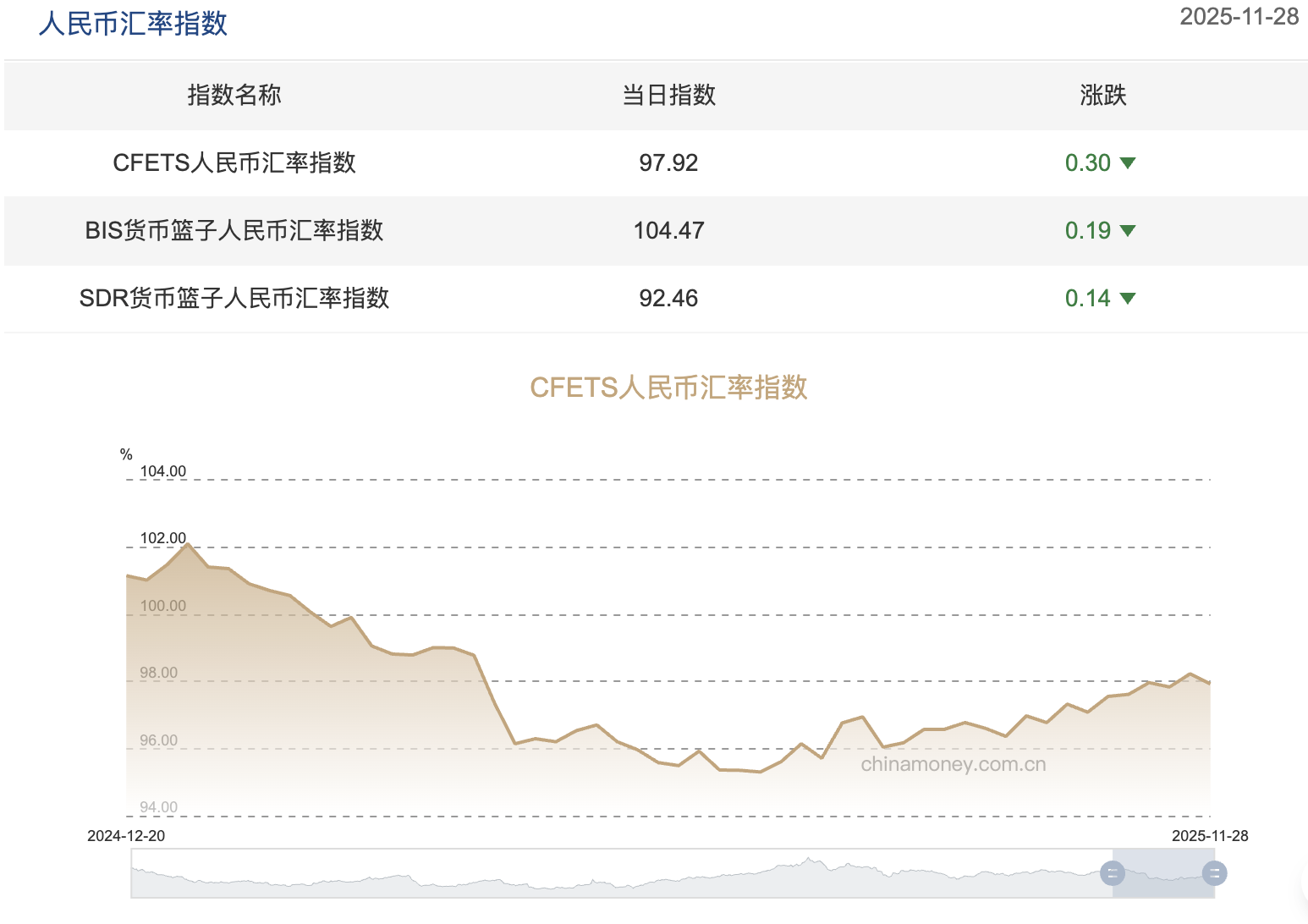
Core Viewpoint - The Chinese yuan's exchange rate indices have declined, reflecting a broader trend influenced by expectations of a Federal Reserve interest rate cut and changes in market sentiment towards the dollar [1][5]. Group 1: Exchange Rate Indices - The CFETS yuan exchange rate index reported at 97.92, down 0.3% week-on-week [1][2]. - The BIS currency basket yuan exchange rate index stood at 104.47, decreasing by 0.19% [1][2]. - The SDR currency basket yuan exchange rate index was at 92.46, with a weekly decline of 0.14% [1][2]. Group 2: Market Influences - The dollar index experienced a decline of 0.71% over the week, falling below the 100 mark, influenced by weak U.S. retail data and heightened expectations for a Fed rate cut [5]. - The yuan strengthened against the dollar, with the onshore yuan closing at 7.0740, up 310 basis points (0.51%) for the week, and the offshore yuan at 7.0713, up 341 basis points (0.48%) [5]. - The yuan's central parity rate against the dollar was adjusted to 7.0789, an increase of 86 basis points for the week [5]. Group 3: Analyst Insights - Analysts attribute the yuan's strength to the Fed's anticipated rate cut, with the probability of a December cut rising from 35.4% to 85.4% within a week [5]. - The chief macro analyst at Guotai Junan noted a trend reversal in foreign trade enterprises' currency settlement preferences, contributing to the yuan's appreciation [6]. - The chief economist at Zhongyin Securities highlighted that the yuan's resilience amidst global economic uncertainties reflects a combination of factors, including a recovering Chinese economy and a weakening dollar [6]. Group 4: Future Outlook - Analysts predict that the yuan's exchange rate will be influenced by the dollar's performance and U.S.-China trade relations, with expectations of continued moderate appreciation [7]. - The chief economist at Qianhai Kaiyuan Fund anticipates a long-term upward trend for the yuan against the dollar, suggesting a potential break below 7 and a return to the 6 range by next year [8].

国泰海通|宏观:破“7”之旅——2026年人民币汇率展望
国泰海通证券研究· 2025-11-19 12:48
Core Insights - The article discusses the expected fluctuations of the RMB exchange rate in 2025 and 2026, highlighting the central bank's effective liquidity management that helps mitigate risks [1] Group 1: 2025 RMB Exchange Rate Outlook - The appreciation of the RMB in 2025 is driven by two main factors: cracks in USD credit and the Federal Reserve's easing measures. However, the appreciation expectation is not straightforward, with significant volatility observed [2] - In April 2025, trade frictions led to a depreciation expectation exceeding 7.5, while the onset of the Fed's rate cut cycle in September brought the appreciation expectation closer to 7.0. This reflects investor uncertainty in a still fragile internal economic environment [2] - A key factor supporting the RMB's appreciation is the reversal of foreign trade enterprises' willingness to settle in RMB. The weakening belief in a strong USD has led to a historic level of cross-border capital inflow, primarily driven by these enterprises [3] Group 2: Central Bank's Management and Policy - The central bank's management of exchange rate controls is described as "brilliant," effectively balancing the optimism of currency holders and the hesitance of currency exchangers. This includes lowering swap market premiums to manage foreign capital inflow and guiding domestic expectations through the central parity rate [4] - The central bank aims to align domestic and foreign pricing expectations, achieving a "three-price unification" where both domestic and foreign asset pricing converge towards the central bank's expectations [4] Group 3: 2026 RMB Exchange Rate Expectations - The article raises the question of whether global easing will continue into 2026, noting a significant "K-shaped" economic divergence in the U.S. This divergence affects high-net-worth individuals and new borrowers differently, impacting credit expansion and overall economic conditions [5] - The central bank's willingness to allow the RMB to break the 7.0 mark is questioned, with indications that it is managing the pace of appreciation through historical low swap premiums. The central bank's focus appears to be on fundamental factors rather than credit-driven factors [6] - The future decoupling of the RMB exchange rate from the USD index is anticipated, with both fundamental and policy support for the RMB to break the 7.0 level. However, the article emphasizes that fundamental changes will be the core variable supporting long-term RMB strength [6]