
多层次债券市场建设

Search documents
浦发银行郑州分行持续推动多层次债券市场建设
Huan Qiu Wang· 2025-11-17 08:54
Core Viewpoint - The successful launch of the flagship store channel counter bond trading business in Henan Province marks a significant advancement in the multi-tiered bond market construction in China, facilitated by Shanghai Pudong Development Bank and Baorui Trust under the guidance of the People's Bank of China [1][2] Group 1: Business Model and Innovations - The counter bond business allows financial institutions to provide services such as bond account opening, distribution, trading, custody, settlement, pledge registration, and interest payment for various types of bonds including government bonds and corporate credit bonds [1] - The newly implemented "flagship store" model integrates functions like pricing, transaction inquiry, position management, and limit control through a standardized system interface, enhancing the efficiency and security of bond trading for financial institutions [2] Group 2: Future Developments - The Shanghai Pudong Development Bank Zhengzhou Branch plans to increase policy promotion efforts and expand the application scenarios and service depth of counter bond business, aiming to provide more efficient and flexible financial service solutions for investors [2]

《中国金融》|加快服务科创的多层次债券市场建设
Sou Hu Cai Jing· 2025-09-10 10:31
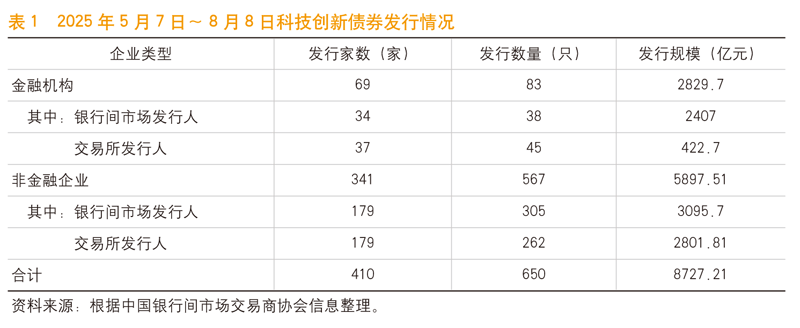
Core Viewpoint - Technological innovation is the primary driving force for high-quality development, and technology finance has become a strategic priority in building a strong financial nation. The establishment of a "Technology Board" in the bond market aims to enhance financial resources for technological innovation and enrich the multi-tiered bond market [1][6]. Group 1: Bond Market and Technology Finance Adaptability - As of July 2025, China's bond market has a stock scale close to 190 trillion yuan, serving as a major venue for direct financing for enterprises, particularly in meeting the financing needs of technological innovation [2]. - The bond market needs innovative institutional arrangements to better adapt to the financing characteristics of technology innovation, which often involves longer cycles and greater uncertainty [2][3]. Group 2: Analysis from Bond Financing Perspective - There is a mismatch between the financing characteristics of technology enterprises and the traditional bond market's supply model, particularly regarding the duration and pricing mechanisms [3]. - The bond market's standardized information disclosure requirements may conflict with technology enterprises' need to keep core technologies confidential, potentially hindering financing efficiency [3]. Group 3: Lifecycle of Technology Enterprises - Different stages of technology enterprises (startup, growth, maturity) have varying financing needs and characteristics, necessitating tailored support from the bond market [4][5]. - Startups often struggle to secure direct financing through bonds due to high uncertainty and revenue characteristics that do not align with market constraints [4]. - Growth-stage enterprises face challenges from competition and management, while mature enterprises have stable cash flows and can issue bonds more readily [5]. Group 4: Innovation in Financing Mechanisms - The "Technology Board" encompasses a complete system for technology innovation bonds, including diverse issuing entities, simplified disclosure requirements, and flexible mechanisms [7]. - The introduction of various financing entities, including private equity and venture capital firms, aims to enhance investment in early-stage and growth-stage technology enterprises [7][8]. Group 5: Market Response and Development - From May 7 to August 8, 2025, 410 institutions issued technology innovation bonds totaling 872.72 billion yuan, indicating strong market engagement [10]. - The issuance of technology innovation bonds has seen significant participation from both financial and non-financial enterprises, with a notable focus on mid-to-long-term bonds [10][13]. Group 6: Risk Mitigation and Credit Enhancement - The establishment of risk-sharing tools aims to provide low-cost funding and enhance credit for technology innovation bonds, facilitating broader participation from private equity firms [15][16]. - Local governments are encouraged to collaborate with risk-sharing tools to mitigate credit risks associated with bond issuance [17]. Group 7: Future Directions for Bond Market Development - Continuous efforts are needed to enhance the bond market's service to technology innovation, including deeper investment research and improved understanding of market rules by technology enterprises [18]. - The development of a multi-tiered bond market requires ongoing policy support and market interaction to address financing challenges faced by technology enterprises [19].

债市“科技板”启航,五方面速览科创债增量政策
Zhong Cheng Xin Guo Ji· 2025-05-09 07:52
Report Industry Investment Rating - No relevant content provided Core Viewpoints - Recent intensive implementation of a package of support measures for scientific and technological innovation and supporting arrangements for the "technology board" reflects enhanced policy consistency, improved operability, and expanded scope of benefits, with a clear support orientation. The more detailed mechanism arrangements for each link of science - and - technology innovation bonds (STIBs) are conducive to driving more financial resources into the scientific and technological innovation field, stimulating innovation power and market vitality, and helping to cultivate new productive forces and build a modern industrial system [2] Summary by Directory I. Enrich the product system of STIBs, optimize the issuance process, and accelerate the construction of a multi - tiered bond market - The new round of incremental policies around the issuance end takes multiple measures in aspects such as the scope of issuers, issuance terms, information disclosure, and use of raised funds, promoting the improvement of the adaptability of bond services and the further play of the financing function of the bond market [3] - The "Announcement" focuses on supporting three types of institutions, including financial institutions, technology - based enterprises, and equity investment institutions, to issue STIBs. The trading association further clarifies the specific requirements for technology - based enterprises and equity investment institutions, and the exchanges also newly support eligible financial institutions and equity investment institutions to issue STIBs, expanding the scope of issuers [3][4] - The policies give issuers certain options in terms of issuance methods, financing terms, and bond terms, and optimize the issuance management process and registration and issuance mechanism. Both the inter - bank and exchange markets apply the "green channel" for STIB financing review, simplifying the requirements for application materials and improving the review speed [4] - The information disclosure rules for STIBs are simplified. The "Announcement" allows issuers to agree with investors to exempt relevant disclosure information, and the trading association further clarifies the specific arrangements. Both markets also allow eligible issuers to apply for an extension of the validity period of financial reports [4] - The policies balance flexibility and standardization in the use of raised funds. For technology - based enterprises, the use of funds is flexibly arranged, and at the same time, a supervision account for raised funds is required to ensure the compliance and effectiveness of fund use [4] - The STIBs have achieved rapid development since their launch, with a current stock scale of about 1.85 trillion yuan. Nearly 500 market institutions plan to issue over 300 billion yuan of STIBs. After the implementation of incremental measures, more entities may enter the STIB market, and the market structure is expected to be more diversified [5] II. Improve the investment mechanism in multiple ways, strengthen the coordination between investment and financing, and optimize the ecological environment of the STIB market - Improving the investment mechanism of STIBs helps enhance the trading activity and price discovery function of STIBs, improve the pricing efficiency and investment confidence of the market, and reduce the issuance and financing costs of enterprises [6] - The policies encourage intermediary institutions to participate in market - making of STIBs and establish an evaluation system. The exchanges have introduced optimization measures to support the pledge financing of STIBs, enhancing the liquidity support for STIBs [6][7] - Long - term funds are included in the scope of investment subjects for STIBs, which helps meet the demand of science - and - technology innovation enterprises for long - term capital, promotes the formation of a diversified investor pattern, and enhances the stability and risk - resistance ability of the STIB market [7] - The creation of STIB indices and related index - linked products is encouraged, which provides convenient risk - dispersion and long - term holding tools for institutional investors, promotes the development of passive investment strategies, and improves the issuance attractiveness and fund - raising ability of STIBs [7] III. Improve the diversified risk - dispersion and sharing mechanism, strengthen the role of credit enhancement, and boost market confidence - The "Announcement" emphasizes improving the risk - dispersion and sharing mechanism for STIBs. On one hand, it increases the support of policy - based tools and encourages market - based credit enhancement. Financial institutions and professional credit enhancement institutions are supported to carry out relevant businesses to support the issuance and trading of STIBs [9] - On the other hand, it promotes the role of regional credit enhancement mechanisms. Local governments are guided to set up risk compensation funds or introduce other preferential policies to provide support such as interest subsidies and government - backed financing guarantees for STIBs [9] - The exchanges encourage issuers to innovate credit enhancement methods, such as setting up pledge guarantees for expected returns and intellectual property rights in the bond issuance stage, exploring the use of intangible assets as collateral for bonds [9] IV. Innovate the credit rating system and construct a rating method suitable for technology - based enterprises and science - and - technology innovation businesses - Traditional rating ideas centered on assets and scale are difficult to meet the development needs of science - and - technology innovation enterprises. The "Announcement" proposes that credit rating agencies should design specialized rating methods and symbols according to the characteristics of relevant institutions and businesses, improving the forward - looking and differentiation of ratings [11][12] - Since 2024, rating agencies have served more than 1,500 STIBs and covered more than 460 STIB issuers. Multiple rating agencies have disclosed rating methods and models for science - and - technology innovation enterprises, but there are few practical cases of using specialized rating methods [12] - Under the policy guidance, credit rating agencies can focus on the characteristics of science - and - technology innovation enterprises, construct targeted rating frameworks, optimize the distribution of individual independent credit levels, and use new technologies such as big data and artificial intelligence to provide "rating +" services [12] V. Improve regulatory services, strengthen the whole - process management of STIBs, and reduce fees to strengthen policy support - The "Announcement" deploys the whole - process management and policy support for STIBs from the perspective of regulatory services, aiming to ensure the use of raised funds as intended and promote financial institutions to strengthen continuous support for innovative entities [13] - The bond market self - regulatory organizations are required to improve the supporting rules for STIBs, provide full - process services for issuance and trading, and reduce relevant fees. Specific measures have been introduced, such as the Shanghai Stock Exchange waiving the issuance subscription fees and trading fees for STIBs, and other exchanges and institutions also following suit [13][14] - The trading association has introduced measures to strengthen information disclosure requirements during the duration of bonds and improve post - issuance tracking and monitoring, enhancing the effectiveness of regulatory services and risk - prevention levels for STIBs [14]