大模型密度法则

Search documents
为什么这一代头部 AI 公司的 ARR 增长比我们想象的更快?|Jinqiu Spotlight
锦秋集· 2026-02-04 14:11
Core Insights - The article discusses the rapid growth of AI companies' Annual Recurring Revenue (ARR) and identifies three underestimated variables contributing to this phenomenon [4][12][32] Group 1: Investment Strategy and Market Position - Jinqiu Fund is an AI-native investment institution, typically investing between $1 million to $25 million in early-stage companies [2][3] - The fund aims to support founders with deep insights and strong execution capabilities, while also leveraging its global investment network [3][4] - Jinqiu has invested in approximately 70 companies, with nearly half being AI application companies, indicating a strong focus on the AI sector [44] Group 2: Underestimated Variables in AI Growth - The first underestimated variable is the true demand and ceiling for AI, which has expanded beyond traditional IT budgets into labor budgets, significantly lowering labor costs [18][22][26] - The second variable is the speed of technological iteration and the growth slope of AI products, with advancements leading to rapid increases in efficiency and capability [32][47] - The third variable is the leverage efficiency of social media, which has transformed user acquisition and product awareness, allowing for faster growth in AI product adoption [66][69] Group 3: Historical Context and Future Implications - Historical shifts in labor sources have often led to GDP surges, and the introduction of AI as a new labor source is expected to have a similar impact [24][30] - The article emphasizes that the service industry is likely to expand significantly as AI capabilities increase, with the potential to create new consumption scenarios [30][41] - The cost of AI-driven services is expected to decrease dramatically, leading to a vast expansion of market opportunities [31][56] Group 4: Examples of AI Impact - AI tools are transforming traditional tasks, such as coding and content creation, making them more efficient and accessible [58][63] - The article highlights the rapid evolution of AI applications, where a small team can achieve what previously required large teams, thus altering the cost structure of software development [60][62] - The potential for AI to operate continuously, breaking the limitations of human work hours, is seen as a significant factor in expanding service industry capabilities [40][41]


大模型每百天性能翻倍,清华团队“密度法则”登上Nature子刊
3 6 Ke· 2025-11-20 08:48
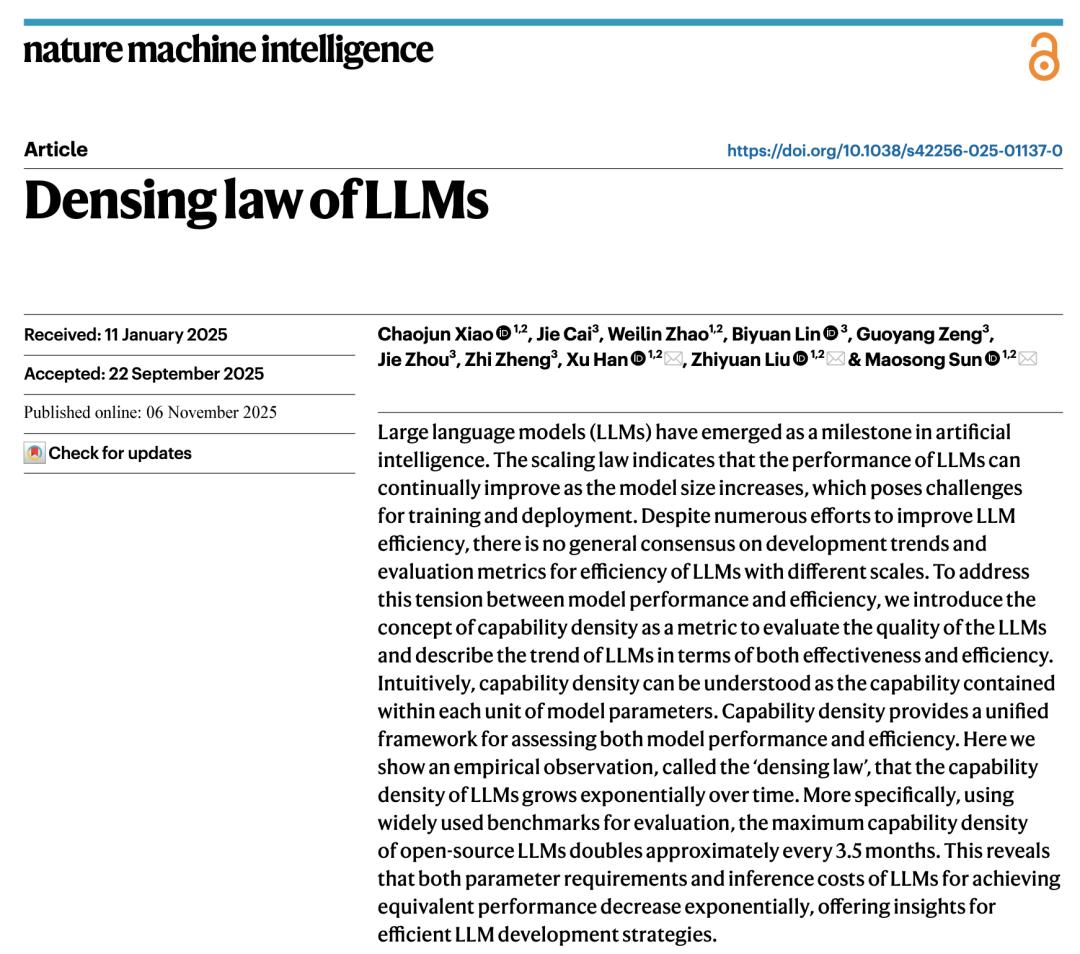
Core Insights - The article discusses the challenges and new perspectives in the development of large models, particularly focusing on the "Density Law" proposed by Tsinghua University, which indicates an exponential growth in the maximum capability density of large language models from February 2023 to April 2025, doubling approximately every 3.5 months [1][8]. Group 1: Scaling Law and Density Law - Since 2020, OpenAI's Scaling Law has driven the rapid development of large models, but by 2025, the sustainability of this path is in question due to increasing training costs and the nearing exhaustion of publicly available internet data [1]. - The Density Law provides a new perspective on model development, suggesting that just as the semiconductor industry improved chip density, large models can achieve efficient development through increased capability density [3][4]. Group 2: Implications of Density Law - The research team hypothesizes that different-sized models, when trained adequately, will have the same capability density, establishing a baseline for measuring other models [4]. - The Density Law indicates that the inference cost for models of the same capability decreases exponentially over time, with empirical data showing that the API price for models like GPT-3.5 has decreased by 266.7 times over 20 months, roughly halving every 2.5 months [7][8]. Group 3: Acceleration of Capability Density - An analysis of 51 recent open-source large models revealed that the maximum capability density has been increasing exponentially, with a doubling time of approximately 3.5 months since 2023 [8][9]. - Following the release of ChatGPT, the capability density has increased at a faster rate, doubling every 3.2 months compared to every 4.8 months prior, indicating a 50% acceleration in density enhancement [9][10]. Group 4: Limitations of Model Compression - The research found that model compression algorithms do not always enhance capability density, as many compressed models performed worse than their original counterparts due to insufficient training [11][13]. Group 5: Future Prospects - The intersection of chip circuit density (Moore's Law) and model capability density (Density Law) suggests that edge devices will be able to run higher-performance large models, leading to explosive growth in edge computing and terminal intelligence [14]. - Tsinghua University and the Mianbi Intelligence team are advancing high-density model development, with models like MiniCPM and VoxCPM gaining global recognition and significant download numbers, indicating a trend towards efficient and low-cost models [16].
大模型每百天性能翻倍!清华团队“密度法则”登上 Nature 子刊
AI前线· 2025-11-20 06:30
Core Insights - The article discusses the evolution of large models in AI, highlighting the challenges posed by increasing training costs and the potential end of pre-training as currently understood by 2025 [1] - It introduces the "Densing Law" from Tsinghua University, which suggests that the maximum capability density of large language models is growing exponentially, doubling approximately every 3.5 months from February 2023 to April 2025 [1] Group 1: Scaling Law and Densing Law - The Scaling Law proposed by OpenAI indicates that larger model parameters and training data lead to stronger intelligence capabilities, but sustainability issues arise as training costs escalate [1] - The Densing Law provides a new perspective on model development, revealing that the capability density of large models is increasing exponentially over time [1][6] Group 2: Key Findings from Research - The research team analyzed 51 recent open-source large models and found that the maximum capability density has been doubling every 3.5 months since 2023, allowing for the same intelligence level with fewer parameters [9] - The inference cost for models of the same capability is decreasing exponentially over time, with empirical data showing that the API price for GPT-3.5 has dropped by 266.7 times over 20 months, approximately halving every 2.5 months [12] Group 3: Implications of Densing Law - The capability density of large models is accelerating, with a notable increase in the rate of doubling from 4.8 months before the release of ChatGPT to 3.2 months afterward, indicating a 50% acceleration in density enhancement [14] - Model compression algorithms do not always enhance capability density, as many compressed models have lower density than their original counterparts, revealing limitations in current compression techniques [16] - The intersection of chip circuit density (Moore's Law) and model capability density suggests significant potential for edge computing and terminal intelligence, leading to a transformative shift in computational accessibility from cloud to edge devices [18] Group 4: Future Developments - Tsinghua University and Mianbi Intelligence are advancing high-density model research based on the Densing Law, releasing several efficient models that have gained global recognition, with downloads nearing 15 million and GitHub stars approaching 30,000 by October 2025 [20]