
大规模杀伤性武器

Search documents
美军“禁毒战”再炸三船,特朗普定性芬太尼为“大规模杀伤性武器”
Jin Rong Jie· 2025-12-16 06:27
Group 1 - The U.S. Southern Command reported that the military attacked three boats suspected of drug trafficking, resulting in eight deaths [1][2] - The operation was conducted under the direction of Defense Secretary Pete Hegseth in the Eastern Pacific, with a video showing the boats being destroyed [1][2] - The attacks are part of a broader strategy by the Trump administration to pressure Venezuelan President Nicolás Maduro and combat drug trafficking in the region [2][4] Group 2 - Trump has classified fentanyl as a "weapon of mass destruction" to intensify efforts against drug smuggling from Latin America [5] - This classification allows the Department of Homeland Security to utilize funds allocated for detecting and eliminating weapons of mass destruction [5][6] - The administration is considering expanding its operations from maritime to land-based targets related to drug production [5][6] Group 3 - There is growing scrutiny from both Democratic and Republican lawmakers regarding the legality of these military actions, with calls for briefings from Secretary Hegseth [2][3] - Legal experts question whether the attacks violate international law and the legitimacy of the claims regarding the boats' intentions [4] - Maduro has threatened a "full uprising" if his country faces foreign attacks, indicating potential geopolitical ramifications [4]
美军“禁毒战”再炸三船,特朗普定性芬太尼为“大规模杀伤武器”
Xin Lang Cai Jing· 2025-12-16 05:57
Core Viewpoint - The U.S. military has conducted airstrikes against three vessels suspected of drug trafficking, resulting in eight fatalities, amidst increasing scrutiny of the Trump administration's actions against Venezuela and drug smuggling in the region [1][6][8]. Group 1: Military Actions - The U.S. Southern Command reported the airstrikes were executed under the direction of Defense Secretary Pete Hegseth in the Eastern Pacific [1][6]. - A video released by the Southern Command shows the vessels being destroyed in a significant explosion [1]. - The military has not disclosed the specific location of the strikes [1]. Group 2: Political Context - The Trump administration is facing heightened scrutiny regarding its unilateral military actions against vessels near South America, particularly in relation to Venezuelan President Nicolás Maduro [1][6]. - Congressional Democrats and Republicans have requested briefings from Hegseth regarding these military actions and are seeking unedited footage from a previous incident [1][7]. - Lawmakers have threatened to cut Hegseth's travel budget if he does not comply with their requests [7]. Group 3: Drug Policy and Legal Implications - Trump has classified fentanyl as a "weapon of mass destruction" to intensify efforts against drug trafficking from Latin America [3][9]. - This classification is intended to allow the Department of Homeland Security to utilize funds allocated for detecting and eliminating weapons of mass destruction [9]. - Legal experts and critics in Congress are questioning whether these military actions violate international law and the legitimacy of the claims regarding the vessels' intentions and cargo [2][8]. Group 4: Future Actions - Trump has indicated that military actions may soon extend beyond maritime operations to land-based targets related to drug production [3][9]. - The administration is also considering reclassifying marijuana as a lower-risk substance, which has positively impacted related stocks [10].
特朗普签署行政命令:将芬太尼列为大规模杀伤性武器!授权五角大楼协助执法,允许情报机构动用通常用于遏制武器扩散手段打击毒品贩运
Ge Long Hui· 2025-12-16 01:34
Core Viewpoint - The article discusses President Trump's executive order classifying fentanyl as a weapon of mass destruction, emphasizing its threat to national security and its role in illegal activities along the U.S. borders [1] Group 1: Executive Order Details - President Trump signed an executive order that categorizes fentanyl closer to chemical weapons than narcotics [1] - The order aims to enhance the crackdown on drug trafficking organizations that are flooding the U.S. with drugs [1] Group 2: Implications for Law Enforcement - The new classification empowers the Pentagon to assist in law enforcement efforts against fentanyl production and distribution [1] - Intelligence agencies are authorized to use methods typically reserved for curbing weapons proliferation to combat drug trafficking [1]


特朗普升级禁毒战 将芬太尼列为"大规模杀伤性武器"
Xin Lang Cai Jing· 2025-12-15 23:29
Core Viewpoint - The article discusses President Trump's executive order classifying fentanyl as a "weapon of mass destruction," significantly expanding the U.S. government's authority to combat the illegal trafficking of this synthetic opioid, which causes tens of thousands of overdose deaths annually in the U.S. [1][2] Group 1 - The classification of fentanyl as a weapon of mass destruction indicates a shift in perception, treating it as a national security threat akin to chemical warfare rather than merely a public health crisis [1][2] - The executive order empowers the Pentagon to assist in law enforcement efforts against drug trafficking organizations that are perceived to be flooding the U.S. with drugs [1][2] - Intelligence agencies are authorized to employ methods typically used to prevent the proliferation of weapons to combat drug trafficking [1][2]
商务部公布对境外相关稀土物项实施出口管制的决定
Shang Wu Bu Wang Zhan· 2025-10-09 01:08
Core Points - The Ministry of Commerce of China has announced export control measures for certain dual-use items to safeguard national security and interests, requiring specific export licenses for overseas organizations and individuals before exporting these items to other countries [1][2][3] Group 1: Export Control Measures - Overseas specific exporters must obtain export licenses for items manufactured abroad that contain or integrate Chinese-origin items listed in the announcement, with a value proportion of 0.1% or more [1] - Export applications to military users and those listed in the export control list will generally not be approved [1] - Applications for items intended for the development or production of weapons of mass destruction, terrorism, or military enhancement will also generally be denied [1][2] Group 2: Special Cases and Reporting - Export applications for research and production of advanced logic chips (14nm and below) and storage chips (256 layers and above) will be reviewed on a case-by-case basis [2] - Humanitarian aid-related exports do not require a license but must be reported to the Ministry of Commerce within 10 working days post-export [2][3] - Exporters must provide compliance notices to overseas importers and end-users when exporting controlled items [3] Group 3: Implementation Timeline - The measures regarding the first two points will take effect from December 1, 2025, while the third point is effective immediately upon publication [3]
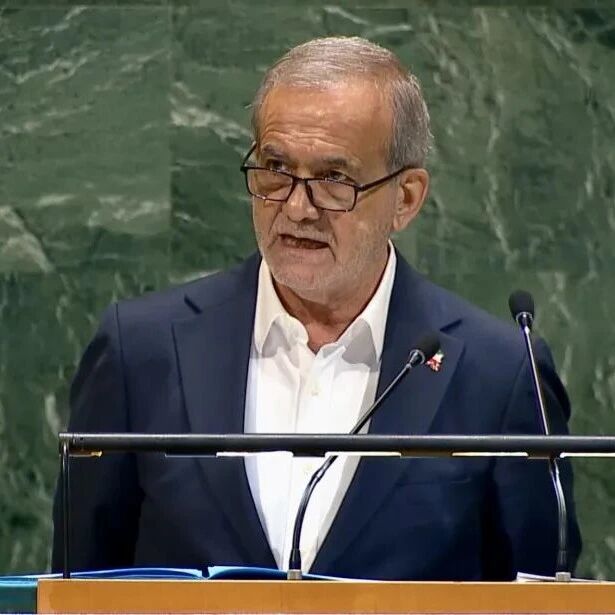
伊朗总统:不会追求拥有核武器
中国能源报· 2025-09-25 01:49
Core Viewpoint - The Iranian President emphasized that Iran will not pursue the development of nuclear weapons or any weapons of mass destruction, asserting that this stance is rooted in the beliefs and moral principles of the Iranian people [3]. Group 1 - The Iranian President, Pezeshkian, reiterated during the 80th United Nations General Assembly that Iran has never sought and will never seek to develop nuclear weapons [3]. - He called for the international community to ensure transparent and fair oversight of nuclear facilities, opposing the targeting of scientists and experts in conflicts [3]. - Pezeshkian criticized the misuse of multilateral mechanisms by certain members of the Security Council, highlighting the double standards that undermine the foundation of multilateralism and international law [3].
国际原子能机构总干事:伊朗核计划倒退“几十年”的说法是“政治评估”
news flash· 2025-06-25 23:48
Core Viewpoint - The Director General of the International Atomic Energy Agency (IAEA), Grossi, expressed skepticism regarding the U.S. claim that military strikes on Iranian nuclear facilities would set back Iran's nuclear program by "decades," suggesting it is more of a "political assessment" rather than a factual statement [1] Group 1 - Grossi lacks confidence in the timeline assessments related to weapons of mass destruction, indicating that such evaluations should be viewed as political rather than technical [1] - He acknowledged that Iranian nuclear facilities have indeed suffered significant damage [1]
伊朗外交部发言人:伊朗仍然反对大规模杀伤性武器。
news flash· 2025-06-16 08:15
Core Viewpoint - Iran's Foreign Ministry spokesperson reiterated the country's opposition to weapons of mass destruction, emphasizing its commitment to non-proliferation efforts [1] Group 1 - Iran maintains a firm stance against the development and possession of weapons of mass destruction [1]