太空移民

Search documents
贝佐斯再创业,新公司估值62亿美元
财富FORTUNE· 2025-11-20 13:04
Core Insights - Jeff Bezos is returning to a significant operational role as co-CEO of an AI startup named "Prometheus Engineering," marking his first major position since stepping down as Amazon's CEO in 2021 [2][3] - The startup has raised $6.2 billion in funding, with some contributions coming from Bezos personally, and focuses on AI applications in various industries including aerospace and automotive [3] - Bezos envisions a future where millions may live in space, driven by advancements in robotics and AI, which he believes will create new forms of labor and innovation [4][5] Company Overview - "Prometheus Engineering" is co-led by Vik Bajaj, a former director at Google's X project, and aims to explore AI technology's applications in engineering and manufacturing [3] - The company remains low-profile, with limited public information available about its founding and operations [3] Industry Context - Bezos's optimistic view on AI contrasts with some skepticism in the tech community, as he believes that AI will significantly impact human civilization and the future of the solar system [5][6] - He acknowledges the existence of a bubble in the AI sector, comparing it to the biotechnology bubble of the 1990s, but emphasizes the long-term societal value of AI technology [6] - The launch of "Prometheus Engineering" is seen as both a technological declaration and a philosophical statement about the potential of technology to enhance civilization [5]



武汉纺织大学×华中科技大学合作论文,登上Cell头条
生物世界· 2025-10-20 00:00
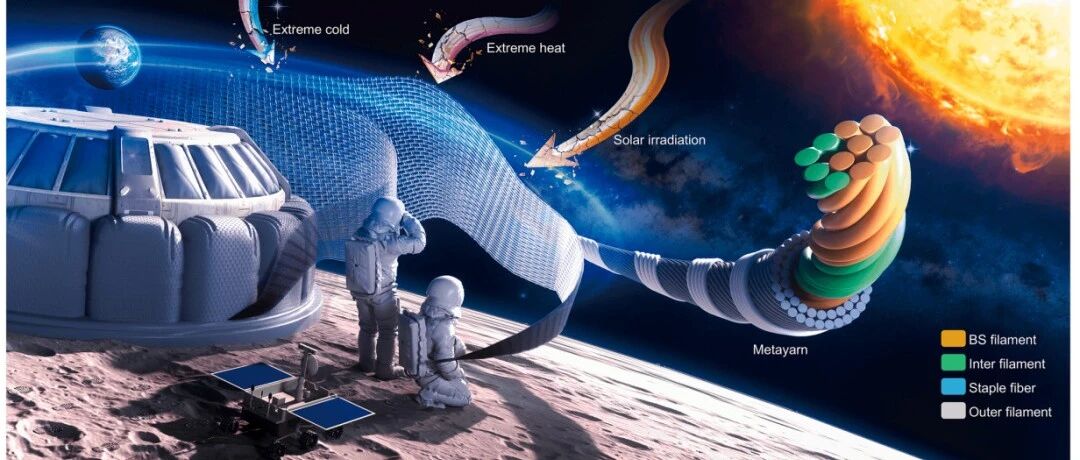
Core Viewpoint - A recent research paper from Wuhan Textile University and Huazhong University of Science and Technology has been highlighted on the Cell Press website, focusing on the development of hierarchical basalt metayarn for ergonomic protective space textiles, which is crucial for future human space colonization [4][7]. Group 1: Research Significance - The paper titled "Hierarchical basalt metayarn for ergonomic protective space textiles" was published online on October 1, 2025, and is authored by notable professors and academicians from the two universities, with Wuhan Textile University as the primary institution [4]. - The research introduces a novel method to transform brittle inorganic basalt fibers into practical ergonomic space protective textiles, essential for human survival in extreme space environments [7][9]. Group 2: Material Properties - Basalt, a common volcanic rock, shares similarities with lunar and Martian soil, making it a vital material for space equipment. It can withstand extreme temperatures ranging from 780°C to -260°C and has excellent resistance to solar radiation [8]. - The newly developed metayarn exhibits flexibility, high strength, and stability, allowing it to be processed into soft fabrics that can endure intense solar radiation and extreme temperature fluctuations [11]. Group 3: Technological Innovation - The research team has pioneered a coaxial spiral wrap spinning technique, enabling the industrial-scale production of multi-level, skin-friendly basalt metayarn, overcoming challenges related to fiber brittleness and weaving [9][11]. - The metayarn can maintain structural integrity even after exposure to flames at 1300°C, showcasing its exceptional fire resistance and comfort-protection integration [11][13]. Group 4: Applications - The ergonomic textiles made from metayarn are cost-effective, dyeable, skin-friendly, and flexible, providing innovative solutions for applications such as space suits, lunar bases, space flags, smart firefighting suits, automotive interiors, and polar exploration equipment [13].