存储成本上升

Search documents
OPPO发布涨价函,2026年全球PC出货量预计下降
Ping An Securities· 2026-03-16 02:00
Investment Rating - Industry investment rating is "Outperform" (expected to outperform the market by more than 5% within the next 6 months) [24] Core Insights - OPPO has announced a price adjustment for certain products starting March 16, 2026, due to rising costs of key components like high-speed storage hardware, which is expected to impact product quality and user experience [3][6] - Global smartphone shipments are projected to decline by 2.1% in 2026, driven by increased costs in the Bill of Materials (BoM) due to rising DRAM prices, which are expected to increase by approximately 25%, 15%, and 10% for low, mid, and high-end models respectively [3][6] - The global PC shipment volume is expected to decrease by 12% in 2026, reaching 245 million units, primarily due to significant increases in memory and storage prices, which have risen by $90 to $165 since Q1 2025 [10] Summary by Sections Price Adjustments and Market Impact - OPPO and OnePlus will adjust prices for certain products, including the OPPO A series and K series, to cope with rising component costs [3][6] - The price adjustments are a response to the increased costs of key components, which are expected to affect the overall market dynamics [3] Smartphone and PC Shipment Forecasts - The forecast for global smartphone shipments indicates a decline of 2.1% in 2026 due to rising storage costs [3][6] - The global PC market is projected to face a 12% decline in shipments, attributed to the financial pressures from increased memory and storage costs [10] Market Performance Overview - The semiconductor industry index experienced a weekly decline of 2.6%, underperforming the CSI 300 index by 2.68 percentage points, while year-to-date, it has increased by 7.07%, outperforming the CSI 300 index by 6.23 percentage points [15]
小米集团-W:供应链成本上升,手机业务后续或承压;下调至中性-20260312
BOCOM International· 2026-03-12 06:24
Investment Rating - The report assigns a "Neutral" rating to Xiaomi Group (1810 HK) with a target price of HKD 37.00, indicating a potential upside of 10.1% from the current price of HKD 33.62 [1][18]. Core Insights - The report highlights that rising supply chain costs, particularly in the smartphone segment, may pressure future performance, leading to a downgrade in the investment rating to Neutral [2][7]. - It anticipates a decline in global smartphone shipments by 11% in 2026, with Xiaomi's smartphone revenue forecasts for 2025 and 2026 adjusted downwards to RMB 182.2 billion and RMB 166.7 billion, respectively [7][19]. - The report also notes that Xiaomi's automotive business may face increased competition, shifting focus from supply capacity to demand orders in 2026, with projected sales of 559,000 vehicles [7][19]. Financial Overview - Revenue projections for Xiaomi are as follows: RMB 270.97 billion in 2023, RMB 365.91 billion in 2024, RMB 452.33 billion in 2025, RMB 492.47 billion in 2026, and RMB 548.83 billion in 2027, with year-on-year growth rates of -3.2%, 35.0%, 23.6%, 8.9%, and 11.4% respectively [3][19]. - Net profit estimates are projected at RMB 17.48 billion for 2023, RMB 23.66 billion for 2024, RMB 39.99 billion for 2025, RMB 33.73 billion for 2026, and RMB 41.29 billion for 2027, with significant growth in 2024 and 2025 [3][19]. - The report indicates a downward adjustment in the earnings per share (EPS) forecast for 2025 and 2026 to RMB 1.49 and RMB 1.53, respectively, reflecting a decrease of 10.5% and 11.8% from previous estimates [7][19]. Valuation Methodology - The report employs a Sum-of-the-Parts (SOTP) valuation approach, applying a price-to-earnings (P/E) ratio of 22.0x for the smartphone and AIoT segments and 1.4x for the automotive and AI segments, resulting in a target price of HKD 37 [7][15].

小米集团-W(01810):小米集团(1810HK)
BOCOM International· 2026-03-12 06:21
Investment Rating - The report assigns a "Neutral" rating to Xiaomi Group (1810 HK) with a target price of HKD 37.00, indicating a potential upside of 10.1% from the current price of HKD 33.62 [1][18]. Core Insights - The report highlights that rising supply chain costs, particularly in the smartphone segment, may pressure future performance, leading to a downgrade in the investment rating to Neutral [2]. - The forecast for Xiaomi's smartphone revenue for 2025 and 2026 has been reduced to RMB 182.2 billion and RMB 166.7 billion, respectively, down from previous estimates of RMB 193.5 billion and RMB 197.7 billion [7]. - The report anticipates a decline in global smartphone shipments by 11% in 2026, projecting a total of 1.13 billion units [7]. - The automotive business is expected to face increased competition, with projected sales of 559,000 vehicles in 2026 [7]. - The AIoT segment is expected to see revenue growth driven by national subsidies and overseas expansion, with projected revenues of RMB 120.2 billion and RMB 133.6 billion for 2025 and 2026, respectively [7]. Financial Overview - Revenue projections for Xiaomi are as follows: RMB 270.97 billion in 2023, RMB 365.91 billion in 2024, RMB 452.33 billion in 2025, RMB 492.47 billion in 2026, and RMB 548.83 billion in 2027, with growth rates of -3.2%, 35.0%, 23.6%, 8.9%, and 11.4% respectively [3][19]. - Net profit is forecasted to be RMB 17.48 billion in 2023, RMB 23.66 billion in 2024, RMB 39.99 billion in 2025, RMB 33.73 billion in 2026, and RMB 41.29 billion in 2027, with significant growth in the earlier years followed by a decline in 2026 [3][19]. - The adjusted EPS for 2025 and 2026 is projected to be RMB 1.49 and RMB 1.53, respectively, down from previous estimates of RMB 1.66 and RMB 1.74 [7][14]. Valuation Metrics - The report employs a sum-of-the-parts (SOTP) valuation method, estimating a target price of HKD 37 based on a P/E ratio of 22.0x for the smartphone and AIoT segments and a P/S ratio of 1.4x for the automotive and AI segments [7][15]. - The overall P/E ratio for 2026 is adjusted to 21.7x, reflecting the revised revenue and profit forecasts [7][15].
电子行业点评:iPhone营收同比增长,大中华区表现靓丽
Ping An Securities· 2026-02-01 11:31
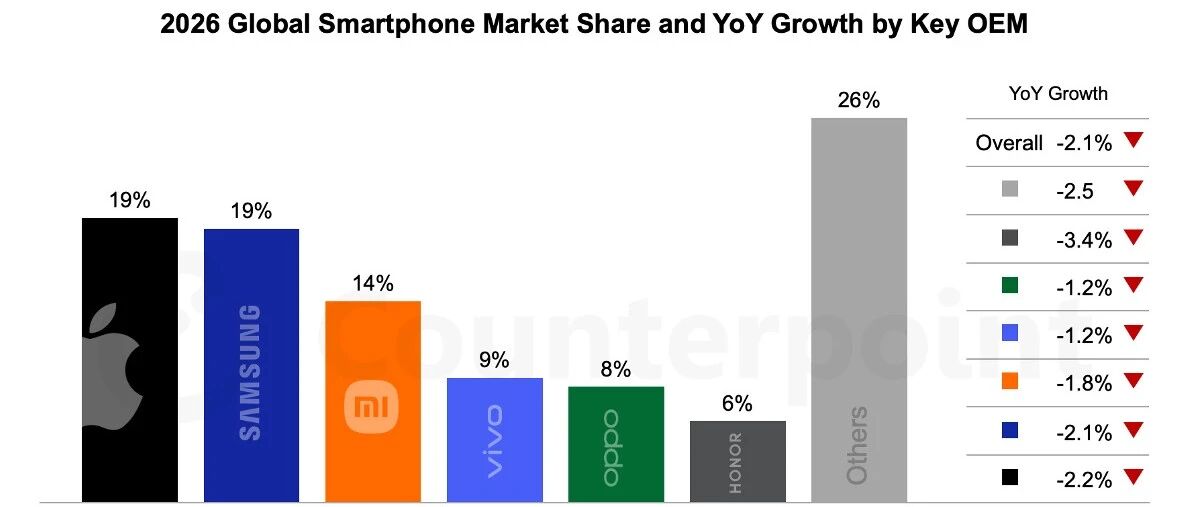
Investment Rating - The industry investment rating is "Outperform the Market," indicating that the industry index is expected to perform better than the market by more than 5% over the next six months [9]. Core Insights - Apple's revenue for the first quarter of fiscal year 2026 reached $143.76 billion, a year-on-year increase of 16%, with net profit at $42.10 billion, also up 16%. Earnings per share rose by 19% to $2.84 [7]. - iPhone revenue, as a key growth driver, amounted to $85.27 billion, reflecting a 23% year-on-year growth and accounting for 59.3% of total revenue. Service revenue was $30.01 billion, up 14%, while iPad revenue grew by 6% to $8.60 billion. However, Mac revenue declined by 7% to $8.39 billion, and wearables, home, and accessories revenue fell by 2% to $11.49 billion [7]. - In the Greater China region, revenue reached $25.53 billion, marking a significant 38% year-on-year increase, while the Americas and Europe saw revenue growth of 11% and 13%, respectively [7]. Market Outlook - Global smartphone shipments are projected to grow by 2% in 2025, reaching 1.25 billion units. The top five smartphone manufacturers in terms of shipments are Apple, Samsung, Xiaomi, Vivo, and OPPO, with respective shipments of 241 million (up 7%), 239 million (up 7%), 165 million (down 2%), 105 million (up 4%), and 101 million (down 3%) [7]. - For 2026, due to rising DRAM prices, the cost of smartphone Bill of Materials (BoM) is expected to increase by approximately 25% for low-end models, 15% for mid-range, and 10% for high-end models, with a potential further increase of 10%-15% by the second quarter of 2026. Consequently, global smartphone shipments are anticipated to decline by 2.1% year-on-year [7]. - The average selling price of smartphones is expected to rise by 6.9% in 2026 due to cost pass-through and product mix adjustments [7]. Investment Recommendations - Short-term pressures from rising storage costs are noted, but emerging products such as foldable phones, AI smartphones, and AI glasses present new growth opportunities for the industry. Companies to watch include Luxshare Precision, Lixun Precision, GoerTek, Lens Technology, and Xinwei Communication [7].

存储成本走高,2026 年智能手机出货预期下滑
Counterpoint Research· 2025-12-19 01:10
Core Insights - The global smartphone shipment volume is expected to decline by 2.1% in 2026 due to rising storage costs, marking a downward revision of 2.6 percentage points from previous forecasts [4][5][7]. Group 1: Market Trends - The increase in component costs is anticipated to impact end-user demand, particularly affecting Chinese OEMs like HONOR, OPPO, and vivo, which have seen significant adjustments in their forecasts [5][7]. - The average selling price of smartphones is projected to increase by 6.9% in 2026, up from a previous estimate of 3.6%, driven by rising Bill of Materials (BoM) costs [7][10]. Group 2: Cost Implications - DRAM prices have risen, leading to an increase in BoM costs by approximately 25% for low-end models, 15% for mid-range, and 10% for high-end models, with further increases expected in the second quarter of 2026 [7][9]. - The cost of storage is projected to rise by about 40% before the second quarter of 2026, further exacerbating BoM costs [9]. Group 3: Strategic Responses - OEMs are likely to adjust their product strategies in response to cost pressures, with some low-SKU models already experiencing reduced shipments [10]. - Companies are adopting various strategies, including adjusting specifications of camera modules, displays, and storage configurations, as well as streamlining product lines to cope with market changes [10].