
学科融合

Search documents
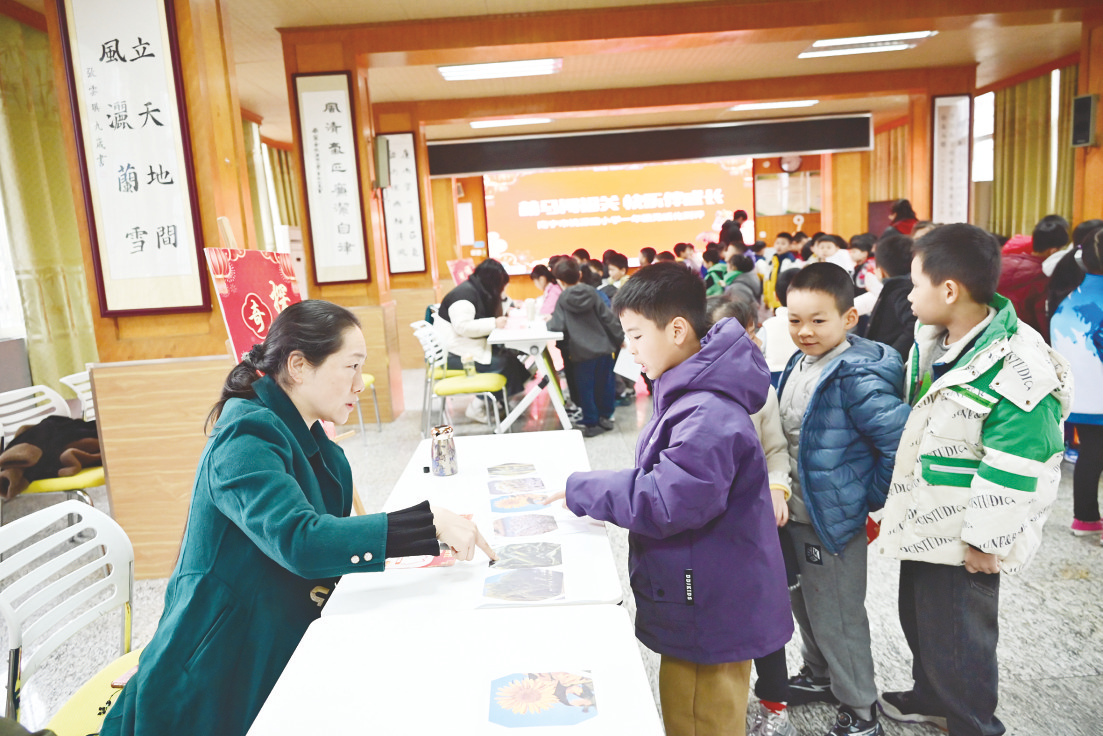
育德路小学举办“学科融合实践成果展”
Xin Lang Cai Jing· 2026-02-13 02:50
Core Viewpoint - The article highlights the successful implementation of interdisciplinary teaching at Yude Road Primary School, showcasing a variety of student projects that integrate different subjects, thereby enhancing students' understanding and interest in learning [1] Group 1: Event Overview - The school organized a "Fusion Innovation, Practical Education" themed exhibition to display the achievements of interdisciplinary teaching across various grades [1] - The exhibition is based on classroom teaching and features a series of unique practical works that combine knowledge from different subjects [1] Group 2: Featured Projects - Notable projects include a "Poetry and Painting" collaboration between Chinese language and art, which merges classic poetry with creative painting [1] - A "Campus Measurement Handwritten Report" integrates mathematics with practical application, allowing students to apply math knowledge in measuring the school [1] - The "Scientific Observation Diary" combines science and language, documenting students' experimental processes and discoveries [1] - Other projects include "English Greeting Card Making" merging English with crafts, and "Classic Poetry Recitation" combining music with language [1] Group 3: Educational Impact - The exhibition serves as a validation of the school's interdisciplinary teaching practices and helps students recognize the intrinsic connections between different fields of knowledge [1] - It fosters cross-disciplinary thinking and practical innovation skills among students, planting the seeds of interest for independent exploration during the holiday [1]
知识闯关启智慧 无纸乐学趣无穷
Xin Lang Cai Jing· 2026-01-27 21:04
Core Viewpoint - Nanning schools have implemented innovative, paperless evaluation activities for first and second graders, integrating academic knowledge into game-like scenarios to promote learning through play and reduce exam pressure [16][18]. Group 1: Activity Overview - Various schools in Nanning have designed engaging activities for students, such as "Wisdom Adventure" and "Knowledge Maze," where students participate in multiple challenges to enhance their learning experience [17][20]. - The activities include diverse subjects like language, mathematics, music, and art, allowing students to showcase their skills in a fun environment [24][25]. Group 2: Educational Objectives - The initiatives aim to deepen the understanding of core subjects while fostering creativity and practical skills among students [23][24]. - Schools focus on integrating different disciplines, such as combining language arts with visual arts and mathematics with physical activities, to create a holistic learning experience [23][24]. Group 3: Student Engagement - Students actively participate in various challenges, earning stamps or rewards for completing tasks, which boosts their confidence and motivation [20][22]. - The activities are designed to be enjoyable and stress-free, encouraging students to engage with the material in a playful manner [18][19].

改革中小学科技教育,创新从娃娃抓起
Nan Fang Du Shi Bao· 2025-11-13 00:27
Core Viewpoint - The recent issuance of the "Opinions on Strengthening Science and Technology Education in Primary and Secondary Schools" by seven departments, including the Ministry of Education, signifies a commitment to enhance STEM education in China, aiming to cultivate innovative talents and support high-quality development in education, technology, and talent integration [1][2]. Group 1: Focus on STEM Education - The "Opinions" emphasize the importance of practical experience in science and technology education, advocating for the optimization of teaching spaces to provide students with real-world exploration and engineering practice opportunities [1][2]. - The traditional knowledge-based, subject-segregated approach to science education is deemed insufficient for nurturing innovative and interdisciplinary talents, necessitating reforms that begin from early childhood education [1][2]. Group 2: Developmental Framework - A "stair-step" educational system is proposed, tailored to the cognitive characteristics of students at different educational stages, promoting engagement through life and game-based scenarios in elementary school, problem-solving in middle school, and experimental inquiry in high school [2][3]. - The integration of disciplines is a key feature, requiring a coordinated approach to resources across science, technology, engineering, and mathematics, focusing on real-world issues rather than isolated subject knowledge [2][3]. Group 3: Collaborative Implementation - The "Opinions" highlight the need for an "open collaboration" model, encouraging partnerships between schools, families, communities, technology companies, and non-profit organizations to enhance technology education projects [3]. - This collaborative approach aims to bridge the gap between classroom knowledge and real-world applications, addressing the disconnect between educational content and societal needs [3].
学科融合 AI赋能 福州这场教学年会超有“料”
Xin Hua Wang· 2025-05-13 10:47
Core Insights - The event showcased over 110 student inventions and innovative educational practices, emphasizing the integration of AI and technology in education [1][4][5] - The activities included cross-disciplinary learning projects, classroom observations, and expert lectures, highlighting the collaborative efforts of the education sector in Fuzhou [1][4][6] Group 1: Event Overview - The 2024-2025 academic year teaching open day and educational conference was held in Fuzhou, organized by the Fuzhou Education Bureau and Fuzhou Education Research Institute [1][2] - The event featured student club activities, cross-disciplinary learning displays, and expert lectures, demonstrating the development of Fuzhou's education sector [1][4] Group 2: Educational Innovations - The "Intelligent Creation Fuzhou Subway Model" showcased a dual-direction train model capable of automatic station stops and voice announcements, reflecting practical applications of technology in education [5] - AI technology was integrated into various subjects, enhancing reading training, cognitive development, and creative aesthetics in language classes [4][6] Group 3: Student Engagement - Students actively participated in demonstrating their cross-disciplinary learning projects, which included over 10,000 words of research reports and interactive cultural content [4][5] - Robotics and AI tools provided engaging experiences for students, fostering a sense of curiosity and excitement about the digital transformation in education [4][8][9]

中国科普研究所党委书记庞晓东:AI使个性化学习成为可能
Zhong Guo Jing Ying Bao· 2025-04-14 14:58
Core Insights - AI enables personalized learning by addressing the "one-size-fits-all" issue in education, allowing for tailored assignments based on individual student performance [1][4] - The essence of education remains unchanged, focusing on knowledge transmission, skill development, and value shaping, while AI can enhance these aspects [2][3] - AI's rapid development is evident, with significant advancements and recognition in research, indicating its disruptive potential in education [2] Group 1: AI in Education - AI facilitates personalized learning by tracking student performance and automatically generating customized assignments, significantly improving learning efficiency [1][4] - The integration of AI in education should focus on enhancing the core educational mission rather than altering it, emphasizing the importance of "education + AI" [2] - AI can provide vast resources for autonomous learning and create platforms for interdisciplinary skill development, fostering a more engaging learning environment [3][4] Group 2: Educational Equity and Challenges - AI has the potential to bridge educational gaps, especially in remote areas, by providing access to quality resources comparable to those available in urban settings [5] - While the future of AI in education is promising, it is essential to remain cautious about potential issues such as content accuracy and the phenomenon of "hallucination" in AI outputs [5]