宏观再定价

Search documents
贵金属转为失速暴跌:金银高位去杠杆,全球市场迎来压力测试
Xin Lang Cai Jing· 2026-02-02 07:17
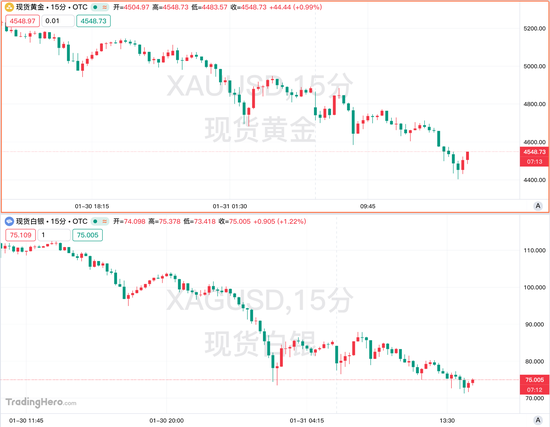
Core Viewpoint - The precious metals market is experiencing a historic crash, with gold prices nearing $4,400 per ounce and silver prices dropping below $72 per ounce, erasing significant gains made throughout the year [1][3][15]. Market Performance - On the previous Friday, gold and silver prices plummeted, with silver falling 26% in less than 20 hours, marking the largest single-day drop in history, while gold dropped 9%, the worst performance since the 1980s [3][17]. - The domestic futures market also saw a "limit down" trend, with significant declines across various sectors, including energy and precious metals, where contracts for SC crude oil and fuel oil hit their limits with declines of 7.02% and 7.01% respectively [3][17]. Regulatory Changes - CME raised margin requirements for Comex gold and silver futures in response to the volatility, increasing gold margins from 6% to 8% and silver from 11% to 15%, effective February 2 [4][18]. - The Thailand Futures Exchange expanded its price limits for gold and silver futures due to significant price drops, allowing for greater fluctuations in trading [4][18]. Analyst Perspectives - Analysts suggest that the recent declines in precious metals are driven by a deleveraging process rather than a fundamental shift in market conditions, indicating a simultaneous sell-off of precious metals and risk assets [5][19]. - CBA commodity strategist Vivek Dhar noted that the market's reaction to Kevin Walsh's nomination as Fed Chair and the strengthening dollar has pressured precious metals, but he views the current drop as an adjustment rather than a fundamental change, maintaining a bullish outlook for gold prices in Q4 [7][21]. - CMC Markets' Christopher Forbes described the situation as a typical deleveraging phase, where previously accumulated leverage is being cleared, leading to a concentrated sell-off in liquid assets [8][22]. Market Dynamics - The rapid price changes in precious metals are seen as a result of position liquidation rather than a clean macro revaluation, with potential for further declines depending on whether forced selling continues [9][23]. - Analysts from Singapore's OCBC Bank highlighted that the ongoing decline reflects a combination of technical and emotional pressures, with sensitivity to dollar movements and Fed policy uncertainty exacerbating the situation [9][23]. Institutional Role - Increased trading activity from institutions has been noted, as they seek liquidity and manage positions amid heightened volatility, which has also impacted other markets like Bitcoin and equities [13][26]. - The volatility in gold and silver has triggered liquidity pressures and margin calls among institutional investors, contributing to broader market declines [13][26].

港股上市公司博雅互动疯狂增持比特币,收益两倍多了,比主业赚钱
Sou Hu Cai Jing· 2025-08-28 02:14
Group 1 - The core viewpoint of the articles highlights the significant investment strategy of Boya Interactive in Bitcoin, with the company holding 3,416 Bitcoins at an average cost of approximately $59,300 per coin, making it the largest holder among Hong Kong-listed companies [1] - The price of Bitcoin surged to $122,300 on August 12, valuing Boya Interactive's holdings at around $420 million, equivalent to approximately 3 billion RMB [1] - The company's chairman, Dai Zhikang, has a history of successful investments in the tech sector and has been accumulating Bitcoin despite market volatility, indicating a strong belief in Bitcoin as a future mainstream asset [1][3] Group 2 - Boya Interactive's recent purchase of about 100 Bitcoins for $7.95 million at a price below $80,000 per coin demonstrates a strategic and timely investment approach [3] - Since 2014, Dai Zhikang has shown a keen interest in Bitcoin, having invested in Huobi, a cryptocurrency exchange, and has since spent over $200 million (approximately 1.5 billion RMB) on Bitcoin [3] - The company has no plans to sell its Bitcoin holdings, reflecting a long-term investment strategy and confidence in the cryptocurrency market [6] Group 3 - The articles also discuss broader market sentiments regarding Bitcoin, with statements from influential figures suggesting that a bear market for Bitcoin may not occur in the coming years, influenced by political and institutional factors [6][7] - Historical patterns indicate that Bitcoin's volatility can be exacerbated by macroeconomic factors such as rising real interest rates and a strengthening dollar, which could lead to increased market fluctuations [7]