
流动性挤压

Search documents
跌超20%后反弹!金价过山车,基民吵翻了:割肉还是硬扛?基金经理最新发声
凤凰网财经· 2026-03-25 13:15
Core Viewpoint - The article discusses the recent fluctuations in gold prices and the performance of gold-themed funds, highlighting the debate on whether to hold or redeem these funds amid significant price drops and market volatility [3][4]. Group 1: Gold Price Trends - Since March 3, gold prices have significantly declined, with spot gold dropping below $4,100 per ounce on March 23, a decrease of over 20% from the March 2 high of $5,419.32 [3][4]. - The gold sector in the A-share market saw a year-to-date increase of 73.38% in January, ranking first among 31 Shenwan primary industries, but has since faced a downturn [4]. Group 2: Fund Performance - By March, the year-to-date return of gold funds fell below 5%, with many ETFs experiencing substantial outflows and declines in net asset value [4][5]. - On March 23, the largest gold-themed ETF, managed by Huashan Fund, reported a year-to-date return of -5.12%, with a decrease in circulation scale by 143.13 billion [5][6]. Group 3: Market Sentiment and Future Outlook - The article notes that the recent downturn in gold prices is attributed to pressures from "monetary policy repricing" and "liquidity squeeze," leading to increased selling pressure in the market [8][9]. - Despite short-term volatility, long-term investment managers believe that gold still holds value as a hedge against inflation and uncertainty, suggesting a potential rebound in interest for gold as a strategic asset [9][10].

贵金属史诗级跳水!白银暴跌10%后再崩26%:全球市场被吓懵了
Sou Hu Cai Jing· 2026-02-02 14:39
Group 1 - The core issue behind the recent sharp decline in precious metals is liquidity tightening rather than a fundamental collapse in prices [4][10] - The immediate trigger for the crash was an increase in margin requirements by exchanges, forcing leveraged funds to liquidate positions, leading to a domino effect [4][8] - The silver ETF experienced an 8.7% drop in a single day, illustrating the passive selling effect caused by the liquidity crunch [4] Group 2 - An unusual divergence has been observed where precious metals are falling despite stable or declining U.S. Treasury yields, indicating that the market is pricing in "liquidity panic" rather than interest rates [6][8] - Concerns over rising leverage costs, tightened risk controls by exchanges, and a hawkish stance from the Federal Reserve are driving investors to sell off volatile assets like silver [8][10] Group 3 - The latest Federal Reserve meeting minutes suggest that the market is adjusting its expectations for a hawkish return, with inflation not yet back to target and premature rate cuts posing risks [10][20] - This shift in expectations is likely to pressure risk assets and make leveraged funds more cautious, further exacerbating the downward pressure on precious metals [10][20] Group 4 - Historical comparisons indicate that the current situation resembles the 2013 "taper tantrum" rather than the 2008 financial crisis, as there are no signs of a systemic financial crisis, but liquidity is indeed tightening [12][18] - The market is currently experiencing a "liquidity squeeze," which may lead to significant short-term volatility, but the long-term trend for precious metals is not expected to change drastically [18][21] Group 5 - Ray Dalio's recent insights emphasize that holding cash can be a proactive defense strategy amid rising policy uncertainty and increased asset price volatility [20] - Three potential liquidity scenarios have been outlined, ranging from mild tightening to extreme liquidity crises, each with different implications for precious metals [22][21]
贵金属转为失速暴跌:金银高位去杠杆,全球市场迎来压力测试
Xin Lang Cai Jing· 2026-02-02 07:17
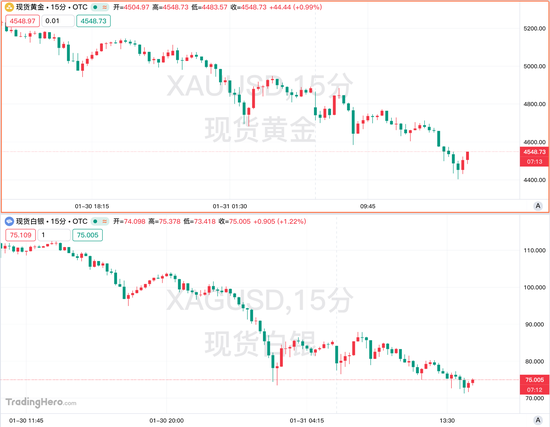
Core Viewpoint - The precious metals market is experiencing a historic crash, with gold prices nearing $4,400 per ounce and silver prices dropping below $72 per ounce, erasing significant gains made throughout the year [1][3][15]. Market Performance - On the previous Friday, gold and silver prices plummeted, with silver falling 26% in less than 20 hours, marking the largest single-day drop in history, while gold dropped 9%, the worst performance since the 1980s [3][17]. - The domestic futures market also saw a "limit down" trend, with significant declines across various sectors, including energy and precious metals, where contracts for SC crude oil and fuel oil hit their limits with declines of 7.02% and 7.01% respectively [3][17]. Regulatory Changes - CME raised margin requirements for Comex gold and silver futures in response to the volatility, increasing gold margins from 6% to 8% and silver from 11% to 15%, effective February 2 [4][18]. - The Thailand Futures Exchange expanded its price limits for gold and silver futures due to significant price drops, allowing for greater fluctuations in trading [4][18]. Analyst Perspectives - Analysts suggest that the recent declines in precious metals are driven by a deleveraging process rather than a fundamental shift in market conditions, indicating a simultaneous sell-off of precious metals and risk assets [5][19]. - CBA commodity strategist Vivek Dhar noted that the market's reaction to Kevin Walsh's nomination as Fed Chair and the strengthening dollar has pressured precious metals, but he views the current drop as an adjustment rather than a fundamental change, maintaining a bullish outlook for gold prices in Q4 [7][21]. - CMC Markets' Christopher Forbes described the situation as a typical deleveraging phase, where previously accumulated leverage is being cleared, leading to a concentrated sell-off in liquid assets [8][22]. Market Dynamics - The rapid price changes in precious metals are seen as a result of position liquidation rather than a clean macro revaluation, with potential for further declines depending on whether forced selling continues [9][23]. - Analysts from Singapore's OCBC Bank highlighted that the ongoing decline reflects a combination of technical and emotional pressures, with sensitivity to dollar movements and Fed policy uncertainty exacerbating the situation [9][23]. Institutional Role - Increased trading activity from institutions has been noted, as they seek liquidity and manage positions amid heightened volatility, which has also impacted other markets like Bitcoin and equities [13][26]. - The volatility in gold and silver has triggered liquidity pressures and margin calls among institutional investors, contributing to broader market declines [13][26].
Fed buying, record repo facility use steady year-end US funding markets
Reuters· 2025-12-31 18:50
Core Viewpoint - U.S. short-term funding markets experienced typical year-end tension, but the Federal Reserve's actions helped maintain liquidity and prevent a significant squeeze [1] Group 1: Market Conditions - The Federal Reserve renewed its buying of short-term government debt to support liquidity in the funding markets [1] - Heavy utilization of the Standing Repo Facility by the Federal Reserve contributed to the flow of cash in the markets [1] Group 2: Impact on Liquidity - Market participants noted that the Federal Reserve's interventions were effective in preventing a larger liquidity squeeze during the year-end period [1]
Why Gold Shines at +55% While Bitcoin Tanks: The Great Divergence of 2025
Yahoo Finance· 2025-11-29 19:28
Core Insights - The World Gold Council reported that global instability and inflation have driven a significant increase in demand for gold as a safe-haven asset [1][5] - Gold experienced a remarkable performance in 2025, achieving a 55% year-to-date increase and hitting an all-time high of over $4,370 per ounce [5][6] - In contrast, Bitcoin faced a substantial decline, dropping over 30% from its peak of $126,200 in October 2025, entering a bear market phase [4][6] Gold Market Dynamics - Central banks, particularly in China, India, and Turkey, have been accumulating gold at near-record rates, collectively purchasing over 1,000 tons annually [9][10] - For the first time in decades, central banks held more gold than U.S. Treasury bonds in their reserves, indicating a shift in reserve asset preferences [10][7] - The broad participation in gold investment included institutional investors and retail investors seeking safety amid market volatility [11] Bitcoin Market Dynamics - Bitcoin's initial rally in 2025 was fueled by the approval of spot Bitcoin ETFs and institutional adoption, but this momentum was short-lived [4][13] - The decline in Bitcoin's value was exacerbated by rising interest rate expectations and a broader risk-off environment, leading to significant liquidations in the crypto market [15][22] - The narrative of Bitcoin as "digital gold" faced challenges as it failed to achieve reserve-asset status and was not held by major central banks [16][23] Comparative Analysis - The divergence between gold and Bitcoin in 2025 highlights a shift in investor psychology, with gold being favored as a proven store of value during times of uncertainty [20][21] - While gold's performance was bolstered by geopolitical tensions and inflation, Bitcoin's appeal diminished as it became more correlated with risk assets [24][25] - The contrasting paths of these assets suggest that in uncertain times, capital tends to flow towards established safe havens like gold rather than speculative assets like Bitcoin [24][25]