宽基资产

Search documents
高切低市场风格下的ETF投资主线
Huafu Securities· 2025-11-27 08:20
- The report discusses the macroeconomic recovery in China, highlighting the transition from "weak recovery" to "marginal improvement" as a key phase for economic activity and liquidity structure, which lays the foundation for subsequent profitability recovery and market style shifts towards dividends and low valuation assets [11][16][17] - A macro scoring model is referenced, indicating that the macroeconomic environment has been in a neutral to slightly pessimistic range in 2025, with the latest score (September 2025) being 7, reflecting a neutral to slightly optimistic outlook [13][14] - Dividend strategies (high dividend yield strategies) are emphasized as a classic value investment method, with their core logic analyzed from three dimensions: investor behavior, corporate operating characteristics, and market valuation systems. The dividend yield is identified as the core metric for evaluating dividend strategies [21][23] - The report highlights the strategic allocation value of dividend assets, emphasizing their long-term stable return characteristics and risk diversification functions, making them suitable as a "ballast" in investment portfolios, especially in a low-interest-rate environment [21][23][25] - The report introduces the "stability value + growth premium" logic for the power and power grid sectors, emphasizing their stable cash flow, regulatory framework ("permitted cost + reasonable return"), and policy support for energy transition and power security [26] - The report provides valuation metrics for high dividend yield-related ETF products tracking indices as of October 20, 2025. For example, the PE ratios for the National New Hong Kong Stock Connect Central Enterprise Dividend Index, Smart High Dividend Index, CSI Dividend Index, and CSI All Power Index are 8.88, 8.73, 8.29, and 17.60, respectively, with corresponding PB ratios of 0.85, 1.11, 0.80, and 1.76 [27][30] - The cyclical sector investment direction is analyzed, with key drivers identified as domestic demand policies and global demand recovery. Non-bank financials and consumer sectors benefit from dual drivers, while financial real estate and infrastructure are supported by domestic policies, and materials benefit from global restocking [40][42][47] - Valuation metrics for cyclical-related ETF products tracking indices are provided as of October 20, 2025. For example, the PE ratios for the Hong Kong Stock Connect Non-Bank, Financial Real Estate, 800 Consumer, All Materials, and Infrastructure Engineering indices are 9.44, 9.10, 19.20, 26.90, and 8.51, respectively, with corresponding PB ratios of 1.13, 0.86, 4.36, 2.10, and 0.72 [51][55] - The report emphasizes the role of broad-based assets like the SSE 50 ETF and CSI 300 ETF as core holdings in portfolios, supported by policy efforts to stabilize the market and attract long-term funds, as well as their low historical valuations and high safety margins [64][65][66] - Valuation metrics for broad-based ETF products tracking indices are provided as of October 20, 2025. For example, the PE ratios for the SSE 50 and CSI 300 indices are 11.99 and 14.22, respectively, with corresponding PB ratios of 1.30 and 1.48. Both indices are near the 68th percentile of their five-year PB range [69][70][71]
当均衡宽基遇上进攻小盘,这个组合赢麻了!
Sou Hu Cai Jing· 2025-05-27 11:25
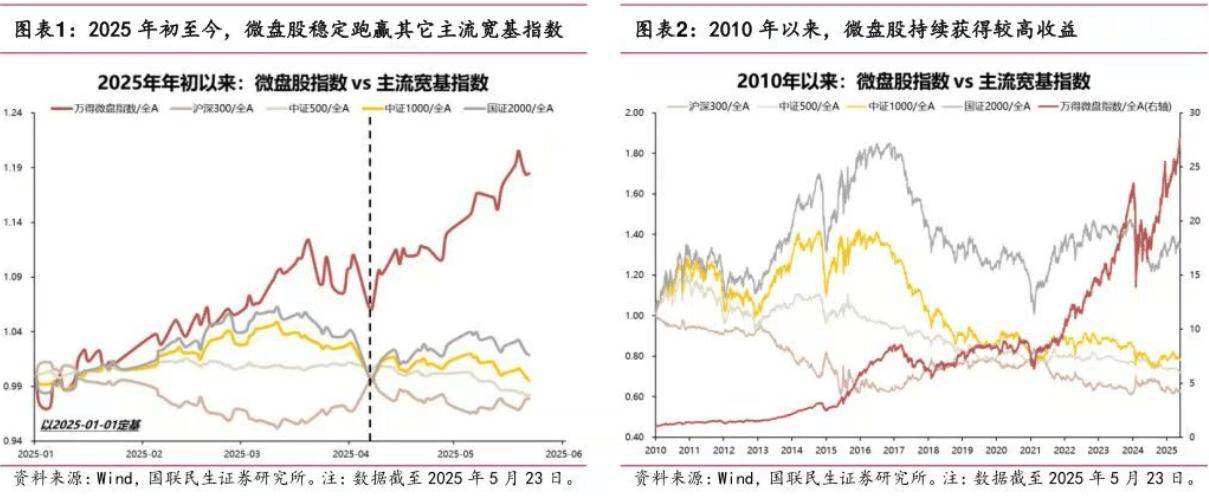
Group 1 - The core viewpoint is that micro-cap stocks have shown strong performance since the beginning of 2025, outperforming broader indices due to their low price-to-book (PB) ratios and small market capitalization, indicating high elasticity [1][3] - The current high crowding in micro-cap stocks and their PB being higher than the overall A-share market presents significant risks, suggesting a balanced approach with broad-based assets to mitigate risks while capturing rebound opportunities through small-cap strategies [3][4] - The CSI A500 Index ETF (SH560610) and the 1000 ETF Enhanced (SZ159680) align well with the strategy of balancing risk and enhancing returns, as the CSI A500 offers a more representative industry weight distribution compared to traditional indices like the CSI 300 [3][4] Group 2 - The CSI A500 serves as a stable foundation, while the CSI 1000 Enhanced strategy acts as an offensive tool, capitalizing on the current favorable environment for small-cap stocks driven by liquidity and supportive policies [4][5] - The 1000 ETF Enhanced has delivered an excess return of over 4% relative to the CSI 1000 since the beginning of the year, with a historical excess return of 28%, making it suitable for aggressive positioning [5] - With the implementation of merger and acquisition policies and sustained liquidity, the micro-cap market is expected to remain volatile at high levels, while broad-based assets provide a long-term anchor for investment portfolios [7]