市值管理改革

Search documents
2026年股指期货行情展望:牛市在犹豫中发展
Shan Jin Qi Huo· 2026-02-13 11:11
1. Report Industry Investment Rating No information provided in the content. 2. Core Viewpoints of the Report - A long - term bull market started in early 2024, and the current market is in the main rising wave [5]. - The driving forces of this bull market include macro - economic policy support, an increase in corporate profit growth, the re - allocation of household savings to the stock market, the return of global capital, the inflow of long - term funds, and the further advancement of market value management reform [5]. - From the perspective of valuation, the bull market has three stages: confidence restoration, the main rising wave, and the crazy bull market. Currently, it is in the main rising wave [5]. - The stock market has multiple positive effects such as promoting economic transformation, stimulating economic growth, improving the corporate financing environment, alleviating debt pressure, and enhancing international competitiveness [82]. 3. Summary According to the Directory 3.1 Why the Current Bull Market Started in Early 2024 - In February 2024, the market completed the bear - to - bull conversion, which is also the case for other indexes [7]. 3.2 Driving Forces of the Bull Market 3.2.1 Macroeconomic Policy and Cyclical Recovery Expectations - The macro - economy is under pressure and requires loose support policies. However, there are positive signals due to industrial chain advantages and key technological breakthroughs [9]. - Fixed - asset investment growth has continued to decline, and the decline accelerated in Q3 and Q4 of 2025, turning negative for the whole year. Manufacturing growth is only slight [10][12]. - The growth of total retail sales of consumer goods has slowed down, and consumer confidence remains low. This is due to weakened income and income expectations, high household leverage, and the need for preventive savings [14][17]. - Inflation is persistently weak. The consumption structure shows a pattern of "strong at both ends and weak in the middle". For PPI, the downward pressure on production material prices is more obvious [19][24]. - Manufacturing PMI has been weak, with环比 data lower than seasonal levels, rising ex - factory prices, a decline in raw material inventory possibly due to active de - stocking, rising raw material purchase prices, and weak new and on - hand orders [25][29]. - Fiscal policy is loose. The government has room to increase leverage, and the average maturity of local government bonds has been lengthening [30][32]. - The money market is loose. The 7 - day reverse repurchase rate has remained low, and there is still room for further decline in interest rates. The adjustment of treasury bond futures indicates a change in market expectations [34][36]. - The Fed's interest rate cuts provide room and necessity for domestic interest rate cuts. The Fed has cut rates by 25 basis points and is expected to cut twice more this year. Domestic commercial banks have lowered deposit rates, and the real domestic interest rate is high [37][39]. - Exports show strong resilience, but exports to the US have declined significantly. China's share of global exports remains stable, and new "new three items" are emerging as new drivers of foreign trade [40][45]. - In the chip industry, the effect of import substitution is emerging, and the export growth rate is much higher than the import growth rate. A complete domestic chip industry chain is rising [49]. - The production, sales, and exports of automobiles are expected to reach new highs this year, and the export volume has exceeded the sum of Germany and Japan [50][53]. - The increase in excavator production and sales is mainly due to the low - base effect and still has a large gap compared with the peak [58]. - The real estate market is in the bottom - building process, with a decline in housing prices. The real estate market will have a lower correlation with the macro - economy in the future, and there is a possibility of a retaliatory rise in housing prices [60]. 3.2.2 Increase in Corporate Profit Growth - The profit growth rate of industrial enterprises above a designated size has rebounded. In 2025, the cumulative year - on - year growth rate of total profits turned positive. The profit of listed companies in the A - share market has also returned to growth, and the scope of profit improvement is gradually expanding [62]. 3.2.3 Re - allocation of Household Savings to the Stock Market - Household deposits are likely to continue to rise, and the ratio of the total stock market value to household deposits is still low, indicating great potential for households to allocate more assets to the stock market [64]. 3.2.4 Return of Global Capital - Global investors plan to increase their investment in China - focused hedge funds in 2026. The net proportion of investors planning to increase investment has reached 14%, higher than the 9% in 2025. At the same time, investors' interest in the North American market has declined significantly [65]. - The US dollar has entered a downward trend, and bank settlement and sales of foreign exchange have turned into a surplus, which may be due to the inflow of overseas hot money. When the settlement and sales of foreign exchange turn into a surplus, the overall trend of the A - share market is usually strong [67][71]. 3.2.5 Inflow of Long - term Funds - A series of policies have been introduced to encourage long - term funds to enter the market. In 2025, the scale of long - term capital entering the market increased significantly, and the investor structure was continuously optimized [75][76]. 3.2.6 Further Advancement of Market Value Management Reform - National - level and state - owned enterprise - specific policies have been introduced to promote market value management. The policy goals include increasing the total market value, repurchase amount, and cash dividend ratio, and improving the equity incentive coverage rate [77][78]. 3.3 Index Valuation - The valuations of the SSE 50 and CSI 300 indexes are not high, while the valuations of the CSI 500 and CSI 1000 indexes are at high levels. This is mainly because the macro - economy is still in the bottom - building process, and the low - interest - rate environment is more favorable to technology stocks [104]. - From a technical perspective, the index has emerged from a large bottom shock and is currently in the main rising wave. If the index continues to rise without an improvement in performance, it may trigger a deep correction. This bull market may experience three stages: confidence improvement and valuation increase, performance improvement, and a crazy bull market driven by retail investors [104]. 3.4 Seasonal Patterns of the A - share Market - The A - share market has seasonal patterns such as "poor in May, dismal in June, and a rebound in July". At the end of the year or the beginning of the next year, the style may shift. After the style shift, the market may continue to rise around the Spring Festival. In the late stage of the medium - term bull market, investors can switch from CSI 500 and CSI 1000 index futures to SSE 50 and CSI 300 index futures. After the medium - term market adjustment ends, they can first go long on CSI 500 and CSI 1000 index futures [105].
资管市场速递:多只绩优基金进一步下调限购额度
Sou Hu Cai Jing· 2025-12-07 11:40
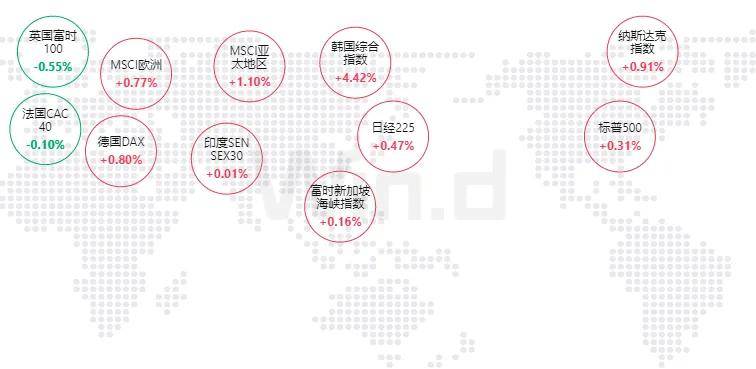
Group 1 - China's first national major scientific and technological infrastructure in the information and communication field, the Future Network Experimental Facility, has officially commenced operations, providing open experimental support for various sectors including industrial manufacturing, energy, education, and healthcare [1] - The State Administration for Market Regulation has released a national standard for food delivery platform service management, aiming to address issues like "ghost deliveries" and enhance the rights of delivery personnel, promoting innovation and healthy competition in the food delivery industry [1] - In November, the number of second-hand residential transactions in first-tier cities reached 49,000 units, marking a seven-month high with a significant month-on-month increase of 20%, and a total of 519,000 units sold in the first eleven months of the year, a year-on-year increase of approximately 5% [1] Group 2 - Multiple high-performing funds have further reduced their purchase limits, with 29 fund managers implementing purchase restrictions on 41 funds on December 4, with limits ranging from 100 yuan to 1.5 billion yuan, aimed at maintaining strategy capacity and reducing transaction costs [2] - In the U.S., the ADP employment report for November showed a decrease of 32,000 private sector jobs, the largest drop in two and a half years, leading to increased expectations for a Federal Reserve interest rate cut [2] - Global funds have continued to buy South Korean bonds, with overseas funds net purchasing $1.39 billion in South Korean bonds on November 28, marking the 20th consecutive day of net buying [2] Group 3 - Major global stock markets mostly rose in the past week, with the A-share indices in China collectively increasing, the Shenzhen Component Index rising by 1.26%, and the Hang Seng Index also showing a weekly increase of 0.87% [3] - In the U.S. market, the Dow Jones Industrial Average rose by 0.50%, the S&P 500 by 0.31%, and the Nasdaq by 0.91% during the week [4] - In Asia, the South Korean Composite Index led with a 4.42% increase, while the Nikkei 225 and the Straits Times Index also saw slight gains [4] Group 4 - Recent trends in government bond yields showed a mixed performance, with the 1-year Chinese government bond yield decreasing by 0.36 basis points to 1.40%, while the 10-year U.S. government bond yield increased by 12.00 basis points to 4.14% [8] - The majority of fund indices showed an upward trend, with the Wind All Fund Index rising by 0.46% and the Wind Stock Fund Total Index increasing by 0.88% [9] Group 5 - In the commodity market, precious metals showed divergence, with COMEX gold decreasing by 0.64% and COMEX silver increasing by 2.86% [11] - The U.S. dollar index fell by 0.46%, while the exchange rate of the dollar against the onshore and offshore Chinese yuan showed slight declines [12]

中小盘风格指数涨跌不一,关注中证1000ETF易方达(159633)、中证2000ETF易方达(159532)投资机会
Sou Hu Cai Jing· 2025-12-04 10:41
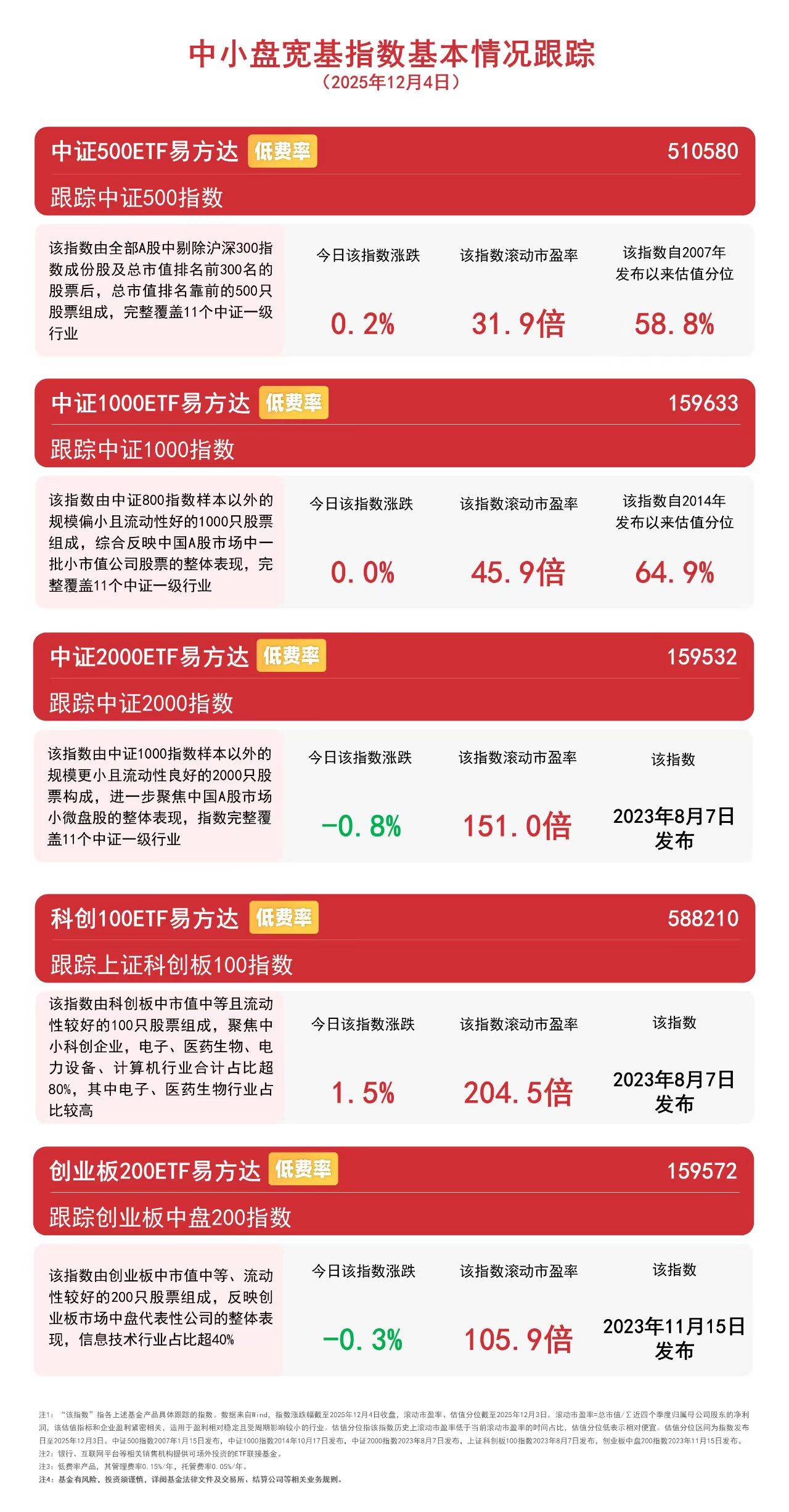
Group 1 - The ChiNext 100 Index rose by 1.5%, while the CSI 500 Index increased by 0.2%, and the CSI 1000 Index saw a slight rise of 0.01%. Conversely, the ChiNext Mid-Cap 200 Index fell by 0.3%, and the CSI 2000 Index decreased by 0.8% [1] - UBS China strategists predict that A-share earnings growth may increase to 8% by 2026, up from 6% in 2025. Despite the stock market's rise this year, valuations remain attractive, supported by a decline in risk-free rates, increased retail investment, long-term capital inflows, and ongoing market capitalization management reforms [1] - Mid-cap stocks show a more balanced industry allocation, with a higher proportion in the technology sector. The implied volatility of indices such as the CSI 500 and CSI 1000 has decreased from its peak in October [1] Group 2 - The CSI 500 ETF by E Fund has a low fee rate and tracks the CSI 500 Index, which consists of the top 500 stocks by market capitalization after excluding the top 300 stocks from the CSI 300 Index. The index covers 11 primary industry sectors [3] - The CSI 500 Index has a rolling price-to-earnings ratio of 31.9 times [3] - The ChiNext Mid-Cap 200 Index is composed of 200 medium-sized, liquid stocks from the ChiNext market, with over 40% representation from the information technology sector. The index has a rolling price-to-earnings ratio of 105.9 times [7]