幽灵网店

Search documents
破解“幽灵网店”难题
Jing Ji Ri Bao· 2026-01-26 00:02
Core Viewpoint - The emergence of "ghost online stores" poses a significant threat to market order, as they lack physical addresses, real contact information, and after-sales support, leading to consumer rights violations and unfair competition [1][2] Group 1: Issues Identified - 14 online stores were investigated for infringing on the "Pang Dong Lai" trademark, with 10 found to be operating without a public address, and 8 of these being particularly elusive [1] - "Ghost online stores" utilize false advertising, low-price temptations, and fake reviews to attract consumers, disappearing after transactions are completed [1] Group 2: Proposed Solutions - A closed-loop system should be established involving platform accountability, regulatory collaboration, and consumer participation to effectively address the issue of "ghost online stores" [1] - Platforms must take responsibility for verifying merchant information, as current practices are often superficial, allowing illegal operators to thrive [1] - The recent draft regulation by the State Administration for Market Regulation mandates that platforms must label stores with false addresses or unreachable contact information, providing a framework for addressing these issues [1] Group 3: Enforcement and Consumer Guidance - Regulatory enforcement should be tailored to specific industry characteristics, with particular focus on supply chain traceability in the food sector, verification of registration information in cosmetics, and increased sampling in electronics [1] - Consumers are encouraged to choose "flagship" or "brand authorized" stores, verify key product information, and report any irregularities through official channels to strengthen consumer rights awareness and reduce the prevalence of "ghost online stores" [2]
新华解码丨聚焦“幽灵网店”商标侵权问题 市场监管总局拟出台新规
Xin Hua Wang· 2025-11-15 00:44
Core Viewpoint - The State Administration for Market Regulation has released a draft regulation aimed at addressing trademark infringement in the e-commerce sector, highlighting the challenges posed by "ghost stores" that complicate enforcement efforts [1][2] Group 1: Challenges in E-commerce Trademark Infringement - Trademark infringement in e-commerce refers to unauthorized use of registered or similar trademarks by operators on platforms [1] - "Ghost stores" often have false registration addresses and untraceable operators, making it difficult to enforce rights [1] - A significant case involved 14 stores on platforms like Pinduoduo and Taobao infringing on the "Pang Donglai" trademark, with 10 stores not operating at their registered addresses and 8 being untraceable [1] Group 2: Proposed Measures in the Draft Regulation - The draft regulation suggests that market regulation departments can issue a notice to platforms if there is preliminary evidence of infringement, requiring platforms to respond within 5 working days [1] - Platforms must notify operators of stores with false address information and prominently mark such stores and products to inform consumers [2] - Two core measures include requiring platforms to urge operators to provide accurate information and marking non-compliant stores to caution consumers [2] Group 3: Implications for E-commerce Platforms - Platforms may be held liable for aiding infringement if they fail to act upon evidence of trademark violations [2] - The regulation emphasizes the responsibility of platforms to ensure compliance and protect consumer interests [2] - The determination of trademark infringement in live streaming scenarios depends on whether consumers can recognize the trademark despite any modifications [2]
虚假登记、老板失联、维权困难……“幽灵网店”如何破?
Xin Lang Cai Jing· 2025-11-15 00:15
Core Viewpoint - The article discusses the issue of "ghost online stores," which are fraudulent e-commerce shops that evade consumer protection and regulatory oversight by providing false contact information, making it difficult for consumers and authorities to address complaints [3][4]. Group 1: Definition and Impact of Ghost Online Stores - "Ghost online stores" are defined as illegal businesses that operate online while intentionally providing false addresses and phone numbers, making it impossible for consumers to reach them for complaints [3]. - These stores not only deceive ordinary consumers but also pose challenges to well-known brands by misusing their trademarks and avoiding regulatory scrutiny [3][4]. - Over half of the online counterfeit cases investigated by market regulatory authorities involve "ghost online stores," highlighting the persistent nature of this issue [3]. Group 2: Regulatory Response - The State Administration for Market Regulation has drafted the "Regulations on E-commerce Platforms Assisting in the Investigation of Trademark Infringement Cases (Draft for Public Comment)" to address the challenges posed by "ghost online stores" [3][4]. - The new regulations aim to integrate e-commerce platforms into the trademark infringement governance system, emphasizing the responsibility of these platforms in protecting intellectual property rights [5][6]. Group 3: Key Measures in the New Regulations - The regulations outline specific measures for e-commerce platforms, including notifying them to take protective actions when evidence of trademark infringement is found [6]. - Platforms are required to prominently mark shops with false address information and inform them to provide accurate details to assist regulatory investigations, effectively warning consumers of potential risks [6]. - The regulations also address jurisdictional conflicts in cases involving multiple regions, enhancing the efficiency of law enforcement resources and case handling [6][7]. - Non-compliance by e-commerce platforms will result in legal action from market regulatory authorities [6]. Group 4: Overall Significance - The draft regulations represent a strategic move to tackle the clear enforcement challenges in the e-commerce sector, establishing a "prominent marking" system and creating responsive channels between departments and platforms to improve enforcement efficiency [7].


中国拟出台新规查处“幽灵网店”商标侵权问题
Zhong Guo Xin Wen Wang· 2025-11-14 05:20
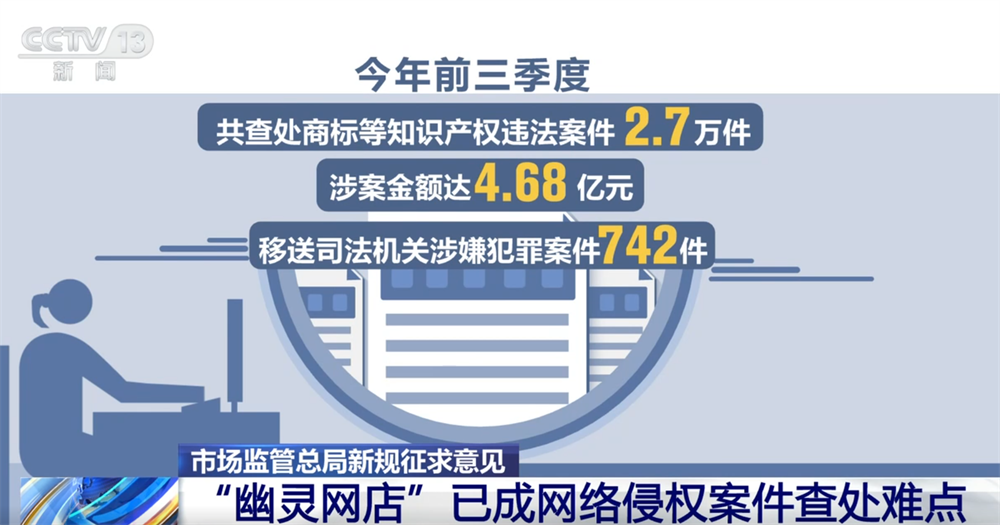
Core Viewpoint - China is drafting new regulations to address trademark infringement issues related to "ghost online stores" in the e-commerce sector, highlighting the increasing concern among businesses and consumers as e-commerce transactions grow [1][2]. Group 1: Regulatory Measures - The State Administration for Market Regulation (SAMR) has proposed the "Regulations on E-commerce Platforms Assisting in the Investigation of Trademark Infringement Cases" to clarify measures for addressing trademark infringement [2]. - The regulations require e-commerce platform operators to assist SAMR in investigating trademark infringement cases, including notifying them of any evidence of infringement [2]. - If a store's address information is inaccurate and cannot be contacted, SAMR will inform the e-commerce platform operator, which must then prominently mark the store and product information [2]. Group 2: Current Situation and Statistics - In the first three quarters of this year, SAMR handled 27,000 cases of intellectual property violations, with a total amount involved of 468 million RMB, and referred 742 cases to judicial authorities [1]. - The issue of "ghost online stores" has been particularly prominent, with 14 stores suspected of infringing on the "Pang Donglai" trademark, of which 10 were found not operating at their registered addresses, and 8 were untraceable [1].
着力破解“幽灵网店”等现实难题 多举措织密电子商务领域知识产权“保护网”
Yang Shi Wang· 2025-11-14 04:04
Core Viewpoint - The rapid development of e-commerce in China has led to increasing concerns over "online trademark infringement," prompting the State Administration for Market Regulation to seek public opinion on new regulations aimed at addressing challenges such as "ghost stores" and unclear platform responsibilities [1][8]. Group 1: E-commerce Growth and Trademark Infringement - E-commerce transactions in China have been expanding significantly, leading to widespread societal concern regarding trademark infringement issues [1]. - In the first three quarters of this year, market regulatory authorities handled 27,000 cases of intellectual property violations, with a total amount involved reaching 468 million yuan, and 742 cases were referred to judicial authorities for suspected criminal activities [1]. Group 2: Ghost Stores Issue - "Ghost stores" refer to online shops on e-commerce platforms that provide false addresses and contact information, making it difficult for enforcement personnel to locate the operators [3][5]. - Over half of the online stores suspected of selling counterfeit goods are identified as "ghost stores" [5]. - A specific case involving 14 online stores infringing on the "Pang Donglai" trademark revealed that 10 of these stores were not operating at the registered addresses, and 8 were untraceable [7]. Group 3: New Regulatory Measures - The draft regulations clarify the responsibilities of e-commerce platforms in assisting with trademark infringement investigations, requiring platforms to take necessary actions against identified infringing behaviors [8]. - Platforms are mandated to notify online stores to provide accurate information and to mark stores with false information prominently, warning consumers of potential risks [10]. - The draft also establishes jurisdictional authority and collaborative mechanisms for market regulatory departments across different regions to enhance enforcement against infringement [12].