底层架构创新

Search documents
刚拿 5 亿又揽 10 亿!AI 算力现最火 “吸金王”
是说芯语· 2026-03-11 08:00
Core Viewpoint - Shanghai Fangqing Technology has become a new focus in the domestic AI computing track after securing significant funding, emphasizing its innovative "decoupled AI computing architecture" [1][2]. Funding and Investment - The company completed a Pre-A round financing exceeding 500 million yuan in December 2025, followed by a 1 billion yuan Pre-A3 round in March 2026, with investments from eight institutions including NIO Capital and Guokai Science and Technology Innovation [1][2]. - The rapid capital influx reflects strong confidence in the company's core technology direction [2]. Technology Innovation - Fangqing Technology addresses the efficiency challenges of large model inference by decoupling the "Attention mechanism" and "Feedforward Neural Network (FNN)" into separate modules, allowing for optimal hardware allocation [2][4]. - This innovative approach is expected to improve computing resource utilization by over 50% and reduce power consumption by 25%-30%, effectively tackling the "efficiency anxiety" in large model inference [4]. Leadership and Expertise - The company is led by Liang Jun, a veteran with over 20 years of chip development experience, known for his role in developing the Kirin SOC chip at Huawei and the first 7nm AI training chip at Cambricon [6]. - Liang's leadership is seen as a significant asset, providing a clear path for technology implementation from architectural innovation to commercial deployment [6]. Future Outlook - Fangqing Technology aims to continue focusing on technology as its core, seeking to transform existing AI hardware design logic and contribute to the diversified development of the domestic AI computing ecosystem [6].


清华紧逼谷歌,AI顶会NeurIPS论文数第二,中国占半壁江山
3 6 Ke· 2025-12-10 01:31
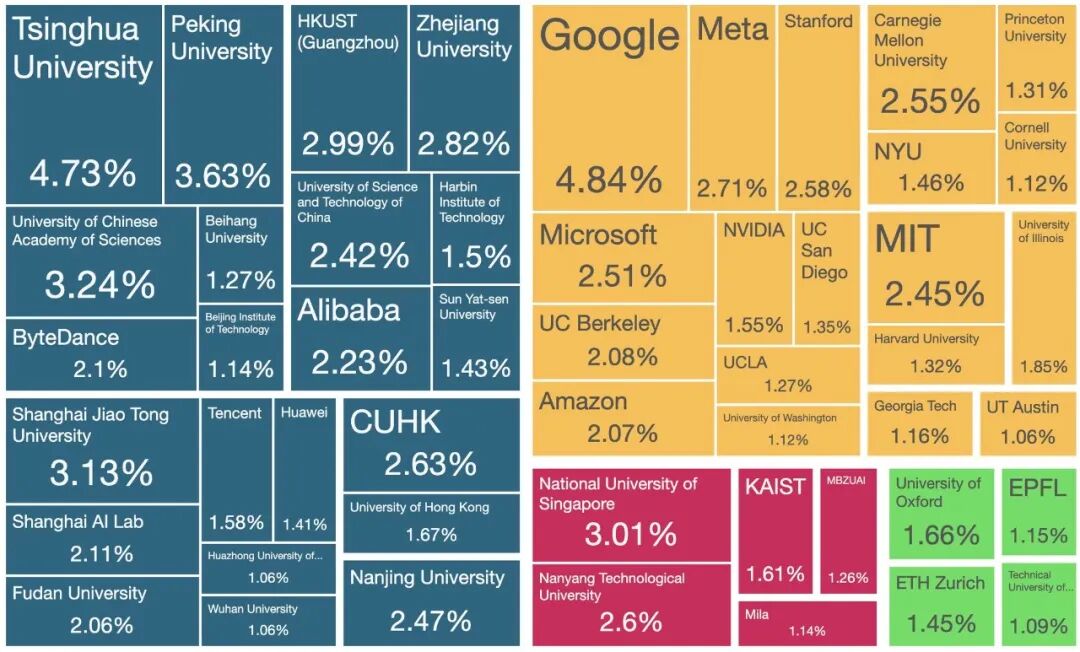
Core Insights - Tsinghua University is rapidly approaching Google in the AI research landscape, indicating a significant shift in the global AI ecosystem [1][3][9] - The NeurIPS 2025 conference highlighted a division between two distinct research ecosystems: one dominated by Silicon Valley tech giants and the other by top Chinese universities [1][9] - The conference's structure, with parallel sessions in San Diego and Mexico City, reflects geopolitical tensions affecting academic collaboration [20][21] Group 1: Research Landscape - Google maintains the top position with 4.84% of accepted papers at NeurIPS 2025, while Tsinghua University closely follows with 4.73%, narrowing the gap to just 0.11% [3][4] - Chinese institutions collectively accounted for 48.68% of the total accepted papers, showcasing a strong presence in the global AI research community [6][9] - The rise of Tsinghua and Peking University, with 3.63% of accepted papers, signifies a shift in research output from traditional Western institutions to Chinese universities [3][4] Group 2: Quality of Research - The Best Paper Award at NeurIPS 2025 was awarded to a team from Alibaba for their innovative work on a gated attention mechanism, marking a significant advancement in AI research [11][13] - This recognition challenges previous perceptions of Chinese AI research as primarily focused on application rather than foundational innovation [11][19] - The Time Test Award was given to a classic paper, highlighting the long-term impact of Chinese researchers in the field [19] Group 3: Geopolitical Context - The conference's dual-location setup symbolizes the challenges faced by Chinese researchers in obtaining U.S. visas, leading to a split in the AI research community [20][21] - The return of top Chinese talent from the U.S. to domestic institutions is contributing to the rapid growth and competitiveness of Chinese AI research [20][21] - The contrasting ecosystems of the U.S. and China in AI research reflect broader geopolitical dynamics, with implications for future innovation and collaboration [9][20]