开放模型

Search documents
大摩:中国在AI竞赛中拥有独特优势,阿里是“最佳赋能者”,腾讯具“最高2C变现潜力”
硬AI· 2026-01-09 12:29
Core Insights - Morgan Stanley highlights that China's AI industry is adopting a unique path by utilizing an "open model" strategy to counter the global "closed" systems, accelerating monetization at the application level [2][3] - The report indicates that major Chinese platforms like Alibaba and Tencent are leveraging their cloud computing capabilities and private data advantages to transform AI technology into high-return commercial value, shifting the capital market's focus from computing power speculation to application-based pricing logic [2][4] Market Trends - Morgan Stanley notes a structural shift in the market, with China capturing a significant share of the global state-of-the-art (SOTA) models, accounting for half of the top 10 as of January 8 [3] - The total addressable market (TAM) for cloud AI in China is projected to reach $50 billion by 2027, indicating a strengthening resilience in the domestic computing supply chain [3] Investment Focus - Investors should focus on the monetization capabilities and ecological barriers at the application level rather than just the infrastructure arms race [4] - Alibaba is identified as the "best enabler" of AI development in China due to its integration of cloud computing and model capabilities, while Tencent is noted for having the highest consumer-facing (2C) monetization potential and high return on investment (ROI) [4][12] Application Landscape - The Chinese market is witnessing a unique landscape where "super applications" evolve alongside the explosion of "AI native applications" [6] - WeChat is emphasized as a pioneer AI agent with significant potential, boasting 1.1 billion monthly active users (MAU) and high user engagement metrics, which provide fertile ground for AI integration [6][8] Competitive Dynamics - ByteDance's Doubao, Baidu's Wenxin Yiyan, and Alibaba's Quark and Yuanbao are rapidly competing for user engagement, evolving from simple chatbots to more complex AI assistants [8] - The enterprise (2B) sector is also experiencing a quiet transformation, with strong intentions for deploying generative AI (GenAI) across various industries, including advertising, healthcare, and finance [10][11] Company Differentiation - Alibaba is positioned as the "best AI enabler" due to its robust infrastructure and integration across various business scenarios, while Tencent is recognized for its high consumer monetization potential through its WeChat ecosystem [12] - ByteDance is characterized as a "full-stack AI leader," with comprehensive coverage from foundational engines to various AI applications, while Baidu faces challenges in its core advertising business due to AI search transformations [12]




黄仁勋,重磅发声!
Zheng Quan Shi Bao· 2026-01-06 08:56
Core Insights - Huang Renxun stated that the "ChatGPT moment of physical AI" is approaching, highlighting a significant transformation in the computing industry driven by AI advancements [1][2]. Group 1: Industry Transformation - The computing industry is undergoing a historic transformation every 10-15 years, characterized by a "dual platform shift" where applications are built on AI, and the core computation is shifting from CPU to GPU [2]. - Approximately $10 trillion of global computing infrastructure is transitioning towards AI, with billions of dollars in venture capital flowing into the AI sector [2]. Group 2: Technological Breakthroughs - The Vera Rubin AI supercomputer was launched to address the exponential growth in AI model size and inference token requirements, featuring a design that integrates six custom chips and significantly enhances performance [3]. - The open model ecosystem is rapidly expanding, with models like DeepSeek R1 gaining traction and NVIDIA providing open-source tools to empower global enterprises and research institutions [3]. - Agentic systems, capable of reasoning and planning, are expected to be fully adopted by 2025, transforming software programming methodologies [3]. - The Cosmos foundational model, which can understand physical laws and generate realistic simulation data, is positioned as a key support for robotics and autonomous driving [3]. - The Alpamayo autonomous driving AI has achieved "thinking driving," utilizing end-to-end training to make autonomous decisions and explain actions clearly [3]. Group 3: Industry Collaboration - NVIDIA announced strategic partnerships with Siemens, Palantir, and others to integrate AI into various industrial processes, addressing labor shortages and enhancing automation [4]. - The AI ecosystem now encompasses a wide range of robotics applications, from consumer to industrial robots, all built on NVIDIA's Jetson platform [4]. Group 4: Open Access and Participation - NVIDIA aims to create a full-stack AI platform that allows every enterprise and individual to participate in the AI revolution, providing comprehensive tools for data processing, model training, and deployment [5]. - The introduction of a "blueprint" framework enables developers to easily create customized AI assistants, balancing privacy and functionality [5]. - The future is projected to see widespread adoption of autonomous vehicles, physical AI robots, and AI-driven smart industries, with NVIDIA committed to driving this technological revolution [5].

黄仁勋,重磅发声!
证券时报· 2026-01-06 08:16
Core Viewpoint - The computing industry is undergoing a historic transformation characterized by a "dual platform shift," with AI becoming the core driver of innovation and investment across various sectors [3][4]. Group 1: Dual Platform Shift - The computing industry is experiencing a significant change every 10-15 years, marked by a dual platform shift where applications are built on AI, and the core computation moves from CPU to GPU [3]. - AI is fundamentally restructuring software development and operational logic, enabling real-time content generation and understanding of context [3]. - Approximately $10 trillion in global computing infrastructure is transitioning towards AI, with billions in venture capital flowing into the AI sector [3]. Group 2: Key Technological Breakthroughs - The Vera Rubin AI supercomputer has been launched to address the exponential growth in AI model size and inference token requirements, featuring a design that integrates six custom chips [5][6]. - Open model ecosystems are rapidly emerging, with models like DeepSeek R1 gaining traction and closing the gap with leading models through rapid iteration [6]. - Agentic systems, capable of reasoning and planning, are expected to be fully mainstream by 2025, transforming software programming practices [6]. - The "ChatGPT moment" for physical AI is approaching, with the Cosmos model enabling realistic simulations for robotics and autonomous driving [6]. - The Alpamayo autonomous driving AI has achieved "thinking driving," capable of making decisions and explaining actions, set to debut in vehicles in the US, Europe, and Asia [6]. Group 3: Industry Collaboration and Ecosystem - Strategic partnerships with companies like Siemens and Palantir aim to integrate AI into various industrial processes, addressing labor shortages and automation needs [8]. - The AI ecosystem is expanding across robotics, with applications in consumer, industrial, and medical fields, showcasing the versatility of AI technologies [8]. - Nvidia's mission is to create a comprehensive AI platform that allows participation from all sectors, promoting widespread AI innovation [9].
直击CES|黄仁勋:80%的初创公司都在采用开放模型
Xin Lang Cai Jing· 2026-01-06 01:17
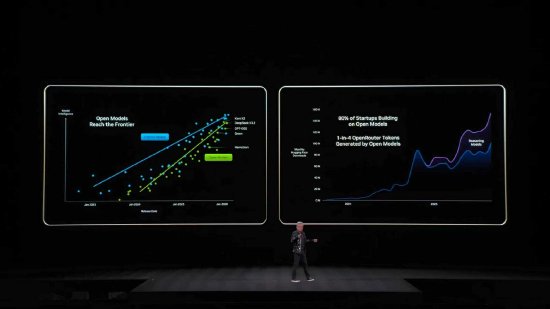
Core Insights - The computer industry undergoes a transformation every 10 to 15 years, with new systems built for new platforms. Currently, two transformations are occurring simultaneously, with applications now being AI-based and software development methods changing [1][3]. Group 1: AI Progress - Significant advancements in artificial intelligence have been observed over the past decade, starting with the first interesting model seen in 2015, followed by the introduction of the Transformer model in 2017, and further impressive models from OpenAI [1][3]. - The exploration of agent models is underway, which can autonomously handle certain AI tasks and learn over time. It is noted that "anywhere in the universe where there is information and structure" can be used to train AI [1][3]. Group 2: Open Source AI Models - As of this month, open-source AI models are approximately six months behind the expensive cutting-edge models from large AI companies [1][3]. - About 80% of startups are adopting open models, indicating a significant trend towards open-source solutions in the AI space [1][3].