微架构与工艺协同设计

Search documents
一位资深CPU架构师的观察
3 6 Ke· 2026-01-05 05:23
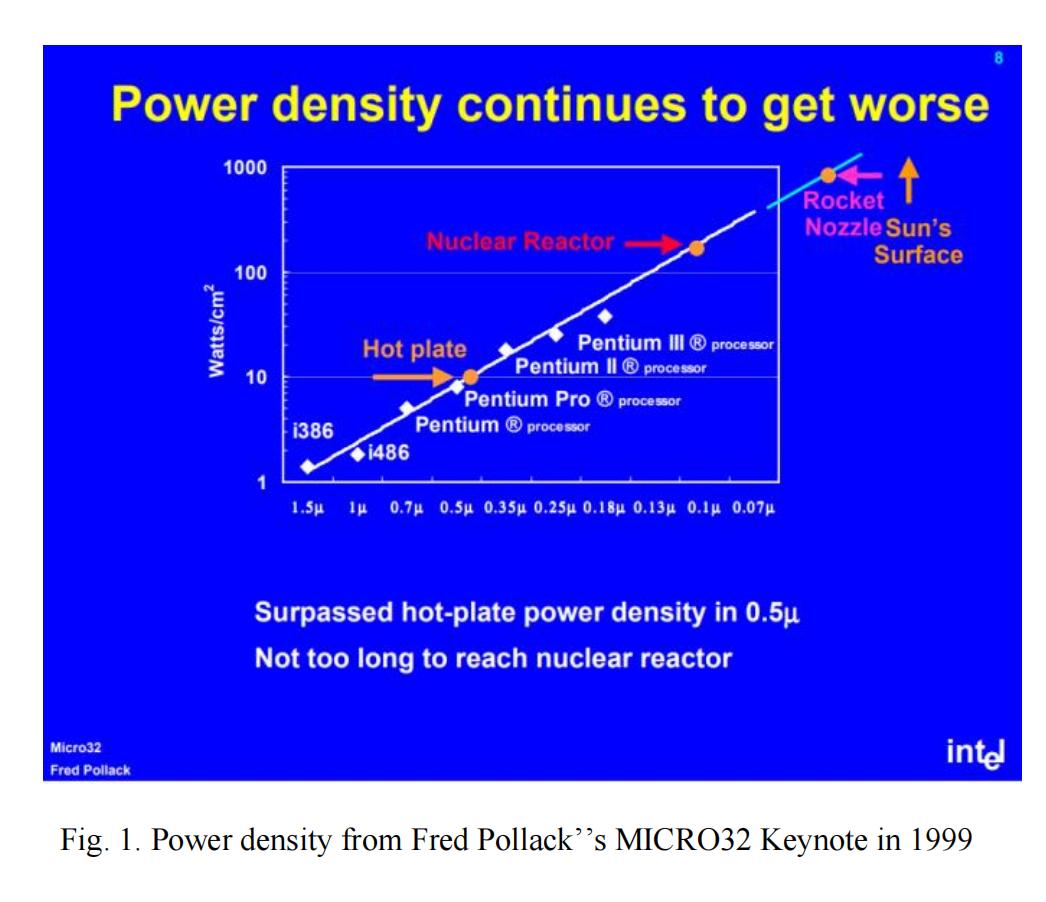
Core Insights - The article emphasizes the need for a collaborative design approach between microarchitecture and process technology to address the increasing challenges of thermal density, power consumption, and performance demands in semiconductor technology [1][2][27]. Group 1: Thermal Density Challenges - Higher integration levels amplify thermal density, defined as power per unit area, leading to localized heating issues as feature sizes shrink [3]. - Current silicon chips can reach critical temperatures rapidly, necessitating the consideration of thermal sensors and cooling measures from the outset [5][7]. - Traditional cooling methods, such as heat sinks and fans, are becoming inadequate, prompting the need for innovative microarchitecture and chip layout strategies for effective thermal management [8]. Group 2: Microarchitecture and Power Management - Microarchitectural innovations must evolve in tandem with process technology, focusing on power supply, thermal management, and computational efficiency at the device and system stack levels [2][26]. - Techniques to manage thermal hotspots include efficient energy performance, thermal-aware layout planning, and sensor-driven control to dynamically adjust workloads and voltage/frequency settings [9][10]. Group 3: Process Technology Advancements - Advances in process technology enable higher performance at constant power and lower power at constant performance, but aggressive size reductions may exacerbate thermal density issues [13]. - Key areas of process research include low leakage and low capacitance materials, thermal-aware 3D integration, and on-chip thermal sensors for real-time thermal management [28]. Group 4: System-Level Scalability - Amdahl's Law highlights the limitations of multi-processor scalability, indicating that performance is increasingly constrained by the serial portions of parallel programs [18][20]. - The dynamic nature of active core counts affects power and bandwidth sharing, influencing the design and optimization of microarchitectures for various workloads [25]. Group 5: Conclusion and Future Directions - Advanced semiconductor process technologies can deliver exceptional performance, but without architectural awareness, their advantages will be limited by power and thermal constraints [27]. - A new paradigm of collaborative architecture and process design is essential for the next generation of computing, focusing on energy efficiency and thermal constraints as shared responsibilities [27].

一位资深CPU架构师的观察
半导体行业观察· 2026-01-05 01:49
Core Insights - The article emphasizes the need for a collaborative design approach between microarchitecture and process technology to address the increasing challenges of thermal density, power consumption, and performance demands in semiconductor technology [1][3][34] Group 1: Thermal Density - Higher integration leads to increased thermal density, defined as power per unit area, which is exacerbated by shrinking feature sizes and higher integration levels [5] - Current silicon chips can reach critical temperatures rapidly, necessitating the consideration of thermal sensors and cooling measures from the outset [9] - Traditional cooling methods like heat sinks and fans are becoming inadequate, prompting a shift towards microarchitecture and chip layout as primary tools for thermal management [10] Group 2: Efficient Energy Performance - The relationship between performance and power consumption is critical, with voltage scaling showing that while performance increases with voltage, power consumption rises exponentially, highlighting the need for technologies that reduce leakage and capacitance [13][16] - Advances in process technology enable higher performance at constant power and lower power at constant performance, but aggressive size reductions may increase thermal density, requiring architectural responses [16] - Simplifying microarchitecture can reduce area, thereby lowering target frequency, capacitance, and leakage, which is essential for optimizing overall system power consumption [20] Group 3: System-Level Scalability - Amdahl's Law illustrates the limitations of performance scalability in parallel processing, indicating that performance is ultimately constrained by the serial portions of programs [23] - The utilization of active cores varies significantly under typical workloads, affecting power and bandwidth sharing among cores [27] - Key research directions in process technology must align with architectural needs, focusing on low leakage and low capacitance materials, thermal-aware 3D integration, and fine-grained power gating [31][32] Conclusion - Advanced semiconductor process technologies can deliver exceptional performance, but without architectural awareness, their advantages will be limited by power and thermal constraints. A new collaborative design paradigm between architecture and process technology is essential for sustainable, high-performance computing [34]