
微观流动性改善

Search documents
陈果:上证指数呈现一定程度春季躁动行情特征
Xin Lang Cai Jing· 2025-12-28 12:20
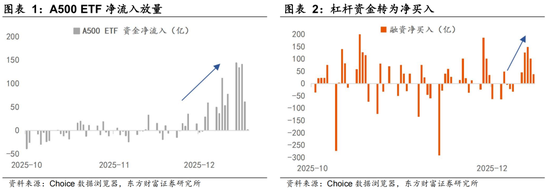
Core Viewpoint - The recent performance of the Shanghai Composite Index, characterized by an "eight consecutive days of gains," indicates a spring market rally, but there is a lack of consensus on the leading sectors for this rally [1][20] Group 1: Market Dynamics - The current market is experiencing high sector rotation intensity, suggesting that funds have not yet formed a clear consensus on the leading sectors [1][20] - The improvement in micro liquidity since late November has prompted a market layout period, although future market performance may not be consistently strong and could experience fluctuations [3][22] - The significant net inflow into the A500 ETF, amounting to 48.17 billion, has improved the micro liquidity environment and ignited bullish sentiment in the market [5][24] Group 2: Price Increase Opportunities - Three categories of price increase opportunities have been identified: 1. High demand and supply mismatch, particularly in the AI industry chain (e.g., storage, copper-clad laminate, semiconductor manufacturing) and energy storage chain (e.g., lithium iron phosphate, separators, lithium carbonate) [1][32] 2. Stable demand with supply disruptions, mainly in industrial metals (copper/aluminum), fertilizers, and some minor metals (e.g., cobalt, tin) [2][34] 3. Cost increases leading to price adjustments, primarily in chemicals (e.g., titanium dioxide, MDI), photovoltaics (modules, silicon wafers), and certain midstream manufacturing sectors [2][35] Group 3: Sector Focus - Key sectors to watch include insurance, non-ferrous metals, chemicals, computing power, semiconductor equipment, aviation, new energy, and machinery [3][22] - Specific themes of interest are robotics, autonomous driving, and commercial aerospace, which are expected to drive future market performance [3][22]

中证红利ETF(515080)发布年内第四次分红公告,每十份分红0.2元,年内累计分红4.21%
Sou Hu Cai Jing· 2025-12-15 02:09
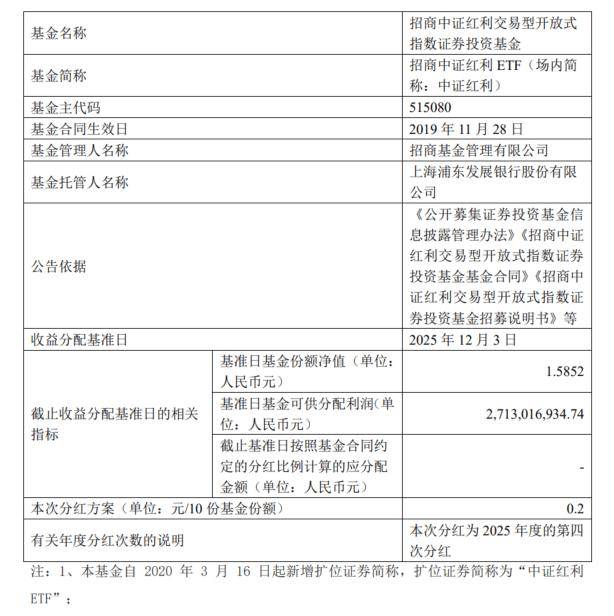
Group 1 - The core point of the news is that the China Securities Dividend ETF (515080) announced its fourth dividend distribution for the year, amounting to 0.2 yuan per ten shares, with a dividend ratio of 1.26% [1] - This marks the 15th dividend distribution since the ETF's inception, with a total cumulative dividend of 3.85 yuan per ten shares [1] - The cumulative dividend ratio for the ETF in 2025, including this distribution, is 4.21% [1] Group 2 - As of December 12, the ETF has seen a net subscription of 342 million yuan over the past five days, and a total net inflow of 871 million yuan over the past 20 days [3] - The market outlook suggests that there may be a moderate improvement in micro liquidity, with a recommendation to focus on financial and dividend sectors as a base for long-term investments [3] - The suggestion is to remain cautious of external disturbances while positioning for potential opportunities as new capital flows in [3]
中证红利ETF(515080)发布年内第四次分红公告,分红比例1.26%,12月17日权益登记
Sou Hu Cai Jing· 2025-12-15 01:34
Group 1 - The core point of the news is that the China Securities Dividend ETF (515080) announced its fourth dividend distribution for the year, with a dividend of 0.2 yuan per ten shares, representing a distribution ratio of 1.26% [1][2] - This marks the 15th dividend distribution since the ETF's inception, with a total cumulative dividend of 3.85 yuan per ten shares [1][2] - Including this latest dividend, the cumulative dividend ratio for the ETF in 2025 is 4.21% [1][2] Group 2 - The dividend distribution dates are as follows: the record date is December 17, 2025, the ex-dividend date is December 18, 2025, and the payment date is December 23, 2025 [2] - The ETF has attracted long-term capital, with a net subscription amount of 342 million yuan over the past five days and a total net inflow of 871 million yuan over the past twenty days [2] - Eastern Fortune Securities suggests that while there may be external disturbances, the market is likely to see a mild improvement in micro liquidity, with a recommendation to focus on financial and dividend sectors as a base for investment [2]
